-->
≡
Home
Woman
Sport
Business
Health
Privacy Policy
Contact Us
Contact Us
Pluto Could Be Made A Planet Again, Along With 102 Other Celestial Bodies
:
:
2017-03-02T22:59:13Z
Thursday, 2 Mar 2017 - 10:59 PM
Hey everyone, I know things look a bit different, but we’ll explain all that at the end, I
promise.
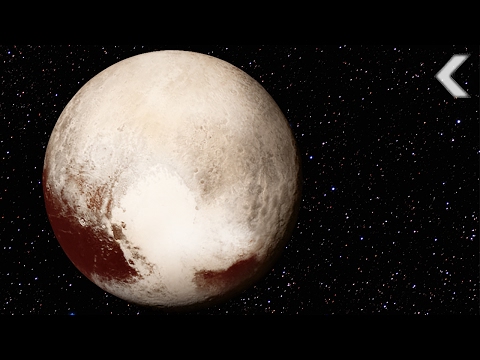
Way back in 2015, when the world made sense, NASA’s New Horizon mission flew by the dwarf
planet, Pluto waay out near the Kuiper Belt -- an asteroid field that encircles our solar
system.
At the time scientists felt they had this planet figured out.
Then these images and the accompanying data from Pluto completely blew their collective
braincases.
Since 2006 when the International Astronomical Union updated their classification of the
word “planet” there’s been a huge debate in the public, and in the scientific community,
about the fate of dwarf planets.
The IAU says a planet has to be a sun-orbiting body that is massive enough to be round, and
will have cleared its orbit -- meaning nothing gets in the way as it goes around the sun.
This definition keeps asteroids, comets, and moons from being planets, but, it excludes
some smaller bodies (which is why Pluto is now called a dwarf-planet).
So now, our solar system has eight planets, and five dwarf planets: Ceres, Pluto, Eris,
Makemake, and Haumea!
That’s right, the current definition upgraded four other objects and yet nobody talks about
it!
We have 13 planets in our solar system.
“Dwarf” planets aren’t technically planets, though for some reason “giants,” and “ice
giants” are.
A new paper purports to change everything when it comes to planetary classification.
The short paper, published in Lunar and Planetary Science, wants to reclassify planets as a
round body that’s never undergone fusion, and has less mass than a star.
That’s it.
This means, Pluto would be planet again… which is great!
But it would also bring along friends; Ceres, Eris, Makemake and Haumea would become planets
as well as 97 other objects.
Under this definition, our solar system would have 110 planets…
There are several reasons scientists care about this.
First, the current definition says all planets have to orbit the sun.
Our sun.
This means, even though we’ve discovered over 1,000 exoplanets, there are only 8 real
planets in the universe.
Planets orbiting other stars, aren’t orbiting the sun and so aren’t technically planets.
Yes, it’s pedantic, this is science we’re talking about.
Pedantry is part of the game.
On the other hand, both definitions count being round as important, because it keeps
asteroids out of the planetary-club.
But, the front-row students are already pointing out, the Moon is round.
And, yes.
Under this definition our Moon would be a planet, as would all the round moons of Jupiter
and Saturn, and elsewhere!
Defining planets in the way the IAU does now is quote “flawed,” according to scientist,
not just because it demoted Pluto, but it also it does seems unfair to discount celestial
bodies that are as unique and interesting as Saturn or Venus.
The researchers hope if we start recognizing Makemake and Ceres and Io and Enceladus all
as planets, maybe we’ll get the budget to go there!
This debate really pits branches of science against each other.
Planetary geoscientists, want to physically explore the planets, astronomers want to classify
and observe them.
One of the lead authors of this paper is Alan Stern, an outspoken critic of the 2006 IAU
re-classification.
This debate was reignited because of the incredible data scientists received from Pluto.
Plus, the things we’re learning about moons like Europa, Enceladus, Titan, Io, and Ganymede.
Pluto, for example, is no longer considered a boring icy rock zipping around out past
(but sometimes nearer, than) Neptune.
Instead, we know it has complex geological processes which may hide a subsurface oceans,
glaciers of nitrogen, a thin atmosphere, and its solar-planetary interaction is unique
and unlike the octet of pompous planets in our solar system!
But does being more interesting than we thought warrantPluto's un-demotion?
What do you think?
By now you may have noticed we’ve made some changes to both the show and the channel.
And more changes will be happening over the next couple of weeks.
We’re now officially Seeker.
Seeker is all about science, innovation, technology and the universe around us.
We’ll be bringing you more in depth documentaries, experiments, VR content, interviews and of
course, science updates from your favorite hosts.
We have a lot of really awesome stuff in the works, so please subscribe, check out Seeker.com
and our Facebook page and thanks for your support.
Tell us your thoughts in the comments, and if you want more incredible science, about
Pluto check out Ian O’Neill’s video on it here, he’s an astrophysicist -- he knows
what he’s talking about.
Facebook
Twitter
Google Plus
Seeker
Latest Posts