-->
≡
Home
Woman
Sport
Business
Health
Privacy Policy
Contact Us
Contact Us
These Strawberries Aren't Red!
:
:
2017-03-10T22:23:21Z
Friday, 10 Mar 2017 - 10:23 PM
First it was the Dress, then a year later it was that Adidas jacket.
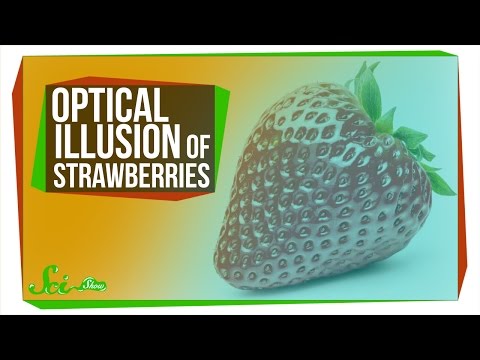
But the latest optical illusion to sweep the internet is a photo of strawberries that appear
red, even though the picture doesn’t contain any red pixels.
It was created by a Japanese psychology professor named Akiyoshi Kitaoka, who studies visual
illusions.
And he’s made a hobby out of producing these mind-boggling images.
For this one, Kitaoka started with a photo of a tart topped with strawberries.
Then, he digitally removed the color red from the image, so only blue-gray tones were left.
When you look at it, though, you probably see reddish strawberries.
And that’s because of the same psychological phenomenon that made that Dress picture so
dang maddening.
It has to do with the way your brain processes everything you see, called color constancy.
Your brain is really good at interpreting the colors of images and objects based on
what you know about the world.
Like, a piece of printer paper looks white, whether you’re inside with incandescent
lights or outside with natural sunlight.
No matter what yellowish or blueish light is being reflected off the paper into your
eyeballs, your brain can perceive that the paper is still inherently white.
And that helps you make sense of reality, because objects aren’t changing color all
the time – just the light around them is.
Scientists think this color correction process could involve specialized neurons in your
primary visual cortex called double-opponent cells, which detect patterns and boundaries
between colors.
When you look at Kitaoka’s illusion, your brain is using those colors to decide that
you must be looking at red strawberries lit by a funky blue light source, not strawberries
that are blue-gray.
So even though your brain is generally good at understanding the world, sometimes it can
lead you astray, especially when it comes to optical illusions.
Speaking of being led astray, scientists have been debating for a long time whether humans
excrete chemical signals called pheromones.
Many plants and animals use pheromones to carry all sorts of messages, spreading alarms
about danger or tips about the tastiest food sources.
One of their most important uses, though, is broadcasting an animal’s sexual availability
to potential mates.
Basically like a love potion in your nose.
So, naturally, scientists have wondered whether humans have sex pheromones too… but there’s
not any really good evidence that they exist.
In fact, a new study published this week in Royal Society Open Science casts even more
doubt that they are a thing.
Many people have said that a partner’s body odor can affect how interested they are.
So B.O. is a ripe area to look for potential sex pheromones.
In past studies, two of the most promising candidates are steroids found in bodily fluids.
Even though steroids might make you think of doping and sports, the word actually refers
to a whole group of fat-soluble organic compounds – even cholesterol is a steroid.
And the two chemicals in question here are androstadienone and estratetraenol.
Androstadienone or AND, is more associated with men than women, and it’s mostly been
found in semen and sweat.
Pregnant women in the third trimester turn AND into a different chemical called estratetraenol
or EST, which can be found in their urine.
Since only pregnant women make EST, the idea that it – or AND, for that matter – could
be a sex pheromone is controversial.
But past studies have provided a little support.
One study showed that exposure to AND or EST slightly affected whether its 96 participants
– a mix of straight and gay men and women – rated a walking style as more masculine
or feminine, respectively.
Another experiment exposed three groups of 12 to 25 women to AND or a control scent before
speed-dating, and found that the steroid sometimes increased their reported attraction to the
men they met.
But this research tested how 94 Australian college students, about half men and half
women, reacted to gender-neutral faces on computer screens after smelling AND, EST,
or a steroid-free control.
In the first task, participants were asked to decide whether they thought each face was
male or female.
In the second, they rated each face’s attractiveness and predicted whether the person would be
a faithful partner.
When all the data was collected and analyzed, the results showed…nothing.
Neither steroid had any statistically measurable effect on what the study’s participants
thought of the faces.
And even while the researchers were recording their data, they didn’t know which chemical
each participant had sniffed.
So AND and EST might be signaling something in your body, because lots of steroids do.
But we don’t know exactly what that is, and it most likely is not sexiness.
Human pheromone research seems to be stuck at square one for now.
So, y’know, don’t buy into any of that pheromone perfume or cologne junk.
It’s… just more chemicals.
And totally not worth it.
Oh, and also, by the way, we obviously love to share our enthusiasm for science with you
both on the internet and in real life.
April 22 is Earth Day and it’s also the day of the March for Science.
The SciShow Team will be marching here in Montana and Michael Aranda will be representing
us in Washington DC.
To show our support for scientists and science communication, we made these Knowledge = Power
shirts and posters.
Our Patreon Patrons helped us come up with the slogan and DFTBA helped us design them.
If you want to show your support for science and SciShow you can get one at dftba.com/scishow.
And, as always, thank you to our Patreon patrons and don’t forget to go to youtube.com/scishow
and subscribe, because we are always making more of these things!
Facebook
Twitter
Google Plus
SciShow
Latest Posts