-->
≡
Home
Woman
Sport
Business
Health
Privacy Policy
Contact Us
Contact Us
World's oldest fossils unearthed (UCL)
:
:
2017-03-02T10:24:15Z
Thursday, 2 Mar 2017 - 10:24 AM
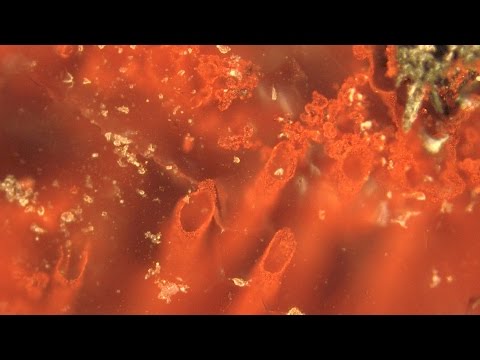
We have discovered microfossils that are composed of haematite,
basically this iron oxide it's like rust.
Through laser imaging of the samples we were able to
identify the microfossils as the oldest known microfossils on Earth.
This is a slab that's been polished.
There are these structures here at this cut on the right-hand side
but you can see kind of a structure that bends the layering in this rock.
It is within these features in part that we find the microfossils.
In diameter the microfossils are half the width of a human hair,
they can be anything up to half a millimetre in length.
The microfossils we discovered are about 300 million years older
than the previously thought oldest microfossils.
These rocks have a minimum age of 3.77 billion years
but some scientists in the field consider them to be as old as 4.28 billion years.
So they are within a few hundred million years from within the accretion of the solar system
and of planet Earth and the Sun and the moon and so on.
These rocks are being mostly composed of silica and haematite, this iron rust.
We find these kinds of environments today in the vicinity of hydrothermal vents,
either in the deep ocean and in some places not in so deep localities
that exhale a lot of iron particulates in water.
This is thought to be the material that these bacteria actually eat and breathe.
The rocks are located in the province of Quebec
on the shoreline near to the Nastapoka Islands.
When I saw these structures in the field I said,
I have to sample this.
One of the big questions when it comes to early life studies
is whether or not the the organic carbon we find in these rocks is actually biological in origin,
especially in hydrothermal vent environments
where you can have special reactions called the Fischer–Tropsch reaction.
We used a very robust rigorous approach
to test whether these microfossils we discovered were non-biological structures
and we were able to do this with our laser imaging system
by looking at the minerals the organic materials associated with,
and we find it with these key minerals apatite and carbonate.
If we are right with our new model
for the origin of these spheroidal structures in these rocks that contain these fossils
then we might want to look for these kinds of things on other ancient planetary surfaces
such as the surface of Mars for instance.
I'm keen to look at more examples of hydrothermal vent deposits
and if we can take our knowledge of how organic matter and microfossils are preserved on Earth
and apply them to hydrothermal systems
on other planets like Mars or Europa.
In 2007, one of the Martian exploration rovers found beds of hematite concretions,
they were called blueberries at the time and it made a big news splash as well.
The origin of this structure is not fully understood even on Earth where we find them.
We don't know really how organic matter can potentially be involved in making these structures.
The most exciting thing about this discovery is that
we know life managed to get a grip and start on Earth at such an early time in Earth's evolution
which gives us exciting questions as to whether we are alone in the solar system or in the universe.
If life happened so quickly on Earth then could we expect it to be a simple process
and start on other planets,
or was Earth really just a special case?
Facebook
Twitter
Google Plus
UCLTV
Latest Posts