-->
≡
Home
Woman
Sport
Business
Health
Privacy Policy
Contact Us
Contact Us
5 Unsolved Mysteries of Space that will Blow Your Mind
:
:
2017-05-01T03:20:06Z
Monday, 1 May 2017 - 03:20 AM
5 Space Mysteries That Are Still Unsolved
It is no secret that space is full of mysteries.
Our civilization has barely gone past our own planet’s moon, and only one of our probes
has ever left the solar system.
Almost everything we know about deep space has been pieced together from falling objects
and views from telescopes.
Hi.
I am Mister Mysterious and today I’ll be your guide through some of the most interesting
mysteries of the universe.
We will take a look at five of the most intriguing unexplained phenomena.
FIVE: Jupiter’s Great Red Spot
The most powerful hurricanes ever recorded in our planet’s history spanned over 1,000
miles with winds gusting up to 200 miles per hour.
That is wide enough to stretch across nearly all U.S. states east of Texas.
However, even that kind of storm is dwarfed by the Great Red Spot, a gigantic storm on
Jupiter’s surface.
With winds peaking at about 400 miles per hour, the Great Red Spot has been swirling
wildly over Jupiter’s skies for several centuries.
The earliest record of this phenomenon dates back to the 1600s, but it is still unclear
what’s behind the Great Red Spot.
However, there is a reason for this.
Jupiter is a thousand times as big as Earth and it consists mostly of gas.
A liquid ocean of hydrogen surrounds its core, and the atmosphere consists of hydrogen and
helium.
That translates into no solid ground like we have on our planet.
On top of that, Jupiter’s clouds obstruct clear observations of its lower atmosphere.
Thanks to orbiting probes and telescopes studying this massive planet, we know plenty about
Jupiter’s upper atmosphere and its chemical elements.
However, scientists don’t know exactly how or even whether these chemicals react to give
colors like those in the Great Red Spot.
After all, this planet is very different from ours and it would be interesting to know the
reason why and how this big red storm manages to exist for over 400 years now.
FOUR: Dark Energy
A mysterious quantity known as dark energy makes up nearly three-fourths of the universe,
yet scientists are unsure not only what it is but how it operates.
The only thing we today know is that dark energy exists.
In 1929, American astronomer Edwin Hubble studied exploding stars known as supernovae
to determine that the universe is expanding.
Since then, scientists and astronomers have sought to determine just how fast.
In the 1990s, two independent teams of astrophysicists discovered that the expansion of the universe
isn’t slowing down.
Instead, it is speeding up.
This means that something must be counteracting gravity and that something is called “dark
energy”.
Knowing how dark energy affects the spreading universe only tells scientists so much.
The properties of the unknown quantity are still a mystery.
The leading theory, however, considers dark energy a property of space.
Albert Einstein was the first to understand that space was not simply empty.
However, even this great scientist admitted that it’ll take some time until we develop
technologies that will unlock this mystery.
In addition, dark energy shouldn’t be confused with dark matter.
Like dark energy, dark matter continues to confound scientists.
While dark energy is a force that accounts for the expanding universe, dark matter explains
how groups of objects function together.
THREE: The Great Attractor
There is an incredibly strange place in the universe that seems to attract planets and
objects.
Unfortunately, it’s on the other side of the Milky Way and we can’t see it.
This is why scientists are trying to uncover what could be doing all this attracting.
Our galaxy and other nearby galaxies are being pulled toward a specific region of space.
It’s about 150 million light years away and we are calling it the Great Attractor.
It lies in a direction of the sky known as the “Zone of Avoidance”.
It is in the general direction of the center of our galaxy, where there’s so much gas
and dust that we can’t see it clearly.
What we know is that our galaxy and other nearby galaxies are moving toward the Great
Attractor, which means that something is causing this reaction.
That means either there must be something massive out there, or it’s due to something
even more strange and mysterious.
Even though we predict that something massive is pulling our galaxy, it seems like there
is something even bigger out there since even the Great Attractor is being attracted by
something called the Shapley Supercluster.
All we know today is that the Great Attractor is not really a thing, but a place: the focal
point of our patch of the universe.
Naturally, some of you might conclude that our planet will be destroyed by the Great
Attractor at some point.
However, this won’t happen and that is because of dark energy and its unknown influence that
prevents our galaxy from being destroyed.
So, despite its ominous name, dark matter is not that dangerous after all.
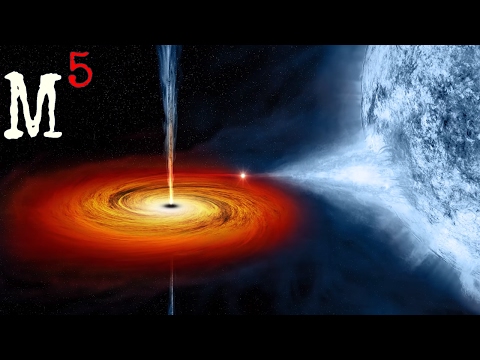
TWO: Black Holes
A black hole in space is what forms when a star of massive size collapses.
One of the main characteristics of a black hole is the tremendous power of its gravitational
pull.
The pull is so strong that nothing can escape it, not even light.
If a star moves close to a black hole, it will be absorbed and will not reemerge.
The existence of black holes was first suggested in the late eighteenth century.
However, it wasn’t until 1967 that American physicist John Wheeler referred to this collapse
mass as a black hole.
Interestingly enough, we cannot see a black hole since it’s invisible.
The presence of a black hole may only be detected by the influence it has on the objects around
it since it attracts them.
Needless to say, we don’t know what happens when a black hole absorbs a star.
We are not sure if that star reappears somewhere else in the universe, or if it gets destroyed.
What we know is that black holes can become very big in time after absorbing a number
of objects.
In fact, the supermassive black hole is located in the center of our galaxy.
One thing is sure.
Black holes are incredibly hard to find and study.
For example, the Cygnus X-1 is a body in space that has been studied since the early 1960s.
Even after 50 years, we believe that we have found a black hole, but we are not 100 percent
sure.
As said before, this is not an object that can be observed in the same way a star or
a planet can be.
ONE: The Mysterious Pyramid on Ceres
In 2015, we received new images from a mysterious dwarf planet called . The stunning images
were taken by the Dawn Spacecraft which was sent to the asteroid belt between Mars and
Jupiter.
This historical achievement resulted in landing the spacecraft on Ceres.
This is how we learned about two of the most enigmatic features found on this planet.
Those are its mysterious bright spots and a pyramidal-shaped structure.
The “Alien Pyramid”, as it has been dubbed by some, is in fact called Ahuna Mons.
From Earth, this structure looked like a pyramid on the surface of the dwarf planet.
As the Dawn Spacecraft circled Ceres at much lower altitudes, the exact shape of this pyramid
came into focus.
Today, we know that Ahuna Mons looks like a dome with smooth, steep walls.
Scientists say that on its steepest side, Ahuna Mons rises 4 miles in height.
However, this structure is still a great mystery.
Around 400 miles northwest of Ahuna Mons lies the now-famous Occator Crater with its enigmatic
and mysterious bright lights.
Scientists are currently claiming that the mysterious bright lights are caused by a type
of magnesium sulfate.
A different type of magnesium sulfate can be found on Earth, and it’s called Epsom
salt.
UFO-logists have a very different opinion.
They claim that the Occator Crater is filled with anomalous structures that are anything
but natural formations.
Several UFO-logists are saying that several buildings can be seen next to the bright and
sparkly spots.
Regardless of what the truth is, researchers have not been able to explain the mysterious
shapes and bright spots.
What do you think about these mysteries?
Feel free to share your opinions in the comments section below.
If you find it interesting, share and like this video.
Also, be sure to subscribe because you don’t want to miss what is coming next.
As always, thank you for watching.
Facebook
Twitter
Google Plus
Mysterious 5
Latest Posts