-->
≡
Home
Woman
Sport
Business
Health
Privacy Policy
Contact Us
Contact Us
How Well Do You Know Your Own Hand?
:
:
2017-04-14T21:25:40Z
Friday, 14 Apr 2017 - 09:25 PM
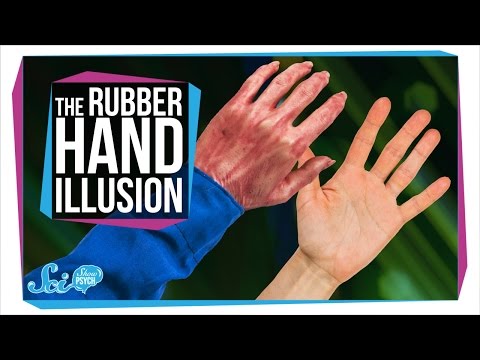
There’s an illusion that’s become a kind of pet experiment that’s used all over the world
by psychologists who like spooking people.
Here’s how it goes:
You sit at a table and hide one hand behind a divider,
with a blanket draped over your shoulder.
There’s a fake hand on the table, and the experimenter arranges it so the fake hand’s wrist
looks like it’s connected to you.
Then, you watch the fake hand as the experimenter strokes both your hidden, real hand
and the fake hand in exactly the same way.
After a few seconds, you start to get the sense that
the fake hand is actually your own.
That’s when the experimenter grabs a hammer and whacks the fake hand with it,
which makes you recoil in panic.
And yeah, it’s kind of mean, but this illusion has actually turned out to be super useful.
It’s helping programmers create better virtual realities,
and it’s also being used in medical treatments.
The trick is called the rubber hand illusion, and it was first published by a group of researchers back in 1998,
when they discovered that if your real hand is hidden, you can convince your brain
to adopt a fake hand as your own.
And there’s a good reason why your brain just misplaces a part of your body
you’ve known and loved your entire life.
It has to do with multisensory integration: when your brain takes information from all
of your senses and puts it together to create one cohesive picture of the world.
Usually, your brain can do this really well, and your perceptions are pretty accurate.
Sometimes, though, the process can go wrong, because your brain trusts certain kinds of
sensory input more than others when it’s building that big picture.
In this case, it gives more weight to what you’re seeing with your eyes
and feeling with your skin.
So you see the fake hand in the spot where your real hand should be, looking like ...
... well, a hand, and you feel touches that match what you see happening to the fake hand.
Your brain trusts that more than your proprioception—
the sense telling you where your hand actually is in space.
So it just corrects your proprioception to match what it thinks
is the most accurate version of what’s happening.
That’s why you feel like the fake hand is yours, even though you know it’s not real,
and you react to the hammer.
But the rubber hand illusion is useful for more than just scaring people.
Researchers can also use it to make virtual reality, or VR, seem more realistic.
In a 2010 study, for example, computer scientists from University College London tested whether
the rubber hand illusion would make it seem more like you’d actually stepped into a simulated world.
They had 20 university students use VR headsets and controllers to experience different simulations.
Then, the researchers monitored their reactions to the simulations using both questionnaires
and what’s known as galvanic skin response,
which measures the intensity of your emotional responses based on how much you’re sweating.
They found that when the simulation included virtual arms
that were in danger of being injured, the players’ alertness spiked.
They were bracing their own bodies for impact, as if they were actually about to be hurt.
But they didn’t tend to brace themselves that way when the simulation just had
plain arrows instead of virtual arms.
Since this was a small study, there’s still a whole lot we don’t know about
how the rubber hand illusion applies to virtual reality,
but the experiment been replicated by other researchers since then, with similar results.
Studies like this could pave the way for new techniques and hardware for more realistic simulations—
and that would be useful for more than just awesome video games.
Realistic, immersive simulations might also help people in physical therapy,
since you can have patients try exercises in ways that would be impossible in the real world—
if you set up a simulation with less gravity, for example.
And a version of the rubber hand illusion is already being used in another kind of therapy,
called mirror box therapy.
It’s used to treat phantom limb pain, where people feel pain from a limb that’s been removed,
as though it’s still a part of their body.
Phantom limb pain is especially hard to treat, because ... there’s nothing there.
Mirror box therapy uses a box with a mirror on it, set up to reflect the patient’s remaining
limb in a way that makes it look like the missing limb is actually there.
As the patient looks at the reflection, they do stretches and exercises with their remaining limb.
Their brain reads what they’re seeing in the mirror as the missing limb moving, stretching,
and generally being healthy, and turns off the painful alarm bells.
Dozens of studies have tested mirror box therapy, and they’ve found that it does work.
So the rubber hand illusion may be a weird cognitive flaw.
But by exploiting it, we can create some amazing virtual worlds—
and hopefully help people with rehabilitation and pain, too.
Thanks for watching this episode of Scishow Psych, and thanks especially to our patrons
on Patreon for making this show possible.
If you want to support this show, just go to patreon.com/scishow.
And don’t forget to go to youtube.com/scishowpsych and subscribe!
Facebook
Twitter
Google Plus
SciShow Psych
Latest Posts