-->
≡
Home
Woman
Sport
Business
Health
Privacy Policy
Contact Us
Contact Us
The first Americans: Clues to an ancient migration
:
:
2017-04-26T17:27:25Z
Wednesday, 26 Apr 2017 - 05:27 PM
My first reaction on reading the paper was no,
this is wrong, something's wrong.
They're going to think this is crazy,
this is outrageous.
I didn’t believe it.
I still don't believe it properly.
It really is a paradigm shift in terms of
when humans arrived on this continent.
And if it does turn out to be true,
it changes absolutely everything.
We're excited about the publication of a research project
we've been working on for a few years
that I guess, in a nutshell, we could call
the oldest archaeological site here in North America.
I first visited the site the day it was discovered.
I was called by Richard Cerutti,
a field palaeontologist here at the Museum,
that he had discovered
what he thought was a mammoth
at a freeway construction site that he was monitoring.
We started realising early on
that there were some odd aspects with the skeleton.
First of all, it was a mastodon not a mammoth,
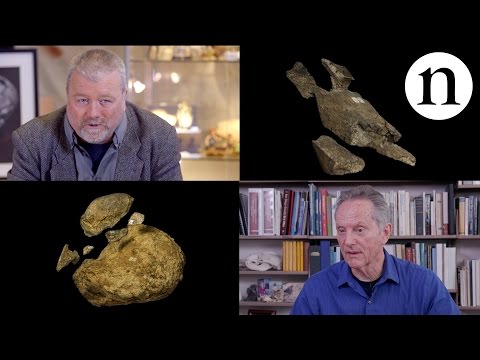
but we also found pieces of sharply broken rocks
such as this specimen.
This was actually the first rock specimen
that Richard discovered
and that was in association
with sharply broken bones of this mastodon.
I mean, this is part of a leg bone of a mastodon.
And then we also found a large rock
in association with these bones
which poses a puzzle
because the remains of this mastodon
were found in a silt layer
and geological processes that would deposit silt
are not going to be depositing or carrying
rocks of this size.
And, so, we're looking at this and thinking,
well how did those rocks get there?
What makes sense to us,
although it's out there,
is the hypothesis suggesting
that humans brought these rocks to this site
and that humans used these rocks
to break bone like this.
It wasn't until 2012
that we had really reliable dates
that the site was as old as 130,000 years.
It's a hundred thousand years older
than the broadly accepted dates
for the first occupation of the Americas.
Now, as far as we understand
from things like genetics and the archaeology,
people move into the Americas sometime
maybe twenty three thousand years ago,
or less,
and they come across the Bering Straits
and these are the ancestors
of all the modern First Nation peoples
of the Americas today.
130,000 years ago: it's different.
The sea lane in between the two continents,
between north-eastern Siberia
and between Alaska is wider
so that's one problem with this:
how do we get humans across?
And the other question is:
which humans are they going to be?
So there are a number of possibilities,
but until we actually find a skeleton at this site,
or at a site of a comparable age in the Americas,
it's all open to speculation and we just don't know.
So for the archaeologists who say that
it's outrageous, how can this be,
there's really no evidence other than this one site
that humans were here 130,000 years ago,
I mean, one of the answers to that question
is that, well, archaeologists
aren't looking at rocks this old
so how can they find evidence
if they're not looking in the right place?
Whether the evidence for human interaction
with this site is convincing or not…
to be honest with you, I'm a little sceptical.
My thing is stone tools
and I look at the pictures of the stones from there,
I put them against the fact that there are
no knapped stone tools around there at all,
and for me that starts to ring alarm bells a little.
I suspect in the long run most people
will want to see it more rigorously investigated.
So, are the stone tools really properly bashed
or is there some explanation for it?
Is the bashing on the bones genuinely what they think?
Of course there are other ways to break bone
besides just smashing them with a rock,
but as we examined closely
the specimens that we had from our site
we found no marks that were consistent
with those kinds of alternative hypotheses.
And we even experimented
with replicating how bones break
and took hammer stones
and broke elephant bone
to see what kind of damage that caused to the bones
and the pattern of breakage
was consistent with what we found
at our site here in San Diego.
There have been stranger discoveries in archaeology.
How implausible is 130,000?
Well, maybe it's not completely impossible
but I think it's less of a filling in of a gap
than an opening of a whole new chapter.
Facebook
Twitter
Google Plus
nature video
Latest Posts