-->
≡
Home
Woman
Sport
Business
Health
Privacy Policy
Contact Us
Contact Us
Why I gave my kidney to a stranger
:
:
2017-04-11T12:38:22Z
Tuesday, 11 Apr 2017 - 12:38 PM
So the tradeoff to me is that I get to stay in bed and watch Jane the Virgin for two weeks
and then someone gets to live an entire life for 7 years and I don't care who that person is;
that's a trade that i'm willing to take.
We’re going to the transplant center at Hopkins hospital in Baltimore.
Oh that button.
All right.
And what you’re here for today?
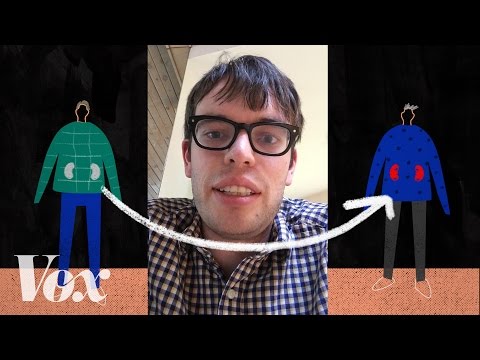
Oh and I’m here to get checked up and meet my surgeon before I give my kidney to a stranger.
The number of Americans waiting for organ transplants has risen dramatically.
But the problem is there’s already a national shortage of kidneys available.
And there aren’t enough donors.
Which means thousands die waiting.
There’s probably about almost 100,000 people on the kidney transplant wait list right now.
And every year the list grows higher and the amount of kidneys that are donated really
is staying the same.
So just to to lay out what it's like before you get a kidney transplant, most people are
on dialysis.
So if it's in a hospital, it's generally 3 days a week, 4 hours at a time.
It's almost impossible to hold down a job with those hours.
You're exhausted.
It's a like immensely physically draining process.
The one year death rate, I believe is, is 20 percent.
And the survival prognosis over 5 years is 33 percent, which is about the same as brain cancer.
And getting a kidney transplant, on average extends lifespan by about 7 years or more.
At this point I’ve done two 24-hour urine collections which are as gross as they sound.
And the results were inconclusive so now I’m going to get some radioactive particles shot
through my kidneys, see what comes out.
The transplant committee at Hopkins has officially looked at my case.
I apparently have a resting heart rate that is slightly below normal, because I’m just
chill as hell, and they wanted to have me talk about that with a cardiologist.
To be able to do this, you generally have to have an employer with generous family leave.
You have to either not have kids or have really good childcare that can get you through a
recovery period.
But I think it's definitely a situation where I'm very privileged to be able to do this.
If you're like going paycheck to paycheck, it would be an insanely
tough thing to do.
Dear Dylan, you have been approved as a kidney donor by our multidisciplinary transplant
team at the Johns Hopkins hospital.
Thank you for coming forward as a living kidney donor and we look forward for assisting you
through your donation.
Sincerely, Pam Walker.
Let’s say there’s a mother and son who don’t match but the son needs a kidney.
And there’s another father and daughter who are in the same boat, but that father’s
kidney matches the other family’s son’s kidney and that mother’s kidney matches
the other family’s daughter’s kidney.
They can do a swap.
And you can even expand it out from there and make them loops with more than two.
But the issue is that you need to close the loop.
And that can be reallly tricky to do and really delicate to put together.
And so that’s where non-directed donation comes in.
I don’t need a kidney.
Like, if you gave me a kidney I would be pretty weirded out.
I’m just giving one with no expectation of reciprocity.
So if I give to someone and then their family member has someone that is on the list who
they match with, they can give to that person, and then that person has a family member who
can give.
And so it’s sort of a chain that doesn’t need to loop back.
It’s all happening.
So it’ll be a 5:15 surgery on Monday because they’re shipping out the kidney to Ohio
for its ultimate recipient.
It’s part of a chain with four transplant centers so yeah.
I think this is emblematic of Dylan in many ways.
I think he has a moral certainty that a lot of us lack, where he's really able to collect
the information available and decide that something is a moral good.
That it will make the world a better place and then he goes and does it.
I read someplace that there was some year, recently, 2013 or 14 when it was like 100
or 200 people in the country made undirected kidney donations.
It's a pretty rare thing, and we've all got reasons.
I'm not doing this.
But Dylan looked at all the reasons why not to do them, and he didn't find any that swayed him.
So — so here we are.
I don't post on Facebook a whole lot and I was really nervous with posting anything
that would come across as like self aggrandizing or like, you know, look at me I'm such
a great person for doing this and I think the reason to do it in spite of that concern
would be if I can persuade someone to do it.
I think that kidney donation is contagious in that way.
Well and it certainly was for me, that I did it because people I knew had done it and so
hopefully that chain, which will remain open-ended can keep going.
I’m trying to steel myself and know that it’s not going to be a cake walk recovering
and that it’s going to involve imposition on people I care about more than I’m usually
comfortable with.
We have to mark your left side before we go back.
My left or your left?
Your left.
My left, OK.
But knock wood, in two months time I’ll be doing all the same things I was doing before.
Someone will have a kidney in Ohio and be living a more active life.
So we had the conference call last night kicking off this chain.
It’s a big deal and you know, a lot of people will get transplanted because of this chain
that’s created.
So it’s a great thing.
And we’ll see you back there.
And when we’re done we’ll come find you in the waiting room, OK?
Any questions?
So here’s Dylan.
His kidney went to this hospital, The Christ Hospital in Ohio.
And then the Christ Hospital donor went to Georgetown Hospital in DC.
Then the Georgetown donor went to a recipient at UCLA in California.
And then the UCLA donor went to University of California, San Francisco.
The last person would have been someone on the waiting list.
So, how are you doing?
I’m good.
I’m good.
I’ve only thrown up once so far.
So there’s that.
And they have a bunch of exercises that I have to do.
And so on.
Apparently that keeps me from getting pnemonia.
Science is a magical thing.
And then I have to do coughs with my cough buddy 3 times an hour.
Still pretty painful but not super painful the way it was yesterday or the day before.
Yeah well and it’s not something I would have envisioned yesterday or the day before,
that each day has been sort of an exponential improvement on the last.
So the first few days are really painful.
I shouldn’t sugar-coat that at all.
But really amazing thing is how fast it went away.
It was two weeks to get back to work and then another week after that to just feeling totally fine.
And do you think other people should do this?
Totally.
I think if this is something you want to do, you should do this.
In the most basic of senses, everyone does not need to do this because if everyone gave
their kidney, there would be way too many kidneys floating around.
But more people should do this and people in a position to do this should do this.
And you know, I think people who struggle with whether their career is making an impact
or if they're doing the right thing, as we all struggle with that and I struggle with
that, it is one way to really make a concrete impact and really help someone
and know that you're helping them.
It’s now March.
March 30th.
And I got a letter from my recipient.
He was on dialysis for 15 months.
I’m in relatively good shape physically and have high hopes to now live perhaps 20 or 25 years
with the kidney which you so graciously gave, which was an excellent match for me.
Let me say again, thank you from the bottom of my heart and assure you I will take most
excellent care of your kidney.
That’s all I can really ask.
Facebook
Twitter
Google Plus
Vox
Latest Posts