-->
≡
Home
Woman
Sport
Business
Health
Privacy Policy
Contact Us
Contact Us
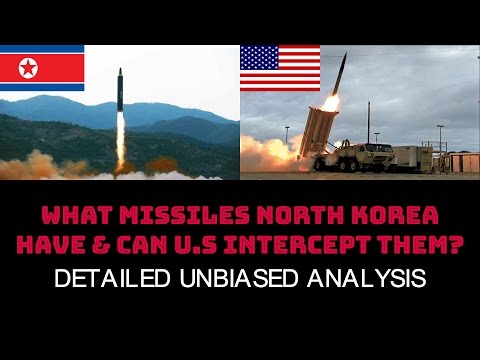
WHAT MISSILES NORTH KOREA HAVE & CAN U.S INTERCEPT THEM?
:
:
2017-05-17T07:38:11Z
Wednesday, 17 May 2017 - 07:38 AM
North Korea's embassy in Beijing issued a fresh warning to the new South Korean administration
of Moon Jae-in, warning Seoul against strengthening the security alliance with "foreign powers"
like Japan and the United States.
The statement comes a day after North Korea tested a ballistic missile that it claimed
could be mounted with a "large-sized nuclear warhead", and capable of reaching the continental
United States and U.S. operations in the Pacific.
In this video, Defense Updates examines the North Korea’s missile capabilities, and
analyzes if U.S can intercept them or not.
Let us first understand what North Korea has, then we look at 3 systems of U.S which can
intercept these missiles, and draw a unbiased conclusion.
So, lets get started.
Here is a list of known North Korean missile along with their capabilities.
North Korea went on to embark on a program in the late 1980s to build a new missile.
It is known as the Nodong, and has range of 1,000km.
Its likely target is Japan.
It’s a single stage missile.
The Taepodong-1 was the country's first multi-stage missile.
Based on satellite photographs, independent think-tank the Federation of American Scientists
(FAS) believes the first stage is a Nodong missile and the second stage is Hwasong-6,
which is a short-range missile.
TAEPODONG-1 has an estimated range of 2200 km.
The Musudan, also known as the Nodong-B, is an intermediate-range ballistic missile.
Its likely targets are Okinawa, Japan, and US bases in the Pacific.
US Missile Defense Agency estimates they have a range of 4000 km.
The Taepodong-2 is also a two-stage ballistic missile, but is a significant advancement
on the Taepodong-1.
The Center for Nonproliferation Studies puts the range at 6,000 km.
If the Taepodong-2 becomes successfully and it reached its maximum estimated range, its
range could put Australia and parts of the US, among other countries, within range.
Let us now look into 3 U.S defenses, which can intercept these missiles.
The list is ordered starting with least effective and moving to most effective system.
Ground-Based Midcourse Defense (GMD) is the United States' anti-ballistic missile system
for intercepting incoming warheads in space, during the midcourse phase of ballistic trajectory
flight.
It is a major component of the American missile defense strategy to counter ballistic missiles,
including intercontinental ballistic missiles (ICBMs) carrying nuclear, chemical, biological
or conventional warheads.
GMD is administered by the U.S. Missile Defense Agency (MDA), while the operational control
and execution is provided by the U.S. Army, and support functions are provided by the
U.S. Air Force.
GMD has its share of hits and misses; the latest test conducted last year was a failure.
On 30 April 2014, the Government Accountability Office issued a report stating that the system
may not be operational any time soon because "its development was flawed".
It says the GMD missile is "capable of intercepting a simple threat in a limited way".
About 3 years down the line, most experts believe that for higher success 4 to 5 GMD
interceptors will have to be launched against a single incoming missile.
The Aegis Ballistic Missile Defense System is a United States Department of Defense (DoD)
program, developed to provide missile defense against short to intermediate-range ballistic
missiles.
Aegis BMD is designed to intercept ballistic missiles post-boost phase and prior to reentry.
It enables warships to shoot down enemy ballistic missiles by expanding the Aegis Combat System
with the addition of the AN SPY-1 radar and Standard missile technologies.
Aegis BMD-equipped vessels can transmit their target detection information to other systems
and, if needed, engage potential threats using either the SM-2 or SM-3 missile.
SM-3 missile having range of 2,500 km & speed of Mach 10.2 will be particularly effective
in this scenario.
5 Ticonderoga class cruisers and 25 Arleigh Burke class destroyers are known to be equipped
with this system.
Some of these vessels are currently loitering near the Korean waters.
Like U.S Carl Vinson is accompanied by the USS Wayne E Meyer, an Arleigh Burke-class
guided-missile destroyer, as part of the carrier strike group.
THAAD has been recently made operational and is deployed in South Korea.
Terminal High Altitude Area Defense, THAAD, is an anti-ballistic missile system, which
is designed to shoot down short, medium, and intermediate range ballistic missiles in their
terminal phase.
THAAD uses a hit-to-kill approach that is the missile carries no warhead, but relies
on the kinetic energy of impact to destroy the incoming missile.
A THAAD battery consists of at least 6 launcher vehicles, each equipped with eight missiles,
with 2 mobile Tactical Operations Centers (TOCs) and the AN TPY-2 Ground-Based Radar(GBR).
The THAAD Radar is an X Band active electronically scanned array Radar developed and built by
Raytheon.
It has an Operational range of around 200 km.
The missile has a speed of 8.24 Mach or 2.8 km/s.
Being deployed close to North Korea, and designed specifically to counter these types of missile,
the THAAD is the best bet for United States.
North Korean missile tests have been unsuccessful many times, showing that it has long way to
go before mastering this technology.
Since U.S has 3 layers of missile defense in place, the North Korea will need at least
8 to 10 successful launches to overwhelm them & have a decent chance.
Looking at the poor success rate of missile launches, North Korea may have to launch around
15 to 20 missiles.
Any current launch of missile by North Korea, takes 1 to 2 days of groundwork and lots of
activity in the Launchpad.
Any preparation of launching 15 to 20 missiles will not go undetected; hence probability
of sudden attack is very low.
U.S will have decent amount of time to prepare for interception, giving it better chance.
Also since the missiles are land based only & North Korea hasn’t yet developed concealed
underground launch facilities, they remain vulnerable to preemptive precision strike
by aircrafts or cruise missiles.
U.S may choose to destroy these missiles in the launch pad before the takeoff, when these
are most vulnerable.
In either case, US will have good chance of taking down these missiles, either on ground or in air.
Facebook
Twitter
Google Plus
Defense Updates
Latest Posts