-->
≡
Home
Woman
Sport
Business
Health
Privacy Policy
Contact Us
Contact Us
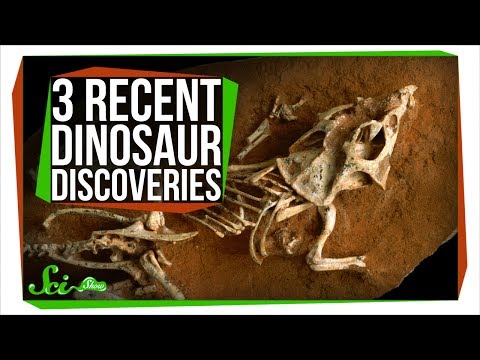
3 Mind-Blowing Recent Dinosaur Discoveries
:
:
2017-06-11T21:30:19Z
Sunday, 11 Jun 2017 - 09:30 PM
Paleontology may be the study of long-dead creatures, but as a field of science it’s
very much alive.
Take dinosaurs, whose remains are a scientific treasure trove.
Even in the past year, some key studies have taught us huge things about what they are,
what they looked like, and how they lived and died.
And there’s still lots to discover!
There’s a new dinosaur species described around one every two weeks – we haven’t
come close to “catching ‘em all” yet.
But as new species are being added to the branches of the dinosaur tree of life, there’s
rumblings of a big shake-up at its base.
A paper from March this year defies a 130-year-old widely-used classification system that divides
up dinosaurs into two groups, based on the orientation of a bone in the hip called the pubis.
If the pubis points tailwards, like in triceratops and stegosaurus, it’s an Ornithischian.
But if the pubis faces the front, it’s a Saurischian.
This group includes sauropods like Diplodocus, and theropods like T. rex and Velociraptor.
To put this simple classification system to the test, the researchers scrutinized fossils
of 74 early dinosaurs and their relatives, measuring 457 characteristics as objectively
as possible.
Using some heavyweight computing power, they suggest that theropods like the T. rex fit
better with the Ornithischians than their traditionally-assigned group!
This new group, which they called Ornithoscelidans, shares 21 criteria, like the shape of the
thigh bone, ridges on the upper jaw, and fusion of certain ankle bones.
So maybe the hip-based system division is deceptively simple, after all.
It might be tricked by convergent evolution.
Basically, if a front-facing pubis evolved more than once in different species, even
though their hips looked the same, they might not be as closely-related as we thought.
After such a strong proposal, there’s probably gonna be a lot of discussion and disagreement
about how we look at dinosaurs.
Whether textbooks get rewritten, or a flaw in the new research means we stick with the
status quo, it's still good for old ideas to be put to the test!
This next study goes beyond bones, and tells us more about dinosaur outsides.
It’s well-established that many dinosaurs had feathers, from a bunch of fossilised impressions.
And a 2016 paper literally added a whole new dimension to the study of these feathers!
It described – for the first time ever – a 99 million-year-old feathered dinosaur tail,
trapped in amber and stunningly preserved in 3D.
The unfused bones in the tail, called vertebrae, give it away as a non-avian dinosaur rather
than a bird.
And these feathers had some never-before-seen details – stuff that’s hard to spot in
flat impressions.
The feathers have alternating branches, known as barbs, poking out from a central stem – which
is different than the paired barbs on bird feathers we see nowadays.
Also unexpected, the barbs are complete with many tiny barbules, a feature that gives feathers
some more structure and wasn’t thought to have evolved until later.
From the size, it’s thought to be from a juvenile dino, so we don’t even know if
this is adult plumage or if it goes through a big molt as it grew up.
But even if there’s a lot we don’t know, this one discovery shows that there were probably
a lot of different dinosaur feather types that died out with their owners.
And, finally, besides how they looked, paleontologists also want to know how dinosaurs lived and died.
This includes the mass extinction 65 million years ago, which wiped out all dinosaurs except
a few – the avian theropods – that live among us today as birds.
Turns out, something about the very start of dinosaur lives might have been partly responsible
for the end: they took too long to hatch.
Compared to reptiles, bird eggs are speedy hatchers, taking somewhere between 11 and
85 days on average.
Getting up-and-running quickly has its advantages.
As a hatchling, you can move around to escape from predators, or find a better habitat if
your old one gets too cold or floods.
But stuck inside an egg, you’re at the mercy of the outside world.
As the closest relatives of extinct dinosaurs, it was assumed that dinosaurs would be speedy
hatchers too, but we don’t know that much about their development.
A 2016 study took another look at some rare embryonic Ornithischian dinosaur fossils.
By examining daily growth-lines in their teeth, researchers could estimate how old they were.
Turns out, they think the dinos took around 3 to 6 months to hatch – much longer than expected.
This slow development presumably worked fine during the Cretaceous, but not when a whopping
asteroid and intense climate change hit!
Being stuck inside the egg for so long might have made late-blooming dinosaurs less adaptable
to this harsh and changing world.
The avian theropods had probably already evolved this quick-hatch lifestyle before the asteroid
hit, and that happened to save their lives.
Evolution is just a series of lucky breaks and adaptations, after all!
Thanks for watching this episode of SciShow, and thanks to all of our patrons on Patreon
who make all this possible.
If you want to help us keep making videos like this, you can go to patreon.com/scishow.
And don’t forget to go to youtube.com/scishow and subscribe!
Facebook
Twitter
Google Plus
SciShow
Latest Posts