-->
≡
Home
Woman
Sport
Business
Health
Privacy Policy
Contact Us
Contact Us
Is the EUROPEAN UNION a CONFEDERATION? - VisualPolitik EN
:
:
2017-06-19T22:38:26Z
Monday, 19 Jun 2017 - 10:38 PM
The European Union is the Windows of politics.
It´s slow, it doesn't work perfectly OK and sometimes it gets “crashes”.
Nonetheless, let's be honest, the other alternatives are not much better… and can certainly be
more costly.
At the beginning of this year, it seemed like the far right was unstoppable.
Some political analysts claimed that Brexit would be the beginning of the end of European
Union.
And during this time the international media was full of words like FREXIT or CZEXIT.
However, this Euroskeptic furor wasn't to last long.
France has elected a brand new president, Emmanuel Macron, who stands up for the European
Union like no one else.
The same happened in other elections around Europe.
In other words… the European Union is alive and kicking.
At least, for the next four years.
But hold on a minute because things are more complex than what they seem to be...
In fact, not all EU fans are the same, many of them don’t even share the same opinion
on what the EU should be.
For instance, Macron stands for a fiscal union, with the same taxes in every country.
But Angela Merkel, nor Jean Claude Juncker are into that.
On the other hand, the former Belgium Prime Minister, Guy (Gee) Verhofstadt, who now is
the President of the European Liberal party, says that Europe should become a FEDERATION,
like the United States.
But… does everyone agree with that?
Well, the answer is, rather unsurprisingly, no.
In fact, the only thing shared by all these politicians is the fact that EU is a good
thing.
But… well, what is the European Union all about?
What should it become?
Is it a federation… or a confederation?
And what are the different models on the negotiation table?
Well, today, we are going to answer these questions!
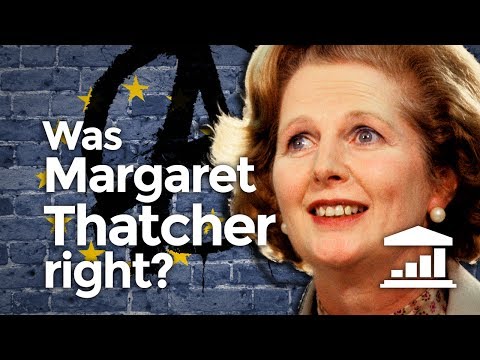
WHAT IF MARGARET THATCHER WAS RIGHT?
Margaret Thatcher is something like Elvis Presley to Eurosceptics.
For decades, this woman, who was the British Prime Minister in the 1980s, has become the
biggest inspiration for many of the movements that want to end the European project.
But then again, reality is seldom simple.
Now, it is true that Margaret Thatcher was a big critic of political integration.
Back in the time, the European Union still didn’t exist.
It was just a community of countries that traded among themselves.
Nevertheless, during the 1980s, the different European governments agreed to deepen this
integration.
This is when they started talking about a single currency and new institutions.
All of this culminatedn 1992, with the signing of the Maastrich Treaty.
But… what did Margaret Thatcher think about all of this?
The truth is, if we forget about stereotypes and we, actually, read her memoir, we find
quotes like this one:
“Britain does not dream of some cosy, isolated existents on the fringes of the European Community.
Our destiny is in Europe, as part of the Community” --Margaret Thatcher, “The Downing Street
Years”
But, importantly, this doesn't mean Thatcher was in total agreement with all the European
politicians - she just wanted a different model.
Unlike those who wanted a United States of Europe, with the capital in Brussels, she
stood for a confederate model.
“Certainly, we want to see Europe more united and with a greater sense of common purpose.
But it must be in a way which preserves the different traditions, parliamentary powers
and sense of national pride in one's own country” --Margaret Thatcher, “The Downing Street
Years”
But before we keep going, we really must explain: What is the difference between a FEDERATION
and a CONFEDERATION?
An example of a federation would be the United States of America.
Texas and California have their own parliaments, their own governments, and their own laws.
Today, for instance, marijuana is legal in California but it is forbidden in Texas.
However, if Congress (in Washington DC) passed a law legalizing cannabis, any state law that
contradicted the federal law one would be automatically abolished.
In a confederation, states have way more autonomy.
Today, there are actually no confederations in the world.
Not even Switzerland.
Of course, in Switzerland, the different cantons enjoy a lot of autonomy and even different
taxes…
But that doesn’t mean they are a confederation!
For instance, if the Parliament at Berna would pass a law legalizing marijuana, the rest
of the cantons would have to accept it.
It Switzerland was a real confederation, each of the different assemblies would have to
have a vote to decide if they want to keep cannabis legal or not.
So, despite what a lot of people say, Switzerland is clearly a federation.
And now you might be wondering, well, what is Europe?
Is it a federation or a confederation?
Of course, there are a lot of people who stand for the federal model.
In the last few years, the champion of this idea has been the President of the Liberals,
Guy (Gee)Verhofstadt.
But let’s go back to the facts.
Today, despite what it looks, national governments have a lot of autonomy.
For instance, years ago, Brussels passed a directive banning smoking in bars.
After that, each of the member countries had to vote on their own anti-tobacco law.
And do you know what happened?
Well…
Austria and Czech Republic did not pass those laws.
And during those years, you could smoke in the cafes of Prague or Vienna while in Berlin
and Paris it was completely forbidden.
Even the VAT, which is the main European tax, is different in each country.
In Spain, they pay a 21%, but in Hungary they pay 27%, and in Germany, they’ve got a 19%.
tax In other words, Europe is not a federation.
But is not a confederation, either.
It´s kind of a… “federal confederation.”
And now you might wonder…
Is this federal confederation model actually working?
Or do we need to move ahead with some sort of “United States of Europe”?
WHAT´S WRONG IN EUROPEAN UNION?
We've all have heard about the many mistakes this European integration has made.
But the truth is many of these flaws could have happened in all the member states individually.
As an example let us consider the refugee crisis.
Now, it is true that Brussels was incapable of crafting a common policy to give asylum
to all the citizens that are running away from countries like Syria, Iraq or Libya.
But let’s not lie to ourselves!
The same happened in every single country.
In Spain, the national government of did everything they could to avoid welcoming the refugees.
On the other hand, Madrid’s city hall did the exact opposite.
“The City Hall of Madrid will make a welcoming project, so the refugees will have a place
to live”
In other words, we cannot expect Brussels to solve the problems that nation-states have
always had.
In politics, such things are simple not possible.
But hold on a moment because this doesn't mean European Union is perfect either.
In fact, there are many problems that are endemic to this institution.
For example, imagine you are a freelancer living in Hungary and you work for a company
based in Belgium.
Should you include the VAT on that invoice?
According to the EU legislation, you shouldn't because it is a service contract.
But each country has it's own tax laws that, in many cases, contradict the EU laws.
But not only that!
What VAT should you include on the invoice?
The Hungarian or the Belgium one?
All this problems could be solved if there was a common ground on taxation matters.
But many countries don't want to lose sovereignty on this matter.
And no one dares make the first step towards this...
So, as you might imagine, it’s hard for important decisions to move forward…
So, what could be the solution to this problem?
A CLUB WITH DIFFERENT KINDS OF MEMBERS?
Constitutions are useful.
They allow politicians and legislators to know what they can do and what they cannot.
It is like a minimal agreement.
This way, a government knows what that it can pass as a law, it’s a system that time
has proven effective.
So, what’s the problem?
Well, all attempts to release a European Constitution have failed.
In 2005, both France and Netherlands had referendums where they rejected the proposal for a European
Magna Carta.
Years later, Brussels politicians met again to write a new version of this constitution,
the so-called Lisbon Treaty.
This was a milder version of the previously drafted constitution.
But integration problems persisted…
The truth is that each country has its own interests and it’s hard to get them all
on the same page.
So… why not recognize the differences?
And this is why, the European Commission has made the European White Book where they imagine
five potential scenarios for EU reform.
One of them would allow each state to have a different level of integration.
On the other hand, at the beginning of 2017, The Economist proposed to create a European
Union with different kinds of membership.
On one hand, there would be the “Premium members,” those who share a common currency,
common fiscal policy, and common foreign policy.
On the other hand, there will be the “Silver members,” who just share a common market
and free movement.
Other members, let´s call them “Bronze members”, will have access to just the common
market.
This way, it would be way easier to convince every country to pass a common European Constitution.
Meanwhile, the idea of a United States of Europe has lost a lot of supporters.
The idea of a Europe with different membership levels currently enjoys a lot more support.
Meanwhile, France’s brand new president is willing to play a major role on the future
of Europe.
But what does he really stand for?
Well, if you want to know more about Emmanuel Macron, don´t forget to check out this video.
And now the question is…
Do you think this hybrid of a federal confederation, with different member categories, can actually
work?
Or we should keep trying for a federation where everyone has the same rules?
Please, let us know what you think in the comments section below.
And, by the way!
We want to thank the Professor Oscar Sanchez, a Constitution expert from the University
of Valladolid for helping us in making this video.
If you are new to VisualPolitik, please don't forget to subscribe to the channel!
We publish brand new videos every Monday and every Thursday so hit that subscribe button
and you won't miss any post.
And if you liked this video, give us a thumbs up.
And, as always…
I’ll see you next time!
Facebook
Twitter
Google Plus
VisualPolitik EN
Latest Posts