-->
≡
Home
Woman
Sport
Business
Health
Privacy Policy
Contact Us
Contact Us
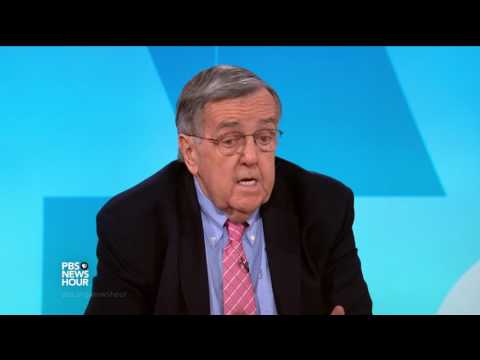
Shields and Brooks on Trump’s response to Russia probe, Scalise shooting
:
:
2017-06-17T00:24:43Z
Saturday, 17 Jun 2017 - 12:24 AM
JUDY WOODRUFF: And to the analysis of Shields and Brooks.
That's syndicated columnist Mark Shields and New York Times columnist David Brooks.
So, gentlemen, it's been another tumultuous week, on top of several others.
We have had the attorney general of the United States testifying before the Senate Intelligence
Committee.
And then we learned, I guess in the last 48 hours, Mark, that the investigation by the
special counsel into the Russia meddling in the election has been expanded to include
whether or not the president committed obstruction of justice.
Is this a one-alarm crisis, two-alarm?
Are we making too big a deal of this?
MARK SHIELDS: Well, based on what the president -- how the president's reacting, Judy, I don't
think we're making too big a deal of it.
I mean, the president, having acted briefly presidential after the tragedy of the shooting
of Steve Scalise and the others at the baseball field, has reverted to form and gone back
to, as you reported at the outset, now the man who told me to fire the FBI director is
after me because -- is investigating me because of firing of the FBI director, which is totally
contradictory to what the president said to Lester Holt on NBC, that the recommendation
of Rod Rosenstein had nothing to do with his decision to fire James Comey as FBI director,
that it was based solely on Donald Trump's desire, as he expressed to the Russians the
next day in the Oval Office, to get the Russian investigation behind him.
And so I just think that he is behaving like a man who really wants to fire Robert Mueller
and, you know, who didn't live through October 20, 1973, when President Nixon ordered Elliot
Richardson to fire Archibald Cox and the independent counsel, and he refused and resigned.
And William Rucklehaus, his deputy, resigned.
And we had a constitutional crisis.
And it led to impeachment hearings.
JUDY WOODRUFF: The president is calling it a witch-hunt, David.
The White House is saying he didn't -- isn't going to fire the special counsel.
But it isn't clear.
There have been reports out about that.
DAVID BROOKS: Yes, it may be a witch-hunt, but he's acting like a witch.
(LAUGHTER)
DAVID BROOKS: To me, we have had this -- the idea that there has been collusion between
the Russians and the Trump campaign has been investigated for a long time.
And so far, we have had no really serious evidence that they did collude, and everything
else seems to be leaking out.
So, I begin to be a little suspicious -- and maybe I'm wrong -- we will see over the long
term -- whether there was any actual act of collusion.
There were certainly conversations maybe about some building and some investment, but so
far, no evidence of an underlying crime.
But this, to me, is not a criminal story.
It is a psychological story.
And it's a story about a president who seems to be under more pressure, under more threat,
lashing out in ways that are painfully self-destructive, but also extremely disturbing to anybody around
him.
And so whether it's the North Korean Cabinet hearing that he held recently, where they
all had to praise him, or the tweets as late as this morning, this is not a president who
is projecting mental stability.
And the idea that he will fire somebody, whether it's Mueller or anybody else, seems very plausible.
And so, to me, if there is something really damaging here, it's something that has not
yet happened caused by the psychological pressure that he apparently feels.
JUDY WOODRUFF: It is.
People are referring, are reflecting back, Mark, to the Whitewater investigation, the
Watergate investigation, that what happened after the original alleged crime made whatever
happened in the first place much worse.
MARK SHIELDS: Well, the two iron rules of Washington scandals, Judy, is, it's never
the act itself.
Rule one, it's always the cover-up.
And rule two is, everybody always forgets rule one.
And that's -- but I think we have got -- I'm not ready for the clean bill of health yet.
We have got the transition to go through and The New York Times' Matt Apuzzo and Michael
Schmidt's story this week that suggested that Robert Mueller was looking at money laundering,
that this would have been the way, through the Russians, that had been -- the beneficiaries
had received their payments through offshore banks.
This kind of opened up a new avenue that's reported in The New York Times.
And so I just think that, Judy, the abject lack, absence of curiosity on the part of
the president in his nine conversations with the FBI correct or any other -- anybody else,
and with the attorney general before the Senate Intelligence Committee, abject lack of curiosity
in how the Russians did it.
I mean, you would come in and you say 17 intelligence agencies have concluded the Russians tried
to sabotage the American electoral process, and there's not a single question about, what
did they do, how did they do it, how can we avoid it, what can we do in the future?
Geez, no, let's go, let's find the three million people who were illegally voting in California
instead.
We will appoint a commission for that.
JUDY WOODRUFF: I mean, Mark does have a point, David, that when the attorney general was
asked about the -- a number of things, one of the things he said was that he had not
been briefed at all on the Russia meddling.
DAVID BROOKS: Yes.
And that's in part why it's a psychological issue.
Every contact we know where Donald Trump had conversations about the Russia thing, he saw
through the prism of his own victory and would he get credit for the victory.
And it's perfectly plausible for a normal human being to think, well, I won the presidency,
but the Russians also did seriously endanger interests, the American political system,
and, therefore, I'm going to go after that.
And so he -- but he's incapable of seeing that second part.
It's just, am I getting full credit for what I think I achieved?
And so it's the intellectual insecurity that I think is overshadowing all else.
And that, by definition, can spill -- this is why it's a little different than Whitewater
and Watergate.
Nixon has his own psychological complexities, but he was someone who acted at least maybe
in Machiavellian ways, but in straightforward, linear ways.
And, certainly, that was true of Clinton.
With this team, no.
And then the second thing to be said is, Clinton had very competent people around him, and
so did Richard Nixon.
That's not the case here.
And you talked to the people in the Clinton White House, it was hell to be in that White
House.
They tried to build these Chinese walls, so they could do their jobs while the investigation
was going on, and it was super tough for them.
I imagine, especially when you have got tweetstorms coming out, it's near impossible to do your
job right now in any corner of the Trump administration.
JUDY WOODRUFF: Tweetstorms from the president.
MARK SHIELDS: Just two quick points, Judy.
And that is, Richard Nixon was no Donald Trump.
I mean, Richard Nixon had served four years in the United States Navy as an officer, 14
years in the House and the Senate, eight years as vice president, and was a constant reader
of history and biography, may have been the best-prepared president in terms of experience
in the history of the nation, and has a record of achievement that -- amply documented character
defects and criminal activity, but a historic record of achievement, whether it's OSHA or
EPA or whatever else.
The two things that David's mentioned, of that Cabinet meeting, it was the most awkward
event I have seen in 50 years.
JUDY WOODRUFF: This is when he went around the table and asked each Cabinet member...
MARK SHIELDS: To tell how wonderful you were, not what I did -- not only what I did on my
vacation, but how wonderful you are.
And there wasn't a single member of that Cabinet, with the exception of Jim Mattis, the secretary
of defense, who escaped with his or her self-respect intact.
I mean, it was: You're wonderful.
They love you in Mississippi.
You're doing a great job.
Everybody's better.
The economy is better.
Everything is terrific.
I mean, this was just -- this was scary.
And the final thing was, yesterday, he goes after Hillary Clinton again, crooked Hillary.
I mean, he's trying to rerun that 2016 election.
JUDY WOODRUFF: Well, all this takes place, David, in a week when, as you both have mentioned,
the shooting happened.
Republicans are practicing for their annual baseball game against the Democrats in Congress,
and this man comes into town from Illinois.
He ends up being killed, grievously wounds Congressman Steve Scalise, still in the hospital
in critical condition.
After this, we see a coming together of the parties.
I wanted to show a picture.
This is from the baseball game last night, where you had -- or two nights ago -- where
you had the four leaders of Congress there for once -- I don't think we have ever seen
a picture like this -- coming together looking like they at least can tolerate each other.
DAVID BROOKS: Yes.
And the thing that's symptomatic of me -- for me is, I used to think polarization was a
Washington phenomenon, that the people on Capitol Hill were polarized, but the country
was sort of still a moderate nation.
But I think there is little evidence to support that now.
This is a polarized country.
And most of the politicians I know, members of Congress, hate the system they're in.
They're stuck in a much more polarized world than they wish they were in.
And it's out of the country.
And that doesn't say the shooter is any way symptomatic.
If anything, he's an atypical nutcase.
But it is a sign on the fringes.
We have seen a ratcheting up of violence.
We saw it, I thought, at the conventions on both sides.
We saw it at the Trump rallies on both sides.
And the people on the fringes of society, we have just seen a ratcheting up in their
feeling of justification that they can resort to violent means.
And this guy apparently had a list of people, according to what's being reported this afternoon,
of people he wanted to shoot.
And so that's weaponizing mentally disordered people through the process of political extremism.
JUDY WOODRUFF: Is this coming together at all, Mark?
Do you see any enduring -- any endurance of that, or is that just -- is it just going
to be a blip?
MARK SHIELDS: You hope, Judy, but to David's point, both parties -- according to Pew Research,
in both parties, what drives the most activist wing is not support and energy and advocacy
of their own side.
It's loathing of the other side.
That's the gauge as to whether you're going to be politically involved, you're going to
vote, and whether you're going to contribute, how much do you loathe the other party, how
much do you hate them.
And there was a time, I will be very blunt, when I came to Washington, when the legitimacy
of your opponent was never questioned.
You questioned their judgment.
You questioned their opinions or their arguments, but you never their legitimacy.
And that changed.
And it changed.
And one of the reasons it changed is that a man was elected from the state of Georgia
who ran on the book, and the book was, you use these words.
You use sick.
You refer pathetic, traitor, liar, corrupt, shame, enemy of normal Americans.
This was Newt Gingrich's bible.
It wasn't an idea of a policy.
It wasn't a program.
He used it and he became successful.
He became speaker of the House.
Donald Trump is a clone of Newt Gingrich.
Donald Trump used, Donald Trump, lying Ted, and lightweight Bobby Jindal, and Mitt Romney
choked like a dog, and used that language.
And you're right.
The left has used similar language and there has been a response and almost a premium on
going after Trump in the same sort of language.
But there's been no punishment.
There's no political downside for this tactic.
JUDY WOODRUFF: Just 45 seconds.
Is one side more responsible than another?
And are we going to see any of this coming together last, or is it...
DAVID BROOKS: Yes, to me, in 1970, people were asked, would you mind it if your son
or daughter married someone of the opposing party?
And 5 percent would mind.
Now 40 percent mind, because people think your political affiliation is a sign of your
worth, your values, your philosophy, your culture, your lifestyle.
It's everything.
All of a sudden, we have been reduced to politics and we have made politics into the ultimate
source of our souls.
And that's -- it's just -- that's not what it should bearing.
It's just about arguments about tax rates.
It's not everything.
MARK SHIELDS: That's a good point.
JUDY WOODRUFF: David Brooks, Mark Shields, thank you both.
MARK SHIELDS: Thank you.
Facebook
Twitter
Google Plus
PBS NewsHour
Latest Posts