-->
≡
Home
Woman
Sport
Business
Health
Privacy Policy
Contact Us
Contact Us
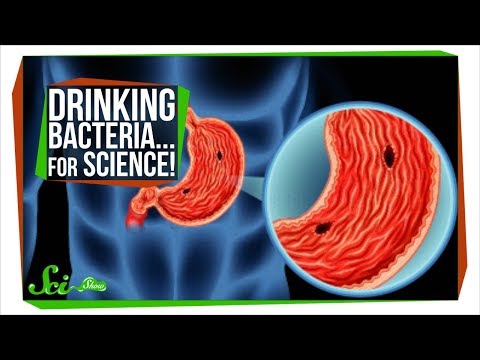
The Man Who Tried to Give Himself An Ulcer... For Science
:
:
2017-06-19T21:38:20Z
Monday, 19 Jun 2017 - 09:38 PM
Here at SciShow, we don’t like to indulge the idea of the ‘mad scientist.’
But sometimes scientists do live up to the stereotype, and resort to doing things most
of us would never do.
Like experimenting on themselves to prove a point.
In 1984, an Australian doctor named Barry Marshall infected himself with a bunch of
dangerous bacteria on purpose.
It sounds pretty stupid.
Like, maybe don’t try that at home.
But by doing that, he showed the world that most stomach ulcers are actually an infectious
disease and saved a lot of people’s lives.
Ulcers are painful sores in the stomach or upper part of the intestine, and they aren’t
just uncomfortable.
If they get bad enough, patients can start bleeding, or their stomach can burst — things
that can be deadly.
Back in the 1970s, ulcers were most common in middle-aged men who smoked and drank, and
they seemed to run in families.
Doctors assumed ulcers happened when people made too much stomach acid, and were a product
of hard-living and some bad luck in the gene department.
The typical advice was to slow down, watch what you put into your body, and take some
antacids.
They also thought that the stomach was sterile — completely bacteria-free.
But in 1979, an Australian pathologist named Robin Warren
began to question that common wisdom.
He was regularly seeing comma-shaped bacteria in the samples from patients who had inflammation
in their stomach tissue, or what’s called gastritis.
He and Barry Marshall set up a formal study and found that nearly all of their ulcer patients
were infected with the bacteria, too.
They identified the bug as Helicobacter pylori, and suspected that it might be the actual
reason why people developed ulcers.
But few physicians were convinced.
The idea seemed absurd.
How could bacteria even survive in the highly acidic stomach?
And if this was true, why hadn’t anyone figured it out before?
By 1984, Marshall was confident of his results, and
frustrated that other people weren’t convinced.
He decided to do something radical.
After making sure he had no H. pylori of his own, he became his own guinea pig, and in
one gulp of meat broth at 10 in the morning, he swallowed a bunch of the bacteria on purpose.
Sure enough, within a few days he wasn’t feeling so great.
He had indigestion, nausea, and bad breath — and began vomiting.
It wasn’t actually an ulcer, but it was close.
It was gastritis.
And it showed that H. pylori wasn’t just along for the ride.
It was the problem.
The bug was attacking the stomach lining, and opening that tissue up to more damage
from all the natural acid sloshing around to break down food.
The infection usually takes a while to cause a problem, and the symptoms can be made worse
by things like smoking and stress, which is why older guys with less-than-stellar health
records seemed to be the most susceptible.
But without H. pylori, most people would never get ulcers.
Marshall and Warren went on to demonstrate that certain drugs could get rid of H. pylori
and cure ulcers, saving countless lives.
The Australian duo was awarded the 2005 Nobel prize in Medicine
for their groundbreaking work.
And their disco-era discovery turned out to have an even bigger impact than anyone imagined.
As more and more people got antibiotics to cure their ulcers,
cases of stomach cancer plummeted.
Today, the World Health Organization recognizes H. pylori as a carcinogen.
The same damage the bacteria does to the lining of the stomach with an ulcer
also causes gastric cancer.
It’s a huge public health victory — in part, thanks to one man’s willingness to
make himself sick.
So, a bacteria that causes ulcers and cancer?!
Definitely want to get rid of that, right?
Well, it turns out that it’s not so simple.
That’s because while most ulcers are caused by H. pylori, most people with H. pylori don’t
develop ulcers -- and even fewer get cancer.
Having it around might even help.
H. pylori seems to protect people from developing heartburn and from getting cancer in the esophagus
and the upper stomach.
Scientists aren’t totally sure why this is the case, but they think the bacteria might
help cut down on acid reflux.
With less acid bathing those tissues,
you’re less likely to damage them and begin growing a tumor.
Unfortunately, you can’t get the best of both worlds.
The strains of H. pylori that are the most dangerous to the stomach are also the most
protective to the esophagus.
It’s one or the other!
So, given that it’s a trade-off anyway, doctors generally agree that it makes sense
to leave the bacteria in the stomach unless it starts causing a problem.
And if it does, antibiotics to the rescue!
Thanks for watching this episode of SciShow.
To learn more about how the bacteria in your gut affect your health, including how fecal
transplants have become the hottest new treatment for certain infections, check out our video
about the microbiome.
Facebook
Twitter
Google Plus
SciShow
Latest Posts