-->
≡
Home
Woman
Sport
Business
Health
Privacy Policy
Contact Us
Contact Us
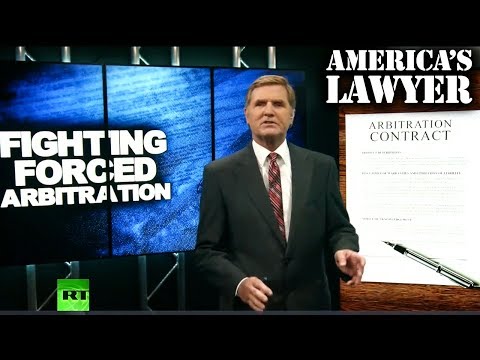
Corporate America's New Way To Steal From You: ARBITRATION
:
:
2017-07-27T18:41:27Z
Thursday, 27 Jul 2017 - 06:41 PM
One of the biggest scams ever collectively pulled off by corporate America is forced
arbitration.
To put it in its simplest terms – forced arbitration eliminates a consumer’s right
to sue corporations when they deceive them.
Millions of Americans have agreed to this by signing “arbitration clauses” in contracts;
they’re in your credit card contracts, your cell phone plans, your car and mortgage loans
– the list goes on and on as corporations are making sure that they're the ones with
a legal advantage over you, when they find themselves in trouble.
And when they do, that contract you singed won't allow you to file a lawsuit or create
a class action against them for ripping you off, instead, you’ll have to go before a
panel of arbitrators to resolve the dispute.
Unless you are a board member of one of these corporations, there is no way that these arbitration
clauses will help you.
Usually corporations pick the arbitrators so they know they are going against a friendly
audience.
They also have the benefit of having almost endless money to drag out the process, where
most consumers can’t even afford to hire a lawyer.
And when you’re talking about small amounts of money, it can cost a customer more to arbitrate
than they could ever get back in damages.
And even if a consumer is willing to jump through the countless hoops corporations put
in place, studies show that it is businesses win 80% of the time.
The deck has been stacked against American consumers.
Now here’s a quick example of how this issue can hurt you personally – suppose your credit
card company or cell phone company was overcharging you 5 dollars a month.
And not just you, but 10 million people a month.
Because you signed that arbitration agreement, you can’t join a class action lawsuit with
the other victims.
Instead, each of you has to hire your own lawyers for hundreds of dollars an hour just
to get your 60 dollars back.
You lose money in the process even if you win, while the corporation pockets 50 million
stolen dollars.
Right now, the Consumer Financial Protection Bureau is trying to work on rules to prevent
corporations from using these binding arbitration clauses in their contracts, but they are facing
stiff opposition from elected officials in Washington, D.C.
When you have both major political parties in the United States controlled by Big Business,
you will always lose as a consumer.
And that’s why corporations have been trying for decades to paint plaintiff’s attorneys
negatively.
Both Democrats and Republicans are owned and operated by Big Business and the US Chamber
of Commerce.
That’s why forced arbitration is a way corporations will be stealing from consumers for a very
long time.
Joining me now to talk about these arbitration clauses and how they work and how they overwhelmingly
help corporations, is Tim O'Brien.
Tim, tell us what arbitration clauses do to American consumers.
Pretty simple.
It's two things.
Number one, these clauses enable fraudulent corporate conduct.
Number two, they facilitate, and let's talk about what facilitate means.
It means to make easy.
These clauses facilitate, make easy, the hosing of the American consumer.
That's all there is to it; it's plain and simple.
What kinds of businesses and companies use these clauses and when did they become, really,
widespread?
I remember the US Chamber of Commerce started this jihad against both consumer lawyers,
and at the same time that they were attacking consumer lawyers, so the person on the street
simply didn't have access to the court.
That was their goal.
They were also putting in place this arbitration idea.
This is heavily drawn, heavily pushed, by the US Chamber of Commerce, those folks that
we always believe is Mom and Pop grocery store down the street.
It's not is it?
This US Chamber of Commerce is 19 of the largest multinational corporations in the world, fund
the US Chamber of Commerce.
So, this arbitration clause is perfect for them isn't it?
It absolutely is.
And there are very few guarantees that anyone, any attorney like me can ever make, but I
can make this guarantee to everyone watching your program, Mike, and that is this: you
are a subject of an arbitration clause.
If you have spent any money in the United States over the last few years, you are part
of an arbitration agreement.
You don't even know that.
So it's everything from your credit cards to your cell phone to your cable bill to your
Internet service provider to even the apps that you sign up for that you quickly accept.
And unfortunately, there's very little you can do.
If you want that service, if you want to have a telephone in your house, then you've got
to accept.
You've got to put yourself into this arbitration agreement and waive your rights to a jury
trial.
It's even worse than that, isn't it Tim?
If you think about it.
Say Wall Street.
Say some broker on Wall Street steals a million dollars from you.
It's your life savings.
They steal a million dollars.
They do that by messing with stocks and bonds that you own.
Do you realize, and I think this is the ugliest thing about it, most people don't know that
you don't get to take that thief to court.
You have to take that thief to an arbitration panel where the thief gets to pick at least
one of the arbitrators, and most of the time, it ends up being two of the arbitrators, and
it's totally stacked against you in favor of the thief.
Is that kind of where this whole thing is going on how the whole court system could
end up there if we don't pay attention to what's happening with arbitration?
It's even worse than that, Mike.
Actually, in a lot of these financial issues, so involving banks and credit cards, it's
a single arbitrator.
And typically, that single arbitrator comes from a group called the National Arbitration
Forum, which is an industry-funded group of attorneys where they select, they hand select
who goes into that forum, into that panel of groups.
So you have one person, one person deciding what is your compensation, if any, and 90-some
odd percent of the time, folks lose.
But number two, what are your rights.
It's really ... it is the encapsulation of the American kangaroo court, is the arbitration
clause system.
In other words, the thief steals money from you.
The corporate thief steals money from you, one way or another, through your phone, through
your credit card, through your bank, through your stock, whatever it may be, your stock
account.
They steal money from you.
And then the thief gets to pick the people who are gonna decide whether they did anything
wrong.
Is ... does that get it right?
Is that accurate?
That's exactly right.
And what's even worse is it can turn on the other side, too.
So in other words, what are your rights against the company?
Now say, as this has happened to many servicemen and woman who have served overseas, what happens,
say, if there's a debt.
And perhaps that debt's valid.
Perhaps it's not valid.
Well typically that debt to be collected goes through a process, and you have the right
to be heard about it.
You have a right to contest the validity of the debt and that debt actually exists.
Many of the debts now or the supposed debts are also subject to this arbitration provision.
So a company can involuntarily put you into an arbitration before a single arbitrator
from this NAF, the National Arbitration Forum, and you're overseas, fighting for our country.
And you have no idea that there now is an arbitration judgment against you for a debt
which you had no ability or even notice that you had the right to contest did that debt
even exist.
So it's not just for protection; it's for offense, and the corporations are using this
arbitration provision offensively.
Okay, let me get this right, though.
This is what's startling about it.
The corporate thief, whether we're seeing it with banks.
Very common with banks.
Very common with credit cards.
Very common on anything you do with Wall Street.
Very common on your phone.
These types of contracts, where thieves can steal $5 a month.
Now let's say at the end of the year, they've stolen ... let's say, at the end of 10 months,
you've figured out they've stolen $50 from you, so you go to get your $50 back, you have
to hire an attorney that's going to cost you $200, but the thief, who has stolen your money,
has done it to 10 million people.
So the thief ... that those 10 million people can't go out and hire their individual lawyers,
and the thief also knows, the corporate thief also knows that you can't join a class action,
can you?
Isn't that part of the arbitration limitation?
Absolutely.
Nine out of ten of these arbitration provisions include class action prohibitions.
The corporations know, they understand the theory of divide and conquer.
They know that most American consumers cannot afford to go collect on a 60 or 100 or even
150 dollar debt or transgression against a corporation.
But when you put these people together in a class action, there's efficiency.
There's strength in numbers.
And it can become a real, real issue for the corporation, because it could cost them tens
and even hundreds of millions of dollars in order to compensate for this collective wrongdoing.
And the corporations know by busting that up, by dynamiting that ability of the American
consumer to do that, they take away and they make a reality of these folks are never going
to have their day court, or even for that matter, before an arbitration panel.
It's all by design, and right now, they are executing it perfectly.
So in other words, the banking thief, they can sit in a boardroom, and they can say,
‘Look, you know we can actually steal $50 a month from ten million people and the reason
we're going to get away with it is because that person we steal from isn't gonna be able
to hire an attorney.
That person we steal from isn't gonna be able to join a class-action,’ so basically, ‘We're
going to pocket all of that $50 to $100 million dollars, and get away with it, because we
have been successful in selling the American public the arbitration clause.’
Real quickly, is there anything a consumer can do about this, Tim?
Anything at all.
There's very little that can be done right now.
Right now, the Consumer Protection Bureau is trying to essentially ban arbitration clauses.
And Congress meanwhile is trying to take that right away.
So call your Congressmen.
Tell them to support the Consumer Fraud Protection Bureau's efforts to regulate arbitration clauses
and consumer contracts.
Facebook
Twitter
Google Plus
The Ring of Fire
Latest Posts