-->
≡
Home
Woman
Sport
Business
Health
Privacy Policy
Contact Us
Contact Us
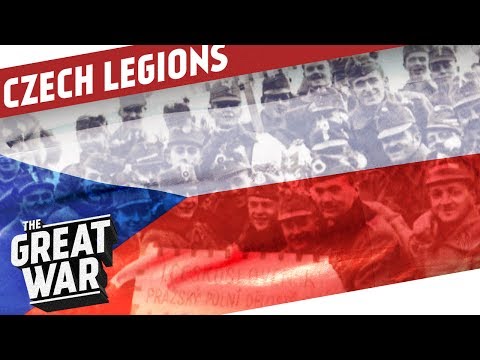
Fighting Without A Country - Czechoslovak Legions of World War 1 I THE GREAT WAR Special
:
:
2017-07-01T13:45:22Z
Saturday, 1 Jul 2017 - 01:45 PM
They were men without their own country, living split up among not one, but two mighty empires.
But when the Great War came and those empires began to crumble, those men took up arms in
the struggle, and fought so that one day they too would have their own nation.
These were the men of the Czechoslovak Legions.
I’m Indy Neidell; welcome to a Great War special episode about the Czechoslovak Legions.
First, I have to say that this is not about Czechs and Slovaks during and before the war
and how their nation came to be, that is a topic for another day.
This is about those men actually fighting the war, and how the Legions themselves came
to be.
Who were these men?
Well, they were Czechs and Slovaks fighting in France, Italy, Russia, and even volunteering
in Serbia.
Why Legion?
Since Czechoslovakia did not yet exist, these volunteers, not allowed to fight in the regular
armies, fought in units that were officially part of the French Foreign Legion, that’s
who also paid them.
Going back a bit, and changing sides, the Czech situation within the Austro-Hungarian
Empire was not ideal before the war.
They hadn’t gotten the recognition that Hungary did, even though they were the industrial
heart of the empire and its third largest nationality, and the largest Slavic one and
Slavs were half the empire.
The Bohemian crown lands were actually as well-developed as Germany or France were,
unlike much of Austria-Hungary, so morale was fairly low among the Czechs when the war
broke out.
And of course the outbreak of war mean soon they were fighting fellow Slavs and even Czechs
and Slovaks in Entente nations.
Those men in those Entente nations weren’t yet Czechoslovak Legions but they’re worth
mentioning - those volunteers in Serbia, the Rota Nazdar in France, and the Ceska Druzhina
in Russia.
The were a few Czech volunteers in the Serbian army from the beginning of the war, but by
the 1916 reorganization of that army, there were hundreds of them, including many officers.
Rota Nazdar was formed already August 31st, 1914 in France, though recruitment had begun
a week earlier.
It consisted of 314 Czech and 2 Slovak volunteers, who became an integrated company in a Moroccan
Division of the French Foreign Legion.
In June 1915 at Arras they suffered huge casualties and the company was disbanded and dispersed
among other Foreign Legion regiments, however, they had laid the foundations for independent
Czechoslovak armed forces.
Over the next couple of years, Tomas Masaryk, future Czechoslovakian President, and General
Milan Stefanik began to organize Czech and Slovak troops in France.
In addition to this, whole units reported from Russia and Romania, and American Czechs
and Slovaks arrived beginning in 1917.
French President Raymond Poincaré signed the decree that allowed autonomous Czechoslovak
units within the French army in December 1917, and the 21st and 22nd Rifle Regiments were
soon established, forming the 1st Czechoslovakian Brigade, which fought over the summer of 1918
on the Western Front.
In Italy the situation was different.
The Italian army did not easily warm to the idea of Czechoslovak Legions.
Before the war, there had only been a few hundred Czechs and Slovaks living in Italy
anyhow, far fewer than were in France or Russia.
See, for Italy to commit to the formation of a Czechoslovak legion would mean committing
to the dissolution of the AH Empire, and initially, Italy only wanted land from AH, not the end
of the empire.
Still, many of the POWs Italy took were Czechs and Slovaks and by January 1917 there were
Italian POW camps by nationality, and that month the Czechoslovak Corps of Volunteers
was created, led by Brother Josef Chapek.
These men were at first used as scouts for the Italian army, indeed, for all the armies
in which they served, since they spoke German or Hungarian, and they knew AH tactics.
They were great for gathering intelligence, though they didn’t have autonomous units
in Italy until after the Italian defeat at Caporetto and intense negotiations by General
Stefanik.
In April 1918, Czechoslovak Military Forces in Italy were approved, by the end of the
summer there were over 13,000 soldiers and over 480 officers in the Legion there, and
the division saw heavy fighting at the front.
Just after the war, the Czechoslovak Army Corps in Italy was formed, to fight for its
new nation’s territorial integrity.
Also, the Czechoslovakian National Guard was created there from former POWs just after
an independent Czechoslovakia was recognized.
It was 60,000 troops strong, still going home in 1919.
Now, in Russia, over 100,000 Czechs and Slovaks were already living there before the war,
many had Russian citizenship.
At the very beginning of the war, those who wished to fight against Austria-Hungary formed
Ceska Druzhina, which awould become the base for the future Legion there.
They never operated as a whole unit, and were tasked with small attacks, getting enemy information,
and convincing Czechs and Slovaks on the battlefield and in POW camps to change sides.
There were also around hundreds of Czech and Slovak volunteers in the Serb volunteer Corps
in Odessa.
They wore Serbian uniforms and were under Serbian regulations.
By 1916, since the Serbs had no plans for the Czechoslovak troops to have independent
units, a majority of them left to join the Czechoslovak Rifle Brigade that formed in
the Russian army that May.
They wanted independent units with the belief that fighting for the Allies would get them
support for their national aspirations.
The problem with that had been that those who were still legally Austro-Hungarian citizens
were breaking the 1907 Hague Convention and were technically traitors.
The Tsar in particular, though he appreciated their bravery, saw them as traitors to a brother
monarch and was a supporter of the Hague Convention, hence his hesitation to have volunteer forces
of foreign nationals in his army.
Masaryk argued that just the willingness to fight against the Central powers demonstrated
loyalty, and that since the Central Powers used poison gas and unrestricted submarine
warfare the Hague Convention was broken and the Entente could legally use Czechoslovakian
soldiers against their former nations.
The greatest moment for the Czechoslovak Legions advancing their cause was the fighting of
the 1st Czechoslovak Rifle Brigade at the Battle of Zborov in July 1917.
3,500 men under Russian Colonel Trojanov were in the trenches holding a 6 kilometer line
opposite a force of largely Czechs and Slovaks in the AH army.
On July 2nd, the second day of the new Kerensky Offensive, the Legionaries attacked as shock
troops.
They breached the barbed wire, advanced deep into enemy territory, and took FOUR lines
of trenches, 3,300 prisoners, and 20 big guns that day.
That’s about as many prisoners as their whole unit’s size.
Legion losses for the day were just 167 killed and around 900 wounded.
This battle meant little for the war in general, but was a real milestone in legion history.
The brigade gained international attention, and the battle did wonders for new recruiting,
and for Masaryk’s negotiating position.
An enlargement of the brigade followed and by October 1917 the Czechoslovak Army Corps
was formed with two divisions and two artillery brigades.
There were so many volunteers they even had a reserve brigade and a shock battalion.
Soon Masaryk had set up an autonomous Czechoslovak Corps of more than 50,000 soldiers.
This was declared part of the autonomous Czechoslovak Army, headquartered in France, in February
1918.
However, the Russian Legion was going to have a hard time making its way to Western Europe.
Ukraine signed a peace treaty with the Central Powers February 9th, and after Russia did
the following month, it was too dangerous for the Legion to head to Archangel or Murmansk
in the north, they couldn’t go west or south without reaching enemies, so they had to head
east.
This would mean crossing Siberia to reach Vladivostok and then around the world to fight
in France.
The Bolsheviks wanted to disarm the soldiers, though Josef Stalin, the chief Russian negotiator,
drafted an agreement by which they were civilians that could carry some weapons as self-defense.
Still, at every train station on the long route the Bolsheviks tried to demand more
and more weapons from the Legionaries.
...and there I’ll leave you hanging, for the tale of the Czechoslovak Legion crossing
Russia, the uprising at Chelyabinsk, Trotsky’s manipulations to capture them and turn them
in to the Central Powers, the liberations of Siberian cities by the Legion, the fighting
together with the White Russians, the action on lake Baikal, the machinations of the Allies
to keep them in Russia and hopefully reopen the Eastern Front, and the ultimate evacuation,
are a tale for another special.
Which we will 100% do, and it might be the most exciting one of them all.
But in order to get there, we had to start here, with the origins of the Czechoslovak
Legions and their actions in the First
World War.
Facebook
Twitter
Google Plus
The Great War
Latest Posts