-->
≡
Home
Woman
Sport
Business
Health
Privacy Policy
Contact Us
Contact Us
How fentanyl is making the opioid epidemic even worse
:
:
2017-07-27T12:27:31Z
Thursday, 27 Jul 2017 - 12:27 PM
This dot represents ten people
and this dot represents one hundred people.
In 2015, this many died from gun violence in America,
this many died in car crashes,
but even more Americans died from a drug overdose.
52,000 people.
That's more people
than there are seats at Yankee Stadium.
More people are dying because of the opioid epidemic:
a public health crisis that is causing
waves of progressive drug use.
First, Americans got hooked on prescription painkillers.
Next, addicted users moved on
to more potent drugs, like heroin.
Now, an increasing number of Americans
are overdosing on an even more powerful opioid:
"Fentanyl is taking the opioid epidemic to a new level..."
"...fentanyl..."
"...more potent than heroin..."
"Another drug is surging..."
"Fentanyl. So potent you could die
with the syringe still in your arm."
The explanation for the rise of fentanyl
begins in the late 1990s...
"Since I've been on this new pain medication,
I have not missed one day of work
and my boss really appreciates that.
'Lauren is there every day'."
That's when pharmaceutical companies began
advertising new opioids
that were supposedly non-addictive.
"...but these are the same drugs that have a reputation
for causing addiction and other terrible things.
They do not have serious medical side effects,
and so these drugs,
which I repeat: are our best, strongest pain medications,
should be used much more
than they are for patients in pain."
American doctors started prescribing opioids,
like OxyContin, Percocet, and Vicodin,
at record numbers and overdoses began spiking.
In the 2000s, the government took steps
to limit the supply of prescription pills.
Pharmaceutical manufacturers were sued
for falsely marketing their products as non-addictive,
doctors were prosecuted for overprescribing pain pills,
and authorities tightened limits on painkillers.
By 2013, prescription drug abuse leveled off
as pills became harder to find,
but that didn't help Americans
who were already hooked.
When addicts couldn't get pills,
they found more dangerous drugs.
Many started using heroin,
an extremely potent opioid that is
made from the sap of the opium poppy.
It's this transition that has led
the opioid crisis to epidemic proportions.
The Center for Disease Control found that
people addicted to prescription painkillers are
40 times more likely to be addicted to heroin.
Heroin is more potent than prescription pain pills
and therefore more lethal.
Soon, heroin overdoses began skyrocketing
and as usage became widespread,
users with a high tolerance for heroin
began seeking even stronger opioids.
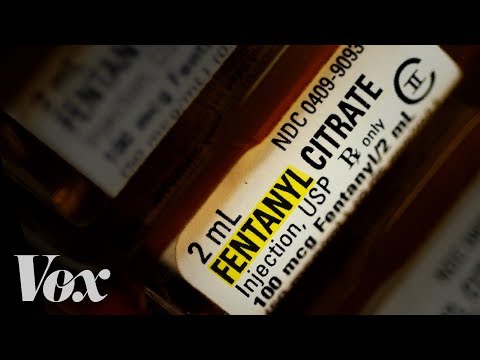
And that's part of what led to fentanyl:
a synthetic opioid that is more powerful
and cheaper to make than heroin.
Unlike heroin, fentanyl can easily be made in a lab.
It was first developed as
an anesthetic for surgeries in the 1960s
and later found use as
a treatment for chronic pain in the 1990s.
Since then, it continues to be approved
for restricted medical use and is
prescribed for advanced cancer patients.
In regulated medical settings,
fentanyl is often delivered by injection,
or as a patch or lozenge:
forms which allow the drug to be dispensed gradually.
Similar to other opioids like morphine and heroin,
fentanyl sedates the user by reacting
with receptors in the brain to release dopamine.
But fentanyl is about 100 times
more potent than morphine.
Drug traffickers have been using it to cut heroin
to increase the potency and profits from their product.
So heroin addicts can consume fentanyl unknowingly,
which increases the chances of an accidental overdose.
Exposure to the drug is so dangerous that
The CDC requires first responders to wear
protective gear when fentanyl is suspected at a scene.
"It's a scary situation...."
In Ohio, an unprotected police officer
accidentally overdosed after particles of fentanyl
settled on his clothing during a traffic stop.
"That he would just accidentally bump up against
something while he was searching this vehicle,
and for him to drop out like that...It's shocking."
Three years after heroin deaths began to spike,
fentanyl overdoses began rising.
Already, new opioids are fulfilling
the next iteration of this progression.
Carfentanil, an opioid used as an elephant tranquilizer,
is a growing cause of overdoses in The United States.
This photo compares a potentially lethal dose
of all three drugs, showing that it could take
just a few grains of carfentail to kill someone.
The fact that cracking down on prescription painkillers
has pushed users to even more dangerous opioids
demonstrates the need for better drug policies.
In addition to targeting the supply of drugs,
providing better treatment options for addiction
will reduce the demand for them.
In 2016, preliminary estimates of
Americans that died by drug overdose
are as high as 65,000 people.
Experts estimate 2017 will be even worse.
As long as people are addicted,
they're going to find ways to satisfy that addiction
even if it means using more dangerous drugs,
like fentanyl.
Facebook
Twitter
Google Plus
Vox
Latest Posts