-->
≡
Home
Woman
Sport
Business
Health
Privacy Policy
Contact Us
Contact Us
Meet CERN's New Particle: A Double-Charm Baryon!
:
:
2017-07-14T22:00:51Z
Friday, 14 Jul 2017 - 10:00 PM
This episode of SciShow is brought to you by Anker SoundCore Portable Speaker Series.
[INTRO ♪]
We’re covering the gamut of scale on SciShow News this week,
from fundamental particles to the time when life started getting bored of being microscopic
and grew much bigger.
We’ll start with the particles, because physicists just found a new one.
Most of the familiar, mass-having stuff around us is made of quarks.
Three quarks join up to form a baryon, like a proton or a neutron.
A proton is made of two up quarks and one down quark,
and a neutron is two down quarks and an up quark.
But there are six varieties of quarks: up, down, strange, charm, top, and bottom.
And according to the Standard Model, the physics theory that describes how the subatomic universe works,
any of those six are fair game to make a baryon.
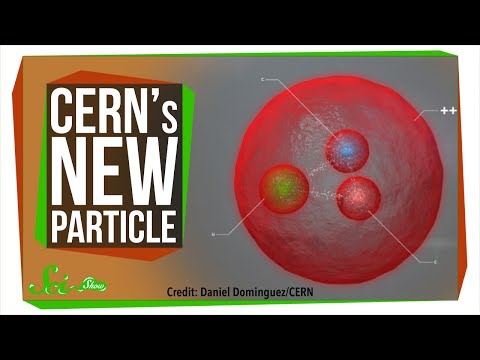
On July 6th, CERN scientists announced they had found a new particle with the catchy name
Xicc++,
made of two charm quarks and one up quark.
And this gives us a new tool to study one of the fundamental forces that binds our universe together.
The names of quarks don’t really have anything to do with their properties.
But the important thing here is that the up and down quarks are much lighter than the other four,
like charm and strange.
We’ve observed some heavier baryons before.
Lambda particles, for instance, can have one charm or one strange quark alongside an up and a down.
But the new CERN particle has two charms, making it nearly four times heavier than a proton!
The data was gathered last year by the Large Hadron Collider beauty experiment.
This detector is extra good at measuring particles that form after smashing protons together,
and their radioactive decay products.
And this is the first time scientists have confidently observed a baryon containing
two heavier flavors of quark.
Now, this finding doesn’t really shake up our understanding of particle physics.
The Standard Model predicts the existence of these baryons, so they weren’t, like,
a huge surprise.
But being able to observe them is really important, because it gives physicists a new tool
to examine the strong force, the fundamental force that holds quarks together.
Inside a baryon like a proton, the three light quarks are pretty evenly balanced and zip
around each other.
If they stray a little too far, the strong force pulls them back, refusing to let them split up.
When two of the quarks are heavy, physicists expect that the lighter quark will circle
around them,
kind of like a planet around a binary star system.
CERN scientists hope that studying these double-charm particles, learning more about their lifetime
and how often they form, will let them see if these expectations are true.
And with more data, researchers can keep updating our theories about the strong force.
As always, there’s still more work to do.
For example, scientists at Fermilab thought they found a double-charm baryon way back
in 2002.
That finding isn’t as statistically strong as this new one, though, because the mass
was too light
and it decayed faster than physicists had expected.
But even though the data doesn’t square up with this new, more confident finding,
it hasn’t been ruled out completely.
So some researchers are working on a way to explain both observations.
Going from the very small to the surprisingly big: Life has been microscopic for most of
history, so why did it get big in the last few hundred million years?
It may sound like something out of an RPG, but a rangeomorph is a very old form of multicellular life,
dating about 571 million years ago to the mid-Ediacaran period.
Rangeomorphs were probably animals, but they’re so primitive and vaguely fern-like that it’s
hard to be sure.
They have no mouths, no guts, no side-to-side symmetry, and certainly no squishy fish cheeks.
They aren’t the earliest animals, if they’re animals at all, but they’re some of the
first big ones.
Some of them stayed under ten centimeters tall, but others could get up to two meters.
And a study out this week in Nature Ecology and Evolution suggests a reason why:
they may have been among the first organisms to change their size and shape because of
changing ocean chemistry.
These researchers studied the shapes of rangeomorph fossils and developed computer models to simulate
their growth with different amounts of nutrients.
And the simulations suggested that where nutrients were hanging around probably affected rangeomorph
size and shape a lot.
Scientists call this ecophenotypic plasticity.
It’s why trees grow differently in a dense forest or an open field,
or why one mollusk might have a different shell shape depending on where it grows up.
This makes a lot of sense, because rangeomorphs might have fed by absorbing nutrients directly
from seawater into their branched bodies.
So if nutrients like oxygen or organic carbon were more available in slightly higher-up
water, for example,
the simulated rangeomorphs grew taller and thinner.
That way, they could maximize the amount of nutrients they could grab from the ocean.
Ocean chemistry was changing a bunch in the Ediacaran,
so this kind of growth flexibility probably helped rangeomorphs survive.
And the researchers think that at least one of these big nutrient shifts might have let
organisms that were living side-by-side with rangeomorphs
grow bigger than ever before.
This episode of SciShow News is brought to you by SoundCore Boost, this 20-watt, water
resistant bluetooth speaker made by Anker.
The SoundCore Boost features dual drivers, twin subwoofers, and Anker’s patented BassUp
technology to fill any room enhanced bass.
And don’t you want to fill your rooms with enhanced bass?
Of course, I say any room—I mean, a house-sized room. Like, not like Carnegie Hall, but a-a room in your house.
Its small minimalist design means you can have it on your shelf looking nice,
or you can take it with you on-the-go,
and get up to 12 hours on a single charge, thanks to Anker's trademark battery technology.
SoundCore Boost comes with an 18-month warranty, friendly customer service,
and 66 feet of bluetooth range.
Head to the link in the description to learn more about Anker’s SoundCore Boost.
Facebook
Twitter
Google Plus
SciShow
Latest Posts