-->
≡
Home
Woman
Sport
Business
Health
Privacy Policy
Contact Us
Contact Us
Our First-Ever Missions to Mars, and What We Learned From Them
:
:
2017-07-31T23:02:20Z
Monday, 31 Jul 2017 - 11:02 PM
This episode is brought to you by Squarespace.
[♩INTRO]
It might seem like we know a ton about the solar system, but we’ve really only learned
most of what we know in the last 60 years or so.
Before that, we didn’t even know much about our closest neighbors: Mercury, Venus and Mars.
And then the Mariner program came along.
When you think about space exploration in the 1960s, the Apollo landings are probably
the first things that come to mind.
But the Mariner probes made huge leaps in how we understand the solar system today -- and
especially how we understand Mars.
Starting in 1962, the Mariner missions explored the inner solar system, in NASA’s first
program that resembled what we think of today as planetary science.
There were ten missions in all, with only three failures — which was pretty impressive
for early spaceflight.
One of the reasons the Mariner program was so successful was because of a new feature
called three-axis stabilization.
It allowed engineers to control the spacecraft’s orientation in three dimensions, so scientists
could point its instruments wherever they liked -- which was important for getting those
older cameras to take clear pictures.
Other spacecraft were stabilized by spinning like a top, which could be useful in some
situations — just not this one.
It also helped that NASA’s Jet Propulsion Laboratory built each spacecraft with a common design.
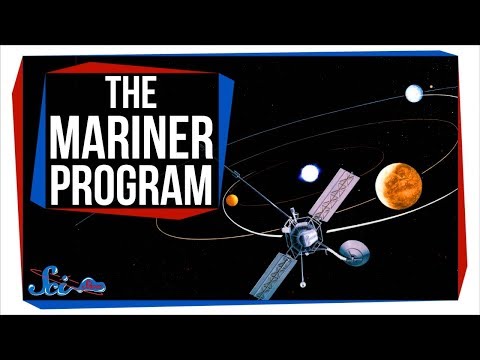
The electronics were kept in a central hexagonal or octagonal housing called the “bus,”
with pairs of solar panels attached to the sides.
Reusing basic pieces allowed them to refine components in an era when more than half of
all missions could fail.
Which is what happened to Mariner 1 in 1962.
But later that year, its twin, Mariner 2, visited Venus and became the first spacecraft
to fly past another planet!
Among other things, it taught us that Venus doesn’t have a powerful magnetic field like
Earth does.
Then, two years later, with Mariner 3, NASA set its sights on Mars … but its solar panels
didn’t work, so the mission failed.
Thankfully, everything went okay for Mariner 4, and in 1965, it became the first spacecraft
to visit Mars!
It sent back only 5.2 million bits of data, or about 650 kilobytes, which is probably
less than it takes to store half a second’s worth of the video you’re watching right now.
But at the time, that was enough to include about 20 images, plus other observations,
like surface temperature and pressure.
Along with the news that Mars also doesn’t have much of a magnetic field.
And Mariner 4 properly disproved an idea that had been popular decades earlier: that Mars
was crisscrossed by a series of enormous canals, which were built by an advanced civilization
in a last-ditch effort to save their dying home.
By the time the Mariner missions launched, most scientists didn’t agree with that,
but other people still believed it.
And with no sign of canals or other evidence of life, those first images were also proof
that Mars was a dead world, at least on a large scale.
The computers in the ‘60s didn’t transmit or process data very quickly, though, so it
took a while for those pictures to pop up on computers back home.
It took so long that by assigning colors to the numbers Mariner sent back, the first image
from Mars was colored by hand faster than it could be rendered on screen!
So, yeah, the very first pictures we saw from a Mars probe were essentially coloring pages
for scientists.
Sounds like my kind of coloring book.
These days, we receive data from probes around Mars tens of thousands of times faster, so
we’ve made plenty of progress.
A few years later in 1969, just days after Apollo 11 landed on the moon, Mariners 6 and
7 arrived at Mars as the first successful dual mission.
Mariner 6 launched and arrived first, which allowed scientists to study broad images of
the surface.
The wanted a closer look at Mars’ south pole, so they used the camera on Mariner 7
to make more detailed observations five days later.
Sending two probes together was so useful that NASA did this for other exploration missions,
too, like the Voyager trips to Jupiter and Saturn.
Still, even with that one-two punch model, Mariners 6 and 7 only managed to image about
20% of the Martian surface.
Clearly, just flying by wasn’t good enough, so Mariners 8 and 9 aimed to fix that!
8 was destroyed in a launch malfunction, which is a nice way of saying that after liftoff
it came right back down and landed in the Atlantic Ocean.
But in 1971, Mariner 9 became the first spacecraft to orbit another planet!
Nature almost threw a wrench in its plans, though.
When the orbiter arrived, it found a global dust storm on Mars obscuring all but the tallest mountains.
But just like Mariner 7, Mariner 9 was flexible and could receive new tasks from Earth, so
NASA had it wait to start start seriously taking pictures until the storm settled in January.
Whereas two Soviet probes that arrived just weeks after Mariner 9 couldn’t accept new
input from Earth, so they took a lot of pictures of dust.
In the end, Mariner 9 imaged 85% of the Martian surface, taking more than 7300 pictures, which
was way more than the other missions.
It also taught us more about Mars’ atmosphere and surface.
So this whole orbiting thing worked out great!
After the Mariner program wrapped up at Mars, Mariner 10 went on to be the first spacecraft
to fly by Mercury.
And two missions that were originally supposed to be Mariners 11 and 12 became Voyagers 1
and 2, which were among the first few spacecraft to explore the outer solar system.
The Mariner design was also adapted for the Viking orbiters that reached Mars in 1976,
and it’s been used as recently as the Cassini mission, which is just now finishing up at
Saturn after 20 years in space.
To honor the Mariner program’s research at Mars, the solar system’s largest canyon
system, Valles Marineris, carries their name.
Their real legacy, though, is what they taught us about the inner solar system.
Which was a lot!
Do you have something you can teach or share with the world?
You probably need a website for that!
Squarespace makes it easy to create a gorgeous professional website that works on both mobile
and desktop, even if you know nothing about design or coding.
I made a Squarespace site for a side project I work on and the whole process was fast and
really pretty fun.
I picked a template I liked, which was the hardest part because I liked a lot of them,
and then I was able to completely customize it to what I needed.
Whether you’re a teacher, an artist, a scientist, or run a business, a website from squarespace
can help you share your work with the world and be taken seriously, get clients, or get hired.
So support SciShow Space and make your next move by visiting Squarespace.com and use the
code “SPACE” for 10% off your first order.
[♩OUTRO]
Facebook
Twitter
Google Plus
SciShow Space
Latest Posts