-->
≡
Home
Woman
Sport
Business
Health
Privacy Policy
Contact Us
Contact Us
Why there is so much focus on Jared Kushner’s Russia contacts
:
:
2017-07-25T00:21:12Z
Tuesday, 25 Jul 2017 - 12:21 AM
JUDY WOODRUFF: At the start of this week, the latest focus of the Russia investigations
on Jared Kushner has exposed new details of the president son-in-law's dealings with Moscow.
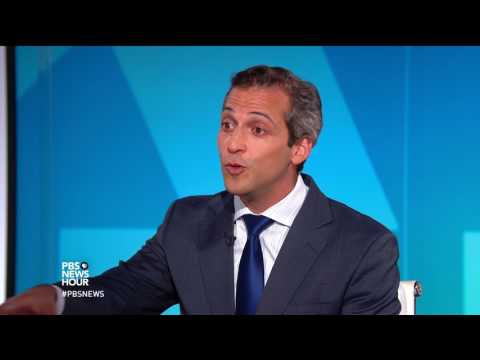
We break down what we know and the key questions that remain with special correspondent Nick
Schifrin.
So, Nick, you have spent the day talking to a lot of people.
What comes out of this?
What new do we learn about Jared Kushner and his dealings with the Russians?
NICK SCHIFRIN: I think the new narrative is that this is the senior adviser to a president
who has questioned whether there was any influence by Russia last year detailing Russia influence
on him and perhaps on Trump policy.
And nobody in this administration has really done that before.
And you have got three examples of that laid out.
One is Ambassador Kislyak, the former Russian ambassador to the United States, asking for
a direct line between the Trump transition team and Russian generals on Syria.
This is very unusual.
Kislyak could have asked the Obama administration, could have used the U.S. government to do
so, and he would be expected to do so.
And he didn't do that.
He tried to circumvent the Obama administration and use Kushner to do that.
Secondly, Sergey Gorkov, the banker that John reported on, introduced to Kushner as a personal
friend of Vladimir Putin, shows up with two gifts, art and dirt.
And many of the people I spoke to today, that metaphor of dirt is not lost on them.
The idea, according to the intelligence officials I spoke to and former diplomats, is to prove
that Russia has a connection to Kushner.
This is dirt from Kushner's grandparents' home in Belarus and also perhaps to convince
Kushner that Russia does its homework on Kushner.
And this is someone who is kind of part of the brotherhood, if you will, of businessmen
with former intelligence ties, who keep those intelligence ties, and could therefore really
represent the Russian government to Kushner, and reach out to someone very close to the
Trump campaign or President Trump himself on behalf of the Russian government, and,
again, using Kushner to do that.
And, thirdly, of course, the meeting we have been talking about for a few weeks now with
Natalia Veselnitskaya, this lawyer who reached out to Donald Trump Jr. and to Kushner.
So, we have three examples of Russia trying to literally get into the Trump family.
And those are the details that we saw today.
JUDY WOODRUFF: So, this on top of what we had learned before this, is all related to
what's happening in Congress, the Senate, even Republicans coming together with Democrats
to impose these new sanctions on Russia.
NICK SCHIFRIN: It's very clear that Republicans are helping lead this effort, certainly bipartisan
effort, but certainly Republicans, fearing the president's rhetoric on Russia, responding
to the president's rhetoric on Russia, frankly handcuffing the president on his ability to
lift sanctions on Russia that were imposed because of Ukraine, Eastern Ukraine and Crimea,
as well as the 2016 elections.
Now, Republicans wouldn't use that word handcuff, but that is really what these have done.
It's the first time U.S. has penalized anyone the U.S. believes was part of the campaign
last year to influence the elections directly.
It's not designed to hit ordinary Russians.
It's designed to send a message to Russia that U.S. intelligence knows who's doing these
things.
And it will make it harder for banks and for other companies -- or countries, rather, to
do business with Russia perhaps in the future.
JUDY WOODRUFF: Again, Nick, you talked to a lot of people today.
Any sense that, as Jared Kushner says, he's a babe in the woods, he doesn't know American
politics, he doesn't know diplomacy, that he really was an unwitting figure in all this,
as he says he was?
NICK SCHIFRIN: Some of this is described to me as normal, whether it's Sergey Kislyak's
reaching out to someone who was a neophyte, reaching out to a campaign or a transition
team that was brand-new to Washington.
And some people say, look, this is what any diplomat, any country would do with a new
administration.
But what is not normal is that the president has questioned his intelligence community's
findings about what Russia has done.
What is not normal is not to report some of these meetings that were set up with Russians,
as Kushner admitted that he failed to do initially.
And what's not normal is not to report Ambassador Kislyak's attempt to circumvent the U.S. government
and administration to try and get to the Trump campaign.
So that's why there is so much focus on this meeting.
JUDY WOODRUFF: And, finally, just a couple seconds, Russian reactions to all this?
NICK SCHIFRIN: You know, what's interesting, their focus is on sanctions.
They haven't replied to any request for comment on Kushner.
They say that the sanctions are -- quote -- "extremely negative," if the sanctions go forward from
Congress.
And that is their focus.
They don't want these sanctions to go forward.
And Trump himself has questioned whether these sanctions should go forward in the past.
And if they do, that may be one of the legacies of 2016, turning Congress against Russia to
this point.
JUDY WOODRUFF: Nick Schifrin doing a lot of reporting on this, we thank you.
NICK SCHIFRIN: Thank you.
Facebook
Twitter
Google Plus
PBS NewsHour
Latest Posts