-->
≡
Home
Woman
Sport
Business
Health
Privacy Policy
Contact Us
Contact Us
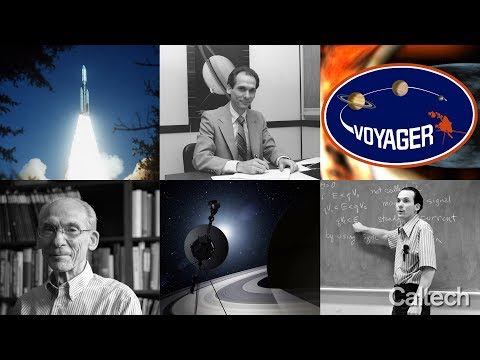
Celebrating Voyager’s 40 Years in Space with Ed Stone
:
:
2017-08-17T23:50:22Z
Thursday, 17 Aug 2017 - 11:50 PM
I came to Caltech in 1964.
I came as a postdoc and then became a faculty member in 1967,
setting up a research group in space physics with Robbie Vogt.
Then in 1972, I was asked to spend part of my time at JPL as chief scientist
for this new mission, which was called at that time MJS ’77, but which became Voyager.
* We have liftoff of the Titan Centaur, carrying the first of two Voyager spacecraft
to extend man's senses farther into the solar system than ever before. *
I hesitated because I was a fairly young professor at that point,
and I still had a lot of research I wanted to do. We had some discussions about how to focus
on the science leadership, and I felt I could continue my research here on campus,
working with students and building instruments; some students actually worked on Voyager with me.
Our first encounters with Jupiter were in 1979.
The next encounter was Voyager 1 with Saturn in Nov. 1980, followed in Aug. 1981 by Voyager 2.
After the Saturn flyby, we had a nice cruising period until 1986 for Uranus,
and so I did, in fact, teach Physics 1 again.
The wonderful thing about planetary flybys is there's a lot of freshman physics that you can talk about
- the encounters, the trajectories. What we see often has some very basic physics
you can talk about. I found a wonderful way to include in the classical physics that you get in Physics 1
some relevant things that are happening now.
Caltech is really a unique place. It has the community that you expect
from a small college, but it's doing really major world-class research.
Caltech founded JPL, and then when NASA was formed in 1958,
it became owned by NASA and run by Caltech. So that makes it possible for a professor here
to actually go to JPL on a part-time basis for an extended period of time,
because it's all the same university.
* The event which really altered our view and our expectation for the rest of the mission
was the discovery of the volcanoes on Io. *
When we saw Io, we had never seen anything like it. It had these large features. There was
this heart-shaped pattern, all these black spots.
We had no idea what we were looking at, even though we had had all these hints.
As we got to closest approach, the Infrared PI, Rudy Hanel, came in and said
"You know there's some peculiar spectrum here on Io. One possibility is we have a calibration problem.
Or maybe it's a new kind of material, which has this particular temperature profile."
Another was "maybe there's more than one temperature on Io."
We all sat there and listened to this, and not one of us said, “That explains what we're seeing!"
When I went to Optical Navigation, here was this white appendage on Io.
Occasionally I'll have little sketches here and there.
Here it is. There's Io, and see that little thing I drew there?
This was the sunset line, and you could see this bright thing up above the dark surface.
She had done a lot of work - Linda Morabito - and was convinced it was not just
another satellite that happened to get in the same field of view.
A couple days later, Rudy Hanel came in and said "We have hot spots, which are lava lakes!"
It's really a remarkable story, how hard it was for us to take the leap
that there could be a small moon with 10 times more volcanic activity than Earth.
And that really opened up our eyes that we were in for a mission that was going to really stretch us
in terms of our understanding of planets
and understanding of Earth.
I think time after time we just found that nature was much more inventive than our models.
Usually, it's the things that we don't anticipate which turn out to be the most important.
It's just that we didn't know that they were out there, whatever they were.
Facebook
Twitter
Google Plus
caltech
Latest Posts