-->
≡
Home
Woman
Sport
Business
Health
Privacy Policy
Contact Us
Contact Us
How online graduate programs offer degrees at significant savings
:
:
2017-09-06T07:31:07Z
Wednesday, 6 Sep 2017 - 07:31 AM
JUDY WOODRUFF: Now we continue our special series on Rethinking College with a look at
graduate students who pay little or even nothing for a top 10 master's degree program.
Hari Sreenivasan has our report.
It's part of our weekly segment Making the Grade.
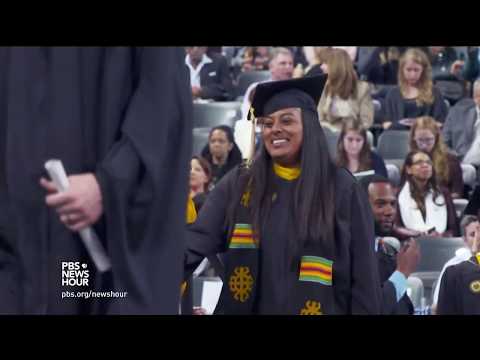
HARI SREENIVASAN: It's graduation day, and these two students are earning their computer
science master's degree from a top 10 program in the country.
But it's the first time they have ever visited campus.
VANESSA ANDERSON, Student: This whole experience was very surreal.
This is my first time on campus, being here.
The energy in this room was crazy.
HARI SREENIVASAN: Students Vanessa Anderson and Miguel Morales did all of their course
work for Georgia Institute of Technology online.
Neither live in Georgia.
MIGUEL MORALES, Student: I'm going to be working in autonomous systems, and just it's a dream
job.
HARI SREENIVASAN: And a job which pays.
The average starting salary for Georgia Tech's master degree graduates is $150,000.
This spring, 64 students earned their computer science master's degree on campus, but 212
earned them online.
CHARLES ISBELL, Georgia Tech College of Computing: The degree is the same on the transcript.
It's the same on the diploma.
There's no distinction whatsoever.
HARI SREENIVASAN: Charles Isbell, a senior associate dean for Georgia Tech's College
of Computing, helped design the online master's program.
CHARLES ISBELL: It's about accessibility.
We see that we can get many more people who don't look like the traditional folks that
we have coming on campus.
HARI SREENIVASAN: In fact, online students are typically older and have full-time jobs.
Online, there are nearly twice as many of students of color than on campus.
And while Isbell insists the quality of learning is equal for the two programs, he points out
one key difference: cost.
CHARLES ISBELL: There's a huge difference in price.
So, for our on-campus degree, it's somewhere north of $42,000 a year.
For the online degree, it's $6,600 for the entire degree.
HARI SREENIVASAN: So, if the experience is the same, how can you deliver a product at
$6,600 that you're delivering at $42,000?
CHARLES ISBELL: Well, there's two big things.
The first is, we don't have to pay for buildings.
We don't have to build new classrooms.
But the really big difference is scale.
So we have about 4,500 students in the program, compared to the 400 or so that we have on
campus.
HARI SREENIVASAN: A recent Harvard study of Georgia's online master's concluded that the
combination of a top 10 program offering a traditional degree at significant cost savings
has created a whole new consumer market in higher education.
For some students, tuition is actually free.
That's because many companies offer their full-time employees tuition reimbursement.
Student Nica Montford is a data integrator for General Motors Innovation Center in Roswell,
Georgia.
NICA MONTFORD, Student: Every GM employee gets $8,500 to spend in higher education every
year, and so it falls well within the $8,500 that we get.
HARI SREENIVASAN: After two-and-a-half years studying online, Montford plans to graduate
this December.
NICA MONTFORD: I'm focusing on the social computing aspect, social media, and the social
landscape.
I'm really interested to see where I can take it, as it expands, and as it grows, and OK
be on the leading edge.
HARI SREENIVASAN: Master's student Eboni Bell, a product software engineer for AT&T, is also
taking advantage of tuition reimbursement.
EBONI BELL, Student; I knew I wanted to get my master's, and I also knew that I wanted
to have a company that paid for it, because I didn't want to go into even more student
loan debt.
HARI SREENIVASAN: Bell would like to start her own company using technology to help solve
societal problems, like obesity and diabetes.
EBONI BELL: I'm interested in interactive intelligence and how can we use, leverage
artificial intelligence, leverage data itself to change the world.
HARI SREENIVASAN: But does learning suffer when the human connection found in physical
classrooms is missing?
Isbell says no.
CHARLES ISBELL: If you're on the fourth row, the fifth row, the 27th row, you're about
as close to me as someone who is online, right?
You're not really getting the face-to-face interaction.
HARI SREENIVASAN: Eboni Bell agrees.
In fact, she says, the way our culture thinks about a classroom should be reconsidered.
Evolving technology, she says, allows her to keep in constant contact with classmates.
EBONI BELL: We communicate daily through chat.
We communicate through Google Hangout, through videoconferencing.
We e-mail each other back and forth.
HARI SREENIVASAN: However, Bell says answers from teaching assistants are not as immediate.
EBONI BELL: I have to go to this online discussion, type my question, and then wait for a response.
And, usually, the response isn't no more than a day, but even the fact that I have to wait
for a day, whereas, if I'm in the classroom, I raise my hand and I get immediate feedback.
HARI SREENIVASAN: That's where Georgia Tech professor Ashok Goel comes in.
A professor of computer and cognitive science, Goel created an artificial intelligence tool
to help answer questions for the 4,500 online master's degree students.
And this is Jill Watson.
ASHOK GOEL, George Tech University: That's right.
HARI SREENIVASAN: What does Jill do?
ASHOK GOEL: Jill is an artificial intelligence T.A.
So, as students ask questions, Jill gives answers to those questions.
HARI SREENIVASAN: Why is there a need for an artificial intelligent T.A.?
ASHOK GOEL: That's a very good question.
So, what happens is that students who are highly motivated, highly engaged, they ask
thousands of questions.
Some of this can be delegated to an artificial intelligent T.A., thereby relieving the professor
to answer more creative questions, more open-ended questions.
HARI SREENIVASAN: So, you're saying, let the artificial intelligence deal with the easy
ones, and let the humans deal with the tough ones?
ASHOK GOEL: That's right.
Yes.
EBONI BELL: We don't really notice who is answering our questions, as long as they're
giving us the best answer.
It doesn't need to be a human.
HARI SREENIVASAN: But she still sees an important role for professors.
EBONI BELL: We need professors.
We need people that are going to help motivate us still in the class, and help us understand
why we're even taking the class.
HARI SREENIVASAN: Not all courses can go online like this.
CHARLES ISBELL: Why not?
HARI SREENIVASAN: There have to be things that a campus experience provides.
Otherwise, why would we have campuses at all?
CHARLES ISBELL: Well, we have campuses because we didn't have online education 150 years
ago, right?
Students have to feel they're a part of that community.
They have to feel engaged.
That's what you get being on a campus.
You get to meet people.
You get to build friendships.
You still get to do that online, if you provide the support for the students.
EBONI BELL: We all have the same goal.
We want to do well.
We want to succeed.
And so that bringing that all together, we find ways to make it work.
HARI SREENIVASAN: In Atlanta, for the "PBS NewsHour," I'm Hari Sreenivasan.
DACA revoked, what should the U.S. do for young undocumented immigrants? This ancient whistling language is in grave danger of dying out The Untold Truth Of Backpack Kid IRMA Update: Strengthening and models change track! - Could set ANOTHER record What we know about Hurricane Irma, the most powerful storm ever recorded in the Atlantic Where Your Cat Goes May Blow Your Mind | National Geographic What happens to 800,000 DACA recipients after program ends? Hurricane Irma 11 p.m. Tuesday forecast update Is an Online Degree as Credible as a Traditional Degree? The life cycle of a t-shirt - Angel Chang
Facebook
Twitter
Google Plus
PBS NewsHour
Latest Posts