-->
≡
Home
Woman
Sport
Business
Health
Privacy Policy
Contact Us
Contact Us
Fighting fatty livers
:
:
2017-10-11T18:16:07Z
Wednesday, 11 Oct 2017 - 06:16 PM
The liver is the body’s metabolic HQ;
detoxifying the blood,
making proteins and hormones,
aiding digestion and processing nutrients.
Most people know it best
as the organ that clears up after a night in the pub,
and that heavy drinking can cause severe damage.
But it's actually Non Alcoholic Fatty Liver Disease,
or NAFLD,
that now has doctors and scientists worried.
Linked to the global increase in obesity,
1 in 4 people has a fatty liver.
When calories are well matched
to the body's energy consumption
the liver orchestrates an ebb and flow
of energy storage and distribution.
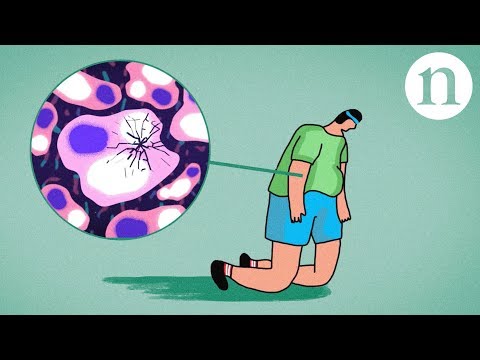
But when fat and carbohydrate flood the liver,
the system becomes overwhelmed
and stops working properly.
If more than 5% of cells in a person’s liver
contain large fat droplets, that person
is said to have a non-alcoholic fatty liver.
At this stage a fatty liver is still reversible
with changes to diet and exercise.
But without intervention, things can get much worse,
leading to to cell death and chronic inflammation.
If this happens, NAFLD becomes
a condition called NASH.
Unchecked, it increases the risk of
cardiovascular disease and serious liver problems
including cancer and cirrhosis,
which is when scar tissue forms in the liver.
Treating NASH is crucial,
but even at advanced stages
its symptoms can be vague
and doctors struggle to diagnose it.
Currently we need a slice of your liver
(hold the fava beans and chianti)
to spot fat depositions, inflammation and scar tissue.
But there has to be an easier way...
Scientists are developing an accurate blood test.
Or we can look to the coolest guy in the hospital.
New, more sensitive, ways of detecting
how ultrasound waves change;
provides a picture of how much fat and scar tissue
is in a liver.
Numerous studies have shown that diet and exercise
can reverse fatty liver and even NASH.
But lifestyle change can be the trickiest prescription of all,
and if NASH continues to worsen,
doctors will want to intervene.
Currently, there are no drugs specifically approved for treating NASH.
However, hundreds of drug trials are underway.
Some drugs act in the gut, halting fat absorption
and stopping the release of proinflammatory signals.
Most target the liver directly,
aiming to stop the metabolic stress that triggers NAFLD.
Others try to prevent NASH
by blocking the effects of metabolic stress,
by stopping inflammation and cell death.
And some drugs are making progress
on that difficult scar tissue.
Livers work relentlessly to keep us going
and researchers are working ceaselessly too,
to better understand, diagnose and treat
this increasingly common condition...
...helping us all live a healthier life.
How to Reverse a Fatty Liver If Your Kidneys Are In Danger, These Are The 5 Signs You Should Not Ignore! Foods to Avoid a Fatty Liver Evan got rid of his Fatty Liver and lost weight. Fatty Liver - Top 5 Foods To Help Your Fatty Liver Today! 5 Symptoms Of Colon Cancer You Should Not Ignore The first Americans: Clues to an ancient migration 80% of fatty liver disease patients don't drink alcohol Cat domestication: From farms to sofas Inside ALS: The neurons behind the disease
Facebook
Twitter
Google Plus
nature video
Latest Posts