-->
≡
Home
Woman
Sport
Business
Health
Privacy Policy
Contact Us
Contact Us
How We Used the Moon to Send Radio Messages
:
:
2017-10-04T03:29:18Z
Wednesday, 4 Oct 2017 - 03:29 AM
If you’re trying to communicate with someone on the other side of the world — say, on
a navy ship positioned near an enemy country — satellites are pretty much the best way to do it.
But before the US launched its first satellite in January 1958, more than a decade into the
Cold War, the military tried out a few … more creative solutions.
Including bouncing radio waves off of Earth’s natural satellite … the Moon.
After World War II, the U.S. was in a political standoff with the Soviet Union, a country
halfway around the world, which created all kinds of new communications challenges.
American and allied ships could be almost anywhere, so the U.S. Navy needed a global
communications system that was reliable and couldn’t be easily intercepted.
Today, there are more than a thousand active satellites orbiting the Earth, and most are
used for communication.
But back in the 1950s, the main technology involved bouncing high-frequency radio waves
off a layer of the Earth’s atmosphere called the ionosphere, which stretches from about
50 to 1000 kilometers above the Earth’s surface.
Problem is, the ionosphere isn’t a very reliable way to boost signals, because it’s
constantly being hit by radiation from the Sun and other objects in the galaxy, which
can sometimes cause a lot of interference.
A poorly timed solar storm, for example, could knock out global communication in the middle
of a crisis, which is pretty much an admiral’s worst nightmare.
Another problem was that it was hard to figure out where the Soviet Union had its radar stations
and what they were capable of.
In case the U.S. ever launched an attack -- which, thankfully, it never did -- those radar stations
would detect the incoming bombers and missiles before they could strike.
And radar waves are so short that they pass right through the ionosphere and into space,
so the US military couldn’t detect them as well as other kinds of waves.
The only real way to map those stations was to fly over them, a mission so risky the military
stopped doing it after 1960.
The Navy thought they might be able to solve this problem by using the Moon to pick up
Soviet signals instead.
The idea was that, if the Moon happened to be overhead when the Soviets sent a signal,
some of the signal might bounce off the Moon’s surface and back toward Earth.
Then, if everything was aligned just right, maybe receivers in the U.S. could pick up
the signals and map where they came from.
If you think that sounds like a shot in the dark, you’re right.
The Navy built a huge antenna to try it out, but the signals were still a quadrillion times
weaker than they would be from a surveillance plane, and they were too unreliable to be useful.
But even if the Moon couldn’t detect Soviet messages, those experiments helped engineers
realize it could solve their secure communications problem instead.
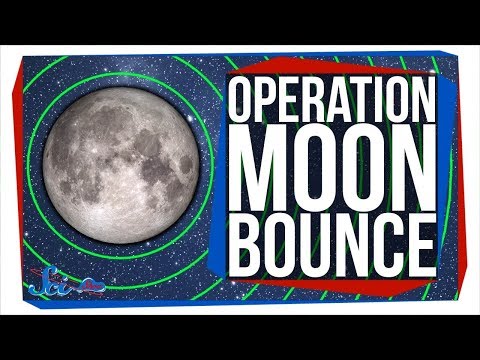
That led to a project from the U.S. Naval Research Laboratory called Operation Moon Bounce.
It didn’t involve any giant, inflatable bounce houses, but it did involve bouncing
radio signals off the Moon, which is almost as fun.
To test out the idea, the Navy built a pair of specialized antennas, one in Maryland and
one in California.
And in 1955, they sent the first successful transcontinental satellite communication by
bouncing a signal off the Moon at exactly the right angle.
Since they were sending specific signals and not just trying to pick up radar from the
other side of the world, the antennas for Operation Moon Bounce only had to be a few
meters across instead of dozens of meters wide.
Within years, the program was expanded and could link Hawaii and Washington, D.C., and
soon after, it connected ground stations with special intelligence-gathering ships at sea.
In 1960, the project was debuted to the public, and the U.S. had a powerful new advantage
in the Cold War.
But as cool as this was, the Moon’s role was short-lived.
Within a few years, the first artificial communications satellites were in orbit, which let you use
much simpler equipment to send a message — something small enough to be carried by one person,
as opposed to an antenna dish the size of a house.
But the project taught us a lot about satellite communication, knowledge that’s still useful today.
Even though we don’t reflect our messages off the Moon anymore, the legacy of Operation Moon Bounce lives on.
Thanks for watching this episode of SciShow Space!
Using the moon to spy on the Soviet Union didn’t work out, but there have been plenty
of other successful spy satellites over the years.
And if you’d like to learn more, you can watch our episode where we tell you all about them.
Why Is That Baby Staring at Me? Why Does the Earth's Magnetic Field Keep Flipping? What Really Happened the First Time We Split a Heavy Atom in Half How Folding Paper Can Get You to the Moon A New Binary Asteroid (That's Also a Comet!) The Fiery, Pitch-Black Egg-Planet Is Quantum Tunneling Faster than Light? | Space Time | PBS Digital Studios Why Russia Did Not Put a Man on the Moon - The Secret Soviet Moon Rocket What If We Detonated a Nuclear Bomb on the Moon? Wringing out a Water Soaked Washcloth in Space | CSA Science HD Video
Facebook
Twitter
Google Plus
SciShow Space
Latest Posts