-->
≡
Home
Woman
Sport
Business
Health
Privacy Policy
Contact Us
Contact Us
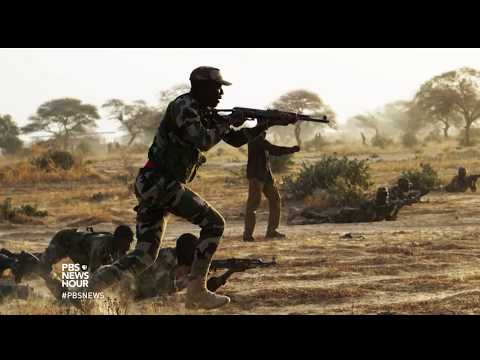
U.S. soldiers were ambushed in Niger. Here's what American forces are doing there
:
:
2017-10-06T01:15:56Z
Friday, 6 Oct 2017 - 01:15 AM
JUDY WOODRUFF: Three U.S. special forces soldiers were killed and two more injured yesterday
while on a training mission with the military of Niger. The soldiers were Green Berets reportedly
caught in an ambush near the village of Tongo Tongo, not far from the Malian border.
Al-Qaida and Islamic State militants are active in that area. U.S. and French commandos have
been training and in some cases fighting alongside local forces around the region.
Joining me for more on the fight against Islamic militants in this part of Africa is Peter
Pham. He's the director of the Atlantic Council's Africa Program.
Peter, welcome back to the program.
We were just talking about this is the first set of U.S. casualties in this region. Tell
us about the mission there. What are the U.S. troops and their allies doing?
J. PETER PHAM, Atlantic Council: Well, we have for several years now had varying numbers,
low several hundreds, U.S. personnel in Niger doing two things primarily, one, operating
a drone base in Niamey, the capital of Niger, and building another drone base in Agadez,
in the center of the country, which will be able to reach surveillance into Mali and Southern
Libya.
And the other mission has been training the Nigerian forces to stand up and fight these
militants, as you mentioned, from both al-Qaida-linked groups and Islamic State-linked groups that
have been crossing in this region and increasingly carrying out violent attacks.
JUDY WOODRUFF: So they are there because -- who are they? Who is the enemy there?
J. PETER PHAM: Well, there are a -- a nation of various Islamic extremists, roughly in
two broad coalitions, one that was announced just this past March that is calling itself
the Group for the Support of Islam and Muslims, GSIM, in the region, which is made up of al-Qaida-linked
groups, including those linked with the ethnic Tuareg, with ethnic Fula or Fulani, as well
as former members of the Al-Mourabitoun, which is Mokhtar Belmokhtar's group, as well as
members of al-Qaida in the Islamic Maghreb's Sahara battalion.
And on the other side, we have this group that is calling itself Islamic State Greater
Sahara, which was approved last year by the so-called caliph of the Islamic State.
JUDY WOODRUFF: And you were just telling me the more active these groups have become,
these various Islamic groups and others have become, there has been more competition.
J. PETER PHAM: There has been, each seeking to be the more lethal, the more dangerous,
the one to join, to attract both recruits and resources.
And, in fact, the leadership of both groups, al-Qaida and the Islamic State, have withheld
approval of the local affiliates until they have shown themselves -- for example, the
Islamic State affiliates were not approved until after the attacks in Burkina Faso last
year, for example.
JUDY WOODRUFF: So, specifically, what are the U.S. troops -- and we were talking French
troops there as well -- what are they doing? They are training, but they are doing more
than that.
J. PETER PHAM: The primary mission is training.
The Nigerian troops in Niger -- and, of course, the French have a large training and antiterrorism
mission across the region, but very active in Mali as well. And so it's a training mission,
but it's also providing ISR, intelligence, surveillance and reconnaissance, to the allied
governments in the region as well.
But, primarily, it's training. There -- certainly, when you are out training with these allies,
there will be occasions where you enter into kinetic operations with them, but that is
not the primary focus.
JUDY WOODRUFF: When they're -- and we see now what happens when they do get out there.
But we know there is a drone base in that area, which is I think what you are referring
to.
J. PETER PHAM: Yes, there is a drone base in Niamey, the capital of Niger, and one that
is almost complete in Agadez in the center of the country.
But in the training, they have built up, for example, a Nigerian unit, the BSR, the security
and intelligence battalion, which has become very, very effective. And this was the unit
that we understand was out there with the special operations forces that were attacked.
JUDY WOODRUFF: Is this viewed as a successful mission, and is it believed that there are
going to be more U.S. troops going there?
J. PETER PHAM: Well, it's been successful, as far as we have stood up local partners
who are now beginning to take the fight out. That's the success.
But this is something that the international community has to invest in building up the
capacity of the countries in the region. Recently, during the United Nations General Assembly,
Secretary-General Guterres convened a meeting of the presidents of the region, plus other
international partners, to look for ways to better integrate.
The area where this attack took place, Tongo Tongo, actually was perhaps the site of the
attack because it's the tri-border region of Mali, Burkina Faso, and Niger. And these
militants use these borders, fluid borders, moving easily to stay one step ahead of forces
pursuing them.
JUDY WOODRUFF: And this is one time when it certainly ended in tragedy for the U.S. forces
and others.
Peter Pham, we thank you very much.
J. PETER PHAM: Thank you.
PBS NewsHour full episode, October 5, 2017 Taliban Takes Shots At US Soldiers And Gets A Proper Reply PBS NewsHour full episode Oct. 5, 2017 3 US Green Berets killed in ambush in Niger Three American Soldiers Killed In Suspected Niger Ambush | NBC Nightly News Lives lost in Las Vegas, remembered by loved ones Afghanistan War - US Soldiers in Heavy Combat Action During Taliban Ambush Las Vegas massacre puts security concerns front and center The deadlines, program lapses and other pressing issues facing Congress right now Report: Russia hacked NSA documents with aid from antivirus software
Facebook
Twitter
Google Plus
PBS NewsHour
Latest Posts