-->
≡
Home
Woman
Sport
Business
Health
Privacy Policy
Contact Us
Contact Us
Armed with tough computer chips, it's time to return to the hell of Venus
:
:
2017-11-22T14:36:24Z
Wednesday, 22 Nov 2017 - 02:36 PM
Venus is Earth’s nearest neighbor.
It is closest to Earth in size and composition.
Yet something clearly went awry.
Its atmosphere is almost entirely carbon dioxide.
Surface temperatures are a scorching
460 degrees Celsius -- hot enough to melt lead.
Pressures are 90 bar --
as crushing as being 1 kilometer deep in the ocean.
Understanding how Venus’s atmosphere
turned into a runaway greenhouse,
boiling away any oceans and baking the surface,
could help astronomers studying other solar systems.
They could distinguish truly Earth-like exoplanets
from evil twins like Venus.
Until recently, Venus’ treacherous surface conditions
made the idea of an extended stay
on the planet a far off dream.
In the 1970s and 1980s,
the Soviet Union hurled mission after mission
into the planet’s inferno
But none survived more than a couple hours.
Under soaring temperatures, silicon,
the backbone of modern electronics,
loses its semiconductor behavior.
Transistors stop working.
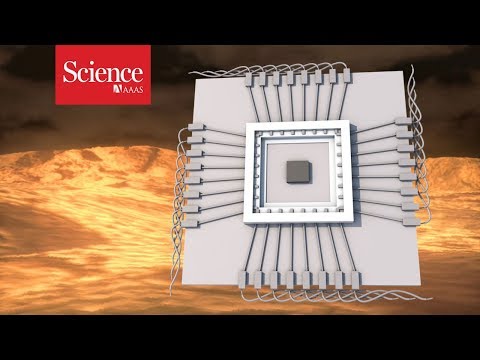
Now, researchers are developing microchips
made of silicon carbide, which can function
at much higher temperatures.
They have not been able to put billions of transistors
on a single chip, as in conventional electronics.
But even with hundreds of transistors,
the chips rival the capabilities of computers
from the early days of solar system exploration.
To test the endurance of these chips,
researchers used NASA’s GEER,
the Glenn Extreme Environments Rig.
GEER is a pressurized chamber the size of a minivan
and weighing in at 14 tons.
It can simulate the temperatures
and pressures of Venus’s surface.
It can also mix in eight different gases
to create a Venus-like atmosphere.
Recently, researchers tested
silicon carbide chips inside GEER.
They functioned well during a 60-day test,
an ordeal that may have changed
the course of Venus exploration.
Rather than hiding electronics in heavy,
refrigerated pressure vessels, researchers hope that by
early next decade NASA may be able to land
simple unprotected robots on Venus’s surface.
And instead of running for a few hours,
the landers could last for months, giving us a
glimpse of Venus’s surface
never before thought possible.
One big question they could help with:
Is Venus geologically dead or alive?
Many researchers think that
some 500 million years ago,
a catastrophic event covered the
planet’s surface in magma
and wiped it clean -- but that Venus
has been pretty much dead ever since.
But in recent years,
measurements from orbit have detected spikes
in volcanic gases such as sulfur dioxide.
And some volcanoes, thought to be dormant,
have been found to be abnormally warm -- signs
that Venus might not be as inactive as we thought.
There is, unfortunately, still a long way to go
until we touch down on Venus’ surface,
but when we do, these resilient electronics
will be crucial in allowing our robots to take the heat.
A surfer and a scientist teamed up to create the perfect wave Aluminum and Mercury Satellite Detects MASSIVE Object Under Antarctica 12/27/16 This is Mars 2017 World's first images of dogs—and they're wearing leashes Everything you ever wanted to know about perovskite Monster magnet meets magnetic fluid... Cesium - The most ACTIVE metal on EARTH! How a CPU is made 10 Things You Never Knew About The Earth
Facebook
Twitter
Google Plus
Science Magazine
Latest Posts