-->
≡
Home
Woman
Sport
Business
Health
Privacy Policy
Contact Us
Contact Us
How Suicidal Tendencies Spread Through Families and Classrooms
:
:
2017-11-16T13:37:07Z
Thursday, 16 Nov 2017 - 01:37 PM
So we focus attention on some of the behaviors on the very dark side of the spectrum of hopefulness
and optimism, which is suicidal behaviors.
When we dug into that literature, we saw the importance of suicide as a cause of death
for young people, and for teenagers it’s the number two cause of death for, I think,
ages 15 to 19 in the United States.
A lot of the scholarship that’s focused on suicide has focused on individual risk
factors—both genetics and the presence of physical and emotional pain—and what we
wanted to do is think a little bit broader about social contagion and social processes
related to suicide.
Processes of social contagion and suicide have also been understudied because social
contagion and social processes for adolescent suicide often come up in the news when a celebrity
commits suicide, and there are public policies for the media not to report celebrity suicides
in order to not have spikes of adolescents committing suicide as copycatting.
More recently the media has being trained that if there is a celebrity suicide to report
the story but also report hotlines and information for adolescents who are feeling the same way.
So there’s a lot of public policy interest in the potential for contagion and suicide.
So we focused some attention on that in our study, too.
So what we did was we surveyed data that had information on suicide, and to think about
social processes, we found data that had not just your own suicidal attempts or suicidality
but also whether or not family members had recently committed suicide.
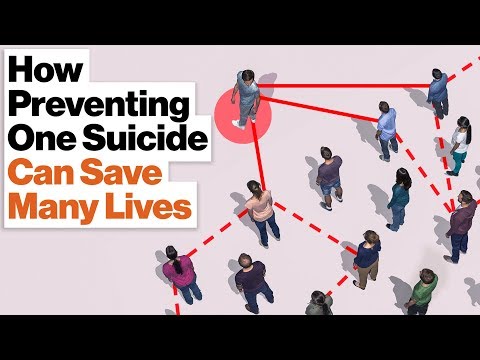
And our thinking was in order to trace a social process we wanted to see, in some sense, patient
zero—which would be a family member having committed suicide—and then trace that through
an adolescent social network.
So we measured family suicides that occurred in a previous year.
We examined the impact on the adolescents in the families that had family suicides,
but then we pivoted and asked the question: do those family processes spill over into
the classroom?
So we examined the impact of having a classmate who had a family member commit suicide in
the last year.
And, again, we found very large effects that seemed to work through having a classmate’s
family member commit suicide, affecting the classmate him or herself, it then spills over
into the classroom on the suicidal behaviors of those who are not directly affected.
And the other surprising finding in that study was that these pathways between a family member
committing suicide, an adolescent increasing their suicidality and then spilling over into
the classroom is that that process only follows gender lines, meaning that if I’m a female
student in a classroom it only matters to me whether females in my classroom had family
members who’ve committed suicide.
Having males in my classroom who had family members commit suicide does not affect my
suicidality.
So it’s a very intriguing and surprising finding.
It says something both on the potential for spillovers for contagion in suicide but also
that it’s a little bit more complicated because once it moves into the classroom I
think these suicide contagions take advantage of preexisting networks where girls are friends
with girls and boys are friends with boys inside classrooms, and when a bad thing happens
to a classmate’s family then that news and those effects seem to travel on gender-specific
lines.
And similar to the child abuse examination where we found that family members or family
processes spilled into the classroom, there’s a policy implication here that successful
suicide prevention programs have this potential for spilling over on people who aren’t treated
themselves or who aren’t intervened on themselves.
If you can successfully prevent a suicide in a family member that actually reduces the
likelihood of a suicide attempt in both the adolescent in the family but also the adolescent’s
classmates.
So again this has the possibility of a larger bang for your buck where you spend money to
reduce suicide or spend money to prevent suicide in a single family but you gain the benefits
of both the family and the classmates of the family.
Strengthen Your Mind Like a Navy SEAL | David Goggins suicide How to Regenerate the Human Body: Hearing Loss, Baldness, Burn Wounds | Chris Loose Why Can't We Find the Theory of Everything? Einstein, Rogue Genius, String Theory | Eric Weinstein 25 Psychological TRICKS That Really Do WORK Bill Gates' Wealth Visualized & 1,000,000 Subscriber Announcement Richard Dawkins Teaching Evolution to Religious Students How Social Media Makes Us Angry All the Time | Molly Crockett 8 Signs of a Toxic Friendship | Sharon Livingston | TEDxWilmingtonWomen Getting stuck in the negatives (and how to get unstuck) | Alison Ledgerwood | TEDxUCDavis
Facebook
Twitter
Google Plus
Big Think
Latest Posts