-->
≡
Home
Woman
Sport
Business
Health
Privacy Policy
Contact Us
Contact Us
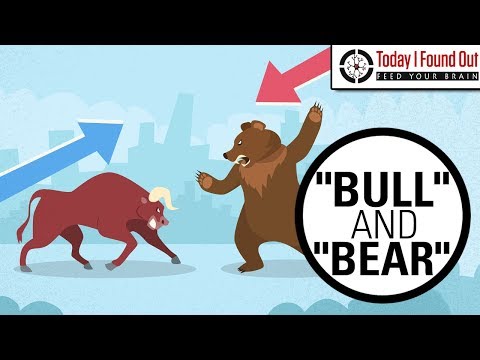
Why are Bull and Bear Markets Called That?
:
:
2017-11-18T18:38:59Z
Saturday, 18 Nov 2017 - 06:38 PM
For those who don’t know, a “bear” market, or when someone is being “bearish” in
this context, is marked by investors being very conservative and pessimistic, resulting
in a declining market generally marked by the mass selling off of stock.
A “bull” market is simply the opposite of that, with investors being aggressive and
positive, with stock prices rising as a result of this optimism.
This “bull” and “bear” terminology first popped up in the 18th century in England.
There are a couple different possible sources for the “bear” part of this tandem, but
the leading theory is that it derived from an old 16th century proverb: “selling the
bear’s skin before one has caught the bear” or alternatively, “Don’t sell the bear’s
skin before you’ve killed him,” equivalent to, “Don’t count your eggs before they’re
hatched.”
By the early 18th century, when people in the stock world would sell something they
didn’t yet own (in hopes of turning a profit by eventually being able to buy the thing
at a cheaper rate than they sold it, before delivery was due), this gave rise to the saying
that they “sold the bearskin” and the people themselves were called “bearskin
jobbers”.
One of the earliest references of this comes from an issue of The Tatler, April 26, 1709:
Forasmuch as it is very hard to keep land in repair without ready cash, I do, out of
my personal estate, bestow the bear-skin, which I have frequently lent to several societies
about this town, to supply their necessities; I say, I give also the said bear-skin as an
immediate fund to the said citizens forever…
In a later edition, June 23, 1709, it goes on to state:
I fear the word Bear is hardly to be understood among the polite people; but I take the meaning
to be, that one who insures a real value upon an imaginary thing, is said to sell a Bear,
and is the same thing as a promise among courtiers, or a vow between lovers…
Yet another early instance of the term is in Daniel Defoe’s The Anatomy of Change
Alley, published in 1719, around the time the term was popularized to something of the
same type of definition we use today:
Those who buy Exchange Alley Bargains are styled buyers of Bear-skins.
The use of the word “bear” in this way was popularized thanks to one of the early
market bubbles known as the South Sea Bubble.
While it was a long and incredibly complex market scheme that led to the bubble, the
gist of it was that the South Sea Company, formed in 1711, was granted by Britain a monopoly
on all trade to South America and would be given an annual sum (6% interest plus expenses)
from the government.
In exchange, the new company agreed to take over large portions of the government’s
debt.
(In fact, this was primarily how the company actually made money throughout its century
and a half it was in business, simply by dealing in government debt.)
Thanks to this deal and an amazing amount of government corruption, insider trading,
and other unscrupulous practices by certain shareholders who knew well that the company’s
trade business had little hope of ever being profitable, the burgeoning company’s stock
soared.
At its peak, based on the stock price, the company was worth about £200 million (by
purchasing power, today this would be about £24 billion or $37 billion; by average earnings,
it would be £350 billion or $537 billion).
Besides the fact that they didn’t even have their first trading shipment until 1717, 6
years after the trading company first formed, one of the problems was that having an exclusive
monopoly on trading to South America from the British government at the time wasn’t
saying much as most of the region was almost entirely held by Spain, who Britain was at
war with.
Nevertheless, amid rampant and widely published rumors (deftly planted by certain stock holders
to jack up the price) of the vast wealth from gold and other resources in those regions
and the potential promise of soon securing trade rights from Spain, the stock prices
soared, even though the company itself wasn’t really doing any actual trading and their
main asset, the monopoly on trade to Middle and South America, was essentially worthless,
as the core stock holders knew well.
Spain did eventually grant the South Sea Company rights to trade in the regions held by Spain,
but only one ship load per year total was allowed in exchange for a percentage of the
profits.
Needless to say, the inability to do any actual real volume of trading and the fact that war
once again broke out in 1718 between Spain and Britain causing much of the company’s
scant physical assets to be seized by Spain, the market crash that followed wasn’t pretty.
As to the “bull” name for rising markets, in this case we have to do a little more speculation
as the documented evidence just isn’t there.
The leading theory is that it came about as a direct result of the term “bear”.
Specifically, the first known instance of the market term “bull” popped up in 1714,
shortly after the “bear” term popped up.
At the time, it was something of a common practice to bear and bull-bait.
Essentially, with bear baiting, they’d chain a bear (or bears) up in an arena, and then
set some other animals to attack the bear(s) (usually dogs) as a form of entertainment
for spectators seated in the arena.
While bears were one of the more popular animals to use in these games, bulls were also commonly
used.
More rarely, other animals were used such as in one instance where an ape was tied to
a pony’s back and dogs were set on them.
According to one spectator, the spectacle of the dogs tearing the pony to shreds while
the ape screamed and desperately tried to stay on the pony’s back, out of reach of
the snapping jaws of the dogs, was “very laughable”…
In any event, the popularity of bear and bull baiting, along with perhaps the association
with bulls charging, is thought to have probably been why “bull” was chosen as something
of the antithesis of a “bear”, shortly after “bear” first popped up in the stock
sense.
But, of course, we can’t be at all sure on this one as there wasn’t the more lengthy
documented progression of definition as with the “bear” term.
A common myth often put forth as to the origin of “bull” and “bear” market terminology
is that it comes from the last names of two prominent banking businesses, the Bulteels
and the Barings, the former supposedly tending to be extremely aggressive in their investments
and the latter supposedly being much more conservative.
While both the Barings bank and the Bulteel bank did in fact exist, there are a couple
problems here.
The first is that the only Bulteel bank around this era wasn’t prominent at all, certainly
not enough to spawn such a term.
Second, and more importantly, is that both the Barings bank and the Bulteel bank were
founded well after “bull” and “bear” were already common stock market terms.
Can You Really Avoid an Airline Baggage Fee by Wearing All Your Clothes? Fire Hydrant Colors Actually Mean Something What Happens if You Accidentally Damage or Destroy a Priceless Work of Art in a Museum How Do They Get Teflon to Stick to Pans? Are There Any Animals Other than Humans That Commit Suicide? Hobbs and His Locks: The Great Lock Controversy of 1851 Is There Any Cheese in Cheez Whiz? (And the Story of Kraft) Are More People Really Killed by Vending Machines Than Sharks An Endless Cycle: Taxing Blank Cassettes and Killing Music 10 Things You Didn't Know About Viking Civilization
Facebook
Twitter
Google Plus
Today I Found Out
Latest Posts