-->
≡
Home
Woman
Sport
Business
Health
Privacy Policy
Contact Us
Contact Us
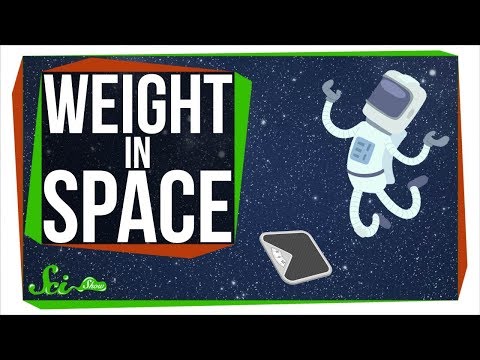
How Do You Weigh Things in Space?
:
:
2017-12-10T16:12:36Z
Sunday, 10 Dec 2017 - 04:12 PM
On Earth, or any other body with enough gravity, we have a couple different tools to measure
how much something weighs.
There are balancing scales, like you might stand on at a doctor’s office, or spring
scales, like the ones you might use to weigh fruit in a grocery store.
Now, astronauts need to know their mass to log things like bone density, muscle loss,
and other data points for human research experiments.
But, in orbit, a normal scale would be free-falling around the Earth with them.
So how do they measure their mass without gravity?
Every accelerating object with mass exerts a force—that’s Isaac Newton's second law of motion.
And weight is the force an object exerts due to gravitational acceleration, like what we
feel here on Earth.
It’s basically a measure of how much the gravity of the planet pulls on objects.
But when people are in orbit, like aboard the International Space Station, their forward
motion is fast enough that when gravity pulls them down, they fall around the curve of the planet.
So because astronauts and cosmonauts are in this constant “free-fall” environment,
they don’t actually weigh anything at all.
But they still have mass.
And even though Earthly scales won’t work, they can measure that mass using Newton’s
second law—with the help of springs.
NASA developed a device called the Space Linear Acceleration Mass Measurement Device, or SLAMMD for short.
It uses a spring that pulls an astronaut less than a meter.
The spring has a known spring constant, which is just a measure of how “springy” it is.
Plus, a very accurate camera measures the acceleration of the astronaut as they get
tugged along.
Basically, the more massive a person is, the slower they’ll be pulled.
And because the springiness and distance are constant, astronauts can use those numbers
and their acceleration to calculate their mass.
Russian researchers, on the other hand, developed a machine called the Body Mass Measurement
Device, or the BMMD.
No cool acronym for this one.
This system has a similar setup.
But instead of measuring acceleration with a camera, the BMMD measures the number of
oscillations per second, or frequency, of a compressed spring that’s released with
an astronaut attached to one end.
It kinda looks like a microgravity version of a pogo stick.
Just like SLAMMD, the more massive the person, the slower the spring oscillates.
And because the spring constant stays the same, astronauts can figure out their mass
using the measured oscillation.
So no matter which device they choose, they’ll get a pretty accurate mass measurement, and
that’s what really matters for science.
Thanks to our Patreon patron Peter for asking this question!
And thanks to all of our patrons, because your support lets us make all these videos.
If you’d like to submit a question, you can go to patreon.com/scishow.
And don’t forget to go to youtube.com/scishow and subscribe!
Why Are Some World Records So Hard to Break? Why Don't Fire Hydrants Freeze and Explode? How do spacecraft navigate in space ? This Is Not What Space Looks Like How Restaurants Use Psychology to Make You Spend More Money 4 Buildings Too Awesome to Be Real (For Now) 9 of the Most Abundant Animals on Earth How Recycling Works Why Getting Sick in Space Is the Worst Why Can't You Bring Mercury Thermometers on Planes?
Facebook
Twitter
Google Plus
SciShow
Latest Posts