-->
≡
Home
Woman
Sport
Business
Health
Privacy Policy
Contact Us
Contact Us
SMALLEST Animals That Can Actually KILL You!
:
:
2017-12-10T16:17:28Z
Sunday, 10 Dec 2017 - 04:17 PM
From a tiny, little octopus, to a huge swarm of ants, here are 10 of the smallest animals
that can actually kill you!
10.
Lonomia Caterpillar
The Lonomia Obliqua is the world’s deadliest caterpillar, and just simply touching one
can result in the end of your life.
They grow to about 5 cm long and can be found in the rainforests of South America.
In adulthood they turn into a species of Saturniid moth, but it’s during their larval form
that you need to watch out!
They are the cause of a number of deaths each year in Brazil, mainly because they camouflage
so well into their surroundings, and have an ingenious defence mechanism.
The urticating bristles along their entire bodies are sharp, and inject venom into any
creature that touches it, whether on purpose or by accident.
The toxin is, effectively, an anti-coagulant that causes internal bleeding, renal failure,
and all kinds of other stuff.
Touching multiple caterpillars will magnify the effect and most likely result in death,
with no effective treatment available.
It’s not all bad with the lonomia caterpillar, though, as their venom is being researched
as a potential anticoagulant to be used to prevent life threatening blood clots.
Perhaps one day they can help save more people than they kill, but until then you should
be very careful next time you’re climbing a tree in Brazil.
9.
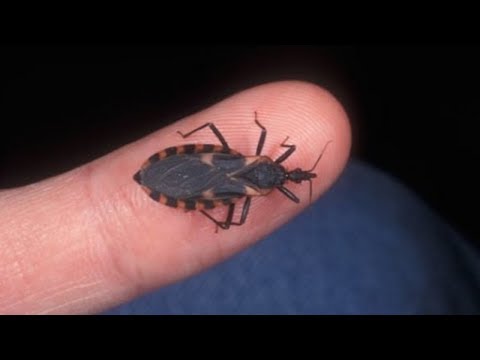
Assassin Bug
Assassin Bugs, also known as kissing bugs, get their nickname because of their fondness
of biting humans near the lips on their face.
These not-so-nice-bugs used to only be found in tropical areas in Central America, but,
as a result of the warming climate, they are now found all across the bottom two thirds
of the US- being quite common in Arizona, California, Texas and New Mexico.
The bugs can be either brown or black, and sometimes have red dots on either side of
their back.
Kissing bugs love to suck blood during the night.
While they aren’t dangerous to humans by themselves, the real danger of the Assassin
Bug comes from a parasite they can carry that causes Chagas disease.
These parasites are present in the bug’s faeces, which they typically will leave near
anyone they have bitten, so if you happen to wipe your bite after this has happened,
it’s possible to introduce them into your bloodstream.
It is difficult to tell if you have been infected with the Chagas disease because its symptoms
at first, are similar to a cold.
Chagas disease can shut down your major organs and can be fatal, even decades after you are
first infected.
It is very destructive on the heart muscle and surrounding nervous system so if you see
one, never touch it with your bare hand.
And now for number 8, but first be sure to subscribe and click the bell to join our notification
squad!
8.
Freshwater Snails
While they may seem harmless enough, and are often present in home aquariums, the freshwater
snail is thought to be responsible for more than 200,000 deaths worldwide every year due
to a parasitic disease that they carry, called Schistosomiasis.
It’s one of the deadliest parasites there is, and infects more than 250 million people
a year- mainly across Asia, Africa, and South America.
The parasitic worms leave the snails in bodies of water, and if you happen to be swimming
in the area at the time, they can simply pass through your skin and into your bloodstream.
It’s not actually the worms that will kill you, though, but their eggs.
Their lifecycle requires them to return to the snails to mature, and while they’re
in your body they latch onto tissue with sharp barbs.
They therefore can result in a wide range of symptoms such as tiredness and anaemia-
and in 10% of chronic cases, death.
It used to be a real problem in Japan until, in the 1970’s, they began a program to reduce
the snail's’ habitat and aggressively treat anyone with symptoms.
There are now far fewer freshwater snails in the country and, because of the two-pronged
approach, infections are very uncommon.
This shows it’s a disease that can be brought under control, but it takes huge resources
to do so.
7.
Tsetse Fly
Tsetse Flies are another species that don’t directly kill you, but can transmit a deadly
disease that will be fatal if left untreated.
They are an incredibly old species, with 34 million-year-old fossils found in the fossil
beds of Colorado, and nowadays are mainly found across the African continent below the
Sahara.
Very similar to house flies in appearance, they feed on the blood of vertebrates, and
in doing so can transmit parasites that cause Sleeping Sickness.
During the first stages of this fever, an infected person can experience fevers, headaches,
itchiness and joint pains, which will begin within three weeks of a bite.
This then progresses to the second stage, with symptoms such as confusion, difficulty
sleeping, numbness and poor coordination.
If Sleeping Sickness is left untreated, it will usually end in the death of the host
after the second stage.
In 1990, before treatments were developed, it was thought to have killed more than 34,000
people.
With the introduction of medications, it’s now thought to be responsible for 3,500 deaths
per year across Africa, which makes it one of the deadliest killers.
6.
Blue Ringed Octopus
The Blue Ringed Octopus lives on coral reefs across the Pacific and Indian oceans, but
don’t let their beauty fool you- they can be incredibly dangerous to humans.
They usually wait around for small animals, like crabs and shrimp, that stand no chance
against their venom, but it is equally as deadly to any human that comes in contact
with it.
Despite their tiny size, no more than a small pencil, they are considered to be one of the
most venomous creatures on the planet due to the presence of the potent neurotoxin,
tetrodotoxin.
You’ll know if you’ve accidentally picked up a blue ringed octopus, because they will
immediately change colour, but by that point it’ll be too late.
The venom is delivered through a tiny nip of the parrot-like beak, which is virtually
undetectable by a human.
10 minutes later you’ll begin to notice the effects.
The toxin is 1,200 times more powerful than cyanide, and you’ll start to notice your
lips and the tips of your fingers going numb.
The venom works by paralyzing the victim very quickly, and you will remain conscious but
completely unable to call or signal for help.
Your body is able to filter the toxin out and recover, but during the stage of paralysis
you will likely need assistance with breathing.
The first 24 hours are crucial.
If you survive them, then you are likely to get through it, but you must have immediate
medical assistance.
If not, well...you know.
5.
Maricopa Harvester Ant
Maricopa harvester ants are the most venomous insects in the world, and if you’re unfortunate
enough to encounter a lot of them, it won’t end well.
They are found across most of Arizona, and spend virtually their entire lives in desert
areas.
These large ants grow to about 3 cm long and can build huge nests up to 10m (30 ft) in
diameter and 2m (6 ft) high.
The ants’ venom contains amino acids, peptides and proteins, and is 20 times as strong as
that of a honeybee.
If a human is stung, the pain will last for up to four hours, but the real danger with
this ant is their ability to swarm.
One of the unique features of their venom is that it contains an alkaline poison that
signals ALL nearby ants.
One single insect will continue biting a target as many times as it can by attaching itself
with its mandibles and moving around to bite different parts.
When more join in the fray, things can get serious, and fast.
They will kill a rat with about 12 stings, and a 150 pound human with as little as 350
stings.
While this may sound like a lot, it’s completely feasible if you find yourself close to a nest
or unfortunate enough to be surrounded by hundreds of them.
In Phoenix, Arizona, residents are often concerned about keeping deadly scorpions out of their
homes, but the maricopa harvester ants are equally as dangerous as the scorpions, and
need to be removed as soon as they are discovered to prevent any loss of life.
4.
Poison Dart Frog
Poison dart frogs are some of the most beautiful, but deadly animals in the world.
Their bright colors are their way of warning predators of their poison, and it sure packs
a punch.
The various species are found across South America, from Costa Rica to Brazil in a wide
variety of colours.
Some of the species are the most toxic you’ll find anywhere.
The 5cm (2 inch) long golden dart frog, for example, has enough poison to kill 10 adults,
and the indigenous tribes have used it to tip their blowgun darts for centuries, hence
the name the ‘dart frog’.
Interestingly, no one is entirely sure where the frogs get their poison from.
It’s thought to be assimilated into their bodies after eating prey that has consumed
poisonous plants.
Dart frogs that are raised in captivity don’t develop any poison, so it isn’t a naturally
occurring toxin.
Nevertheless, you’re only likely to encounter them in the wild so, if you do, you’d best
stay clear and by no means try to grab it!
3.
Indian Red Scorpion
The Indian Red Scorpion is, by far, the deadliest scorpion in the world.
They are found across India, Pakistan, and Nepal, where they prove to be a serious health
hazard to local communities.
Growing up to 90mm long, they can hide in the smallest of spaces, and the majority of
their victims are children.
Once stung, the venom affects the cardiovascular and pulmonary system, which can cause severe
problems in young people.
Symptoms include pain, sweating, vomiting, unconsciousness, breathlessness and shock,
amongst others, and there’s thought to be a fatality rate of up to 40% if left untreated
within 72 hours of being stung.
12 children died in 2011 as a result of their stings, and this represents an unusually high
yearly tally.
Luckily, these scorpions are relatively rare, so there aren’t a large amount of deaths
per year.
2.
Mosquito
Mosquito’s are, quite simply, one of the most dangerous animals on earth, and are responsible
for an estimated million human deaths per year.
Again, this isn’t because of the bite itself, but because of the parasites that they can
transmit in the process.
The males of the species feed on fruit, but the females need to drink blood to produce
eggs.
There are over 3,000 different species of mosquito, but the most important statistic
about these creatures is the fact that they carry at least 7 of the most deadly infections
that humans can contract: Malaria, Yellow Fever, Chikungunya, West Nile Virus, Dengue
Fever, Filariasis, and Zika Virus.
There have been a number of methods suggested to help control the numbers of mosquitoes
and, as a result, prevent the spread of diseases; but they only have limited effects.
They breed in areas with stagnant water, so mass drainage and spraying can help to reduce
numbers, but they are such resilient things and always manage to find a way to survive.
It’s perhaps not a surprise, considering they have been around for at least 80 million
years- meaning it’s likely that they’ll remain around for far longer than us, and
the best we can do is find out ways to mitigate the harm that they cause.
1.
Irukandji Jellyfish
Growing to a maximum size of only 2.5 cm, they were only recently discovered- but have
quickly gained the reputation of being the most venomous animal in the world.
For years, Irukandji syndrome, now known to be caused by the sting of this jellyfish,
would kill people without anyone understanding what was happening.
It was only in 1964 that the true culprit was identified.
There are actually 16 different species of Irukandji that are found in the waters of
Australia, and they all have an unusual feature for jellies- their stingers are on the bell
as well as the tentacles.
The stings are more than 100 as strong as a bite from a cobra, and 1,000 times stronger
than that of a tarantula.
They are responsible for up to 100 people going to the hospital each year, with the
death toll being dictated by how soon antivenom is able to be administered.
Luckily there’s only a relatively small coastal area where these jellies are found,
because if they were present in somewhere more populated they would have a devastating
impact.
Thanks for watching and be careful of tiny creatures!
Remember to subscribe and I’ll see you next time!
Byeeeee
DEADLIEST Creatures Of The Amazon! Most MYSTERIOUS People Finally IDENTIFIED! Most Mysterious Unexplained Airplane Incidents! 75 RARE HISTORIAL IMAGES YOU HAVE TO SEE BEFORE YOU DIE Places on Earth No Human Has Set Foot On 18 Most Shocking Real Mutations In Animals 10 SMALLEST ANIMALS That Can Kill You | Interesting Facts Most BIZARRE Discoveries Found In Drained Water! 14 Ocean's Deadliest Creatures Most MYSTERIOUS Things Found In The Jungle!
Facebook
Twitter
Google Plus
Origins Explained
Latest Posts