-->
≡
Home
Woman
Sport
Business
Health
Privacy Policy
Contact Us
Contact Us
Explorer 1: First U.S. Satellite
:
:
2018-01-25T00:53:56Z
Thursday, 25 Jan 2018 - 12:53 AM
(fanfare music)
[TEXT: 60th Anniversary Explorer 1]
[TEXT:The beginning of the US space program
- [Narrator] Today, a new moon is in the sky,
a 23-inch metal sphere placed in orbit by a Russian rocket.
- [Narrator] The reaction was one of astonishment
and concern, for it was now known
that a potential enemy was at least temporarily ahead
in developing means for space travel.
- [Narrator] President Eisenhower reassures the nation
that Russia's success with the first satellite
does not indicate a serious lag in American rocket research.
- [Narrator] The morning of November 8th, 1957,
at Huntsville, Alabama, a sudden meeting has been called
by General John B. Medaris, commanding general
of the Army Ballistic Missile Agency.
- I promised the secretary of the Army
that we would be ready in 90 days or less.
- [Narrator] All at once, Americans were interested
in the oncoming age of space.
And with the curiosity came a mounting swelling demand
to get a satellite into the air on the double.
But there were disappointments.
- [Narrator] Another setback for the United States,
a loss of thrust and fall back to Earth in split second.
(loud rumbling)
- [Narrator] But meanwhile, far across the country
at the Jet Propulsion Laboratory,
a sprawling 80-acre research and development complex
in Pasadena, California, scientists and engineers
were racing toward the same deadline,
90 days to put a satellite into orbit.
- The Army is requesting the Jet Propulsion Laboratory
to provide the following programs: first, the additional
high-speed propulsion systems required;
second, the orbiting missile or satellite;
and third, the necessary instrumentation
to record and transmit the scientific data
assigned to this experiment.
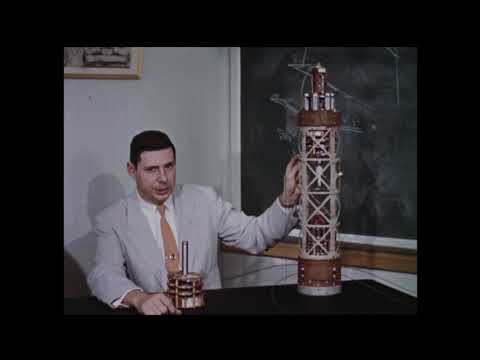
- This assembly, which is the actual payload
for the satellite, contains both transmitters,
the necessary circuits for the impact microphone
which will detect the collisions with meteorite particles,
and a Geiger counter to measure cosmic ray intensity.
(dramatic music)
- [Narrator] At Cape Canaveral, Florida,
the Army's Jupiter-C rocket is readied
for America's second attempt to launch a space satellite.
The hours-long countdown approaches zero,
a moment of enormous tension,
for every missile launching is still an experiment.
Any one of tens of thousands of things can go wrong,
with catastrophic results.
But all that can be done to ensure perfection has been done.
The moment is at hand, the countdown reaches zero.
(loud rumbling)
Some three minutes later, Explorer is in orbit,
broadcasting to the world its coded scientific data.
This close-up of the United State's edition of Sputnik
was made at a press conference
with leaders of the scientific teams:
Dr. Werner von Braun, Dr. James Van Allen,
and Dr. William Pickering, a three-way collaboration
between private industry,
academic science and the military.
Cosmic ray intensity, meteor impact, solar radiation,
these are the dry facts that will help carry man
ever farther into the age of space.
How the US Launched Its First Satellite This is Mars 2018, Curiosity Rover Life of Refugees in Europe And America Documentary 2018 Poverty in America Documentary 2017 U.S. announces new sanctions over North Korean weapons programs Explorer One Internet FAMOUS Pets Landing on MARS - Can we live on MARS? - HD Documentary The Debate - Sessions first member of Trump’s Cabinet to be questioned in Russia probe Northwest Passage: "Coast Guard Cutters Around the Continent" 1957 US Coast Guard
Facebook
Twitter
Google Plus
NASA Jet Propulsion Laboratory
Latest Posts