-->
≡
Home
Woman
Sport
Business
Health
Privacy Policy
Contact Us
Contact Us
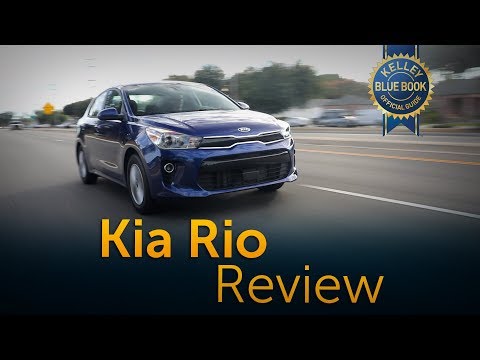
2018 Kia Rio – Review & Road Test
:
:
2018-03-19T15:47:38Z
Monday, 19 Mar 2018 - 03:47 PM
Watch the video
click to begin
Youtube
As a spoiled automotive journalists I drive a lot of fancy cars. The Kia Rio is
not one of them. The subcompact Rio isn't filled with dazzling features, doesn't
inspire envy in strangers, and it's not a pioneer of automotive technology. But
it is cheap transportation. Judged as such how does the Rio stack up? Much
better than you'd think. To start, it drives surprisingly well.
Moving at a brisk pace, vague on-center field means frequent steering
corrections at higher speeds. But at slower speeds or when cornering the
steering provides decent feedback and just the right amount of resistance...
sound effects included. For a subcompact, ride quality is good. The Rio's handling
abilities are well within the scope of acceptability for all but the most
obnoxiously scrutinizing drivers. See she totally pushes at the limit.
The Rio's 1.6-liter engine produces more noise than acceleration but around town
it moves just fine and I'm not filled with fear when merging on the freeway,
which is good because I need my fear for things like killer bees and the fourth
season the Fuller House. Given its modest power you might expect stellar fuel economy
from the Rio. It is efficient but not amazingly so, landing mid-pack among sub-compacts.
For perspective, the mid-sized Toyota Camry L trim is actually more
efficient than the Rio according to the EPA.
Strange, huh? Like most value-priced cars the Kia Rio can be loud on the freeway,
especially around the windshield region but the noise is never overwhelming.
Beyond that, the Rio's small size makes parking easy, the brakes deliver
surprisingly good bite and feedback, the automatic transmission shifts
competently responding to throttle inputs without delay, and the driver
enjoys clear sight lines in all directions. Focus your attention inward
and the hard plastic-clad cabin sports a simple, hip, pleasing design. Put another
way, though inexpensive, the Rio doesn't visually torment you with its cheapness.
Up front, comparative spaciousness and a generally comfortable driving position
make the Rio a more than agreeable commuter. I'm commuting. Wow! As you
probably guessed the rear seats are less welcoming. My head and knees barely clear
but they do clear. Thankfully there's enough space under the front seat that
my feet do not feel cramped and the seat back is comfortably soft. As an average
American male, I dub the Rio's rear quarters 100% inhabitable.
Okay, the middle spot is less inhabitable and cramming three aboard is just a bad
idea but once more, for the price, this ain't half bad. Same deal with the trunk.
For a subcompact, 13.7 cubic feet is good but what's more impressive is how it's
finished. Oftentimes car makers will cheap-out in this area but the plastics
and the materials all feel pretty good. Primo trunk n'. For more serious cargo
hauling choose the Rio hatchback, which offers superior cargo volume and .6 inches
more rear seat headroom for a four hundred dollar premium versus the
sedan. For less than fifteen thousand dollars, including destination charges, a base Rio
LX includes air conditioning, six airbags, a USB port, a long 10-year/100,000-mile
powertrain warranty, and a manual transmission. Budget an extra $1,100 if
you'd like an automatic transmission on your LX or, better yet, move up from the
base trim and the automatic transmission comes standard.
Speaking of, choose the mid-level S trim or higher if you'd like 60/40 split rear
seats on the sedan. Go hatchback and folding seats are standard across the
board. The roughly $17,000 S trim also ditches old-school cranks or properly
civilized power windows and adds cruise control, Bluetooth, a backup camera, a
second USB port, and a center console with a sliding armrest. At the peak of
Rio mountain sits the EX trim with its 15 inch alloy wheels, tilt and
telescoping steering wheel, rear disc brakes, automatic emergency braking, and
excellent seven-inch touchscreen that replaces the base car's 5-inch audio
display. Once again, for a car this cheap the Rio's UVO 3 infotainment system works
great. The available Apple CarPlay and Android Auto spring to life immediately
when you connect your phone, the touchscreen is super responsive, and the
menus are essential to navigate.
Spec a Rio EX sedan with leather-accented seats and the MSRP rings in a
little less than $20,000. That's not a crazy sum but even at maximum swankiness
the Rio still doesn't include power seats or an exterior trunk release. More
critically, for just a few hundred dollars more you could buy a much
roomier, more efficient, more sophisticated Honda Civic LX with a
continuously variable transmission, adaptive cruise control, and Lane Keeping
Assist. Stick with the proper competitive set and though pricier than the Rio in
base form the Honda Fit is notably roomier and has better resale values, the
Chevy Sonic has more standard airbags, 10 to be exact, and the Toyota Yaris has
the notable claim of being a Toyota. If purchase price overshadows all the
Ford Fiesta's base MSRP lands south of $15,000, the Nissan Versa Sedan provides
elemental travel for less than $13,000, and the Mitsubishi Mirage is also a car.
Not everybody wants to drive something that's small and cheap but for those who
appreciate practicality and value a car like the Kia Rio is awesome, especially
since it consistently exceeds your expectations. Times have changed.
These days, if you want to make the practical choice it doesn't have to hurt.
2018 Subaru Outback – Review and Road Test 2018 Kia Rio Review 2018 Lincoln Navigator – Review and Road Test 2018 Lexus LS – Review and Road Test 2019 Volkswagen Jetta - 2018 Detroit Auto Show 2019 Ram 1500 - 2018 Detroit Auto Show 2018 Audi Q5 – Review and Road Test KIA RIO TEST - Fahrbericht & Review Deutsch | neuer Kia Rio 1.0 Turbo 2017 2019 Ford Mustang Bullitt - 2018 Detroit Auto Show 2018 Kia Rio Review with UVO Telematics Test - Best Value Compact Car
Facebook
Twitter
Google Plus
Latest Posts