-->
≡
Home
Woman
Sport
Business
Health
Privacy Policy
Contact Us
Contact Us
Eachine M80S Review & Flight
:
:
2018-03-22T20:01:55Z
Thursday, 22 Mar 2018 - 08:01 PM
Watch the video
click to begin
Youtube
In my neck of the woods winter is still going strong. Instead of waiting for that to pass,
let's have a look at another indoor flyer here on this channel which – I know – at
this point might as well be called "the Tiny Whoop review channel".
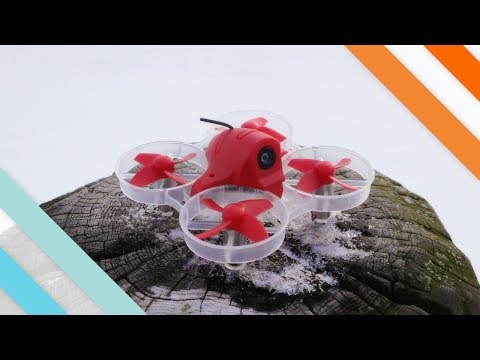
Anyway, the M80S is a recently released ducted quadcopter from Eachine. The craft is set
apart – firstly – by its bigger scale (including faster motors and bigger battery)
– secondly – by some neat features seldom seen on toy grade quadcopters.
Let's get out of the cold and have a look! Welcome to this review and flight test of
the ready-to-fly version of the M80S quadcopter from Eachine.
Like with many (if not most) Eachine products, the M80s is a blatant rip-off of an existing
model. In this case it's the Blade Inductrix FPV+, released in the fall of last year. Just
like the original it's modeled after, the M80s is bigger than your typical brushed Tiny
Whoop, adding an extra centimeter or so both to the motor-to-motor distance and the diameter
of the 4-blade propellers. In fact, in terms of size it's pretty similar to the recently
reviewed brushless Boldclash BWhoop B06. The M80S is a brushed quadcopter, albeit a
comparatively powerful one. The motors measures 8½ millimeters in diameter, compared to 6
on most brushed Tiny Whoops including the original Blade Inductrix. This does mean more
power, but you should keep in mind that the M80S also has a lot more weight to lug around.
The motors use a plug-in system to connect to the flight controller, which should make
them easy to replace. As for the FPV aspect the M80s is about as
standard as they come. You've got a wide-angle camera with 600 TV lines (or TVL) of resolution
and a 25 mW video transmitter with a dipole antenna (which should probably re-adjust
to maximize coverage). If you watched my previous video, you know I've been messing around
with on-screen display (or OSD). Sadly there is none of that here, meaning you'll get
no indication of the quad's battery level, signal strength etc. in your goggles.
Eachine sells the M80S in a number of different configurations. There's the ready-to-fly
(or RTF) version (seen here) which includes a transmitter and three bind-n-fly or (BNF)
versions which can be bound to either DSM, Flysky or Frsky compatible hobby grade transmitters.
Sadly, at the time of this review, the RTF version can't be bound to any other transmitters
and it doesn't seem like there are any ongoing efforts to reverse-engineer the protocol.
The RTF transmitter itself is of the familiar gamepad variety. It won't win any awards
for looks or originality, but is solid and well proportioned. The sticks are long and
– to me – seem to favor pinch over thumb flyers. As a thumb flyer myself, I sometimes
lose my grip of one of them and struggle to find it again quickly with my goggles on.
In case you can't learn to live with them they are removable and thereby replaceable.
On top of the choice between RTF and BNF, you also get to choose how many batteries
(1,2 or 3) you want to come with the quadcopter. Note that the batteries have a nominal voltage
of 3.8 and not 3.7 which is typical for LiPo cells. I assume these are so called high voltage
lithium polymer (or LiHV) batteries, which have been around for a while but more recently
started to gain traction. A quick google search should fill you in on the pros and cons of
this technology. Regardless of what bundle you happen decide
on, you'll also get a USB charging cable and an English instruction manual. Unlike
most manuals for toy grade quadcopters I found this one really well written, but sadly lacking
information on some key FPV aspects (like changing frequency channel and flipping the
image, which some early reviewers reported having to do). Also note that there are no
spare propellers included.
The Eachine M80S has – not one, not two,
but… – three different flight modes: First there's angle mode, the "normal"
mode of toy grade quadcopters. This mode limits maximum pitch/roll and automatically stabilizes
the craft when there's no stick input. Then there's altitude mode, which does basically
the same thing, but also automatically maintains the craft's altitude when the throttle is
centered. Finally, there's acro mode, popular among racing enthusiasts. In this mode you
control the velocity of rotation without any angle restrictions or assistive features.
Since I'm not a big fan of altitude-hold modes and haven't mastered acro flying well
enough to feel like I should comment on it, I'll focus on angle mode. In this mode,
the quadcopter flies great and the transmitter surprisingly allows for pretty good precision.
There's only one pre-defined rate, which is luckily well-measured, but this is a matter
of preference and it would have been nice with some way of adjusting the flight characteristics,
especially for acro mode I imagine. Despite the 8520 motors the quadcopter's
power is – while adequate – not extraordinary, probably because of the added weight of that
big battery. Speaking of the battery, this tends to slide around a little in the frame,
causing its weight to shift around. I found you can easily solve this by applying some
tape in order to make it thicker, which is the reason for the scuff marks you may have
noticed on the battery earlier. The M80S comes with a novel "anti-turtle"
function (or one one-key invert, as it's called in the instruction manual), which allows
you to flip over the quadcopter with the press of a button in case you happen to crash upside
down. The same feature was introduced in the Betaflight firmware not so long ago. It works
well and is pretty convenient (especially when flying with goggles), but note that it
won't work (and may even damage the motors) if the propellers are obstructed by grass
or thick carpet. As for the FPV part of the flight experience,
I haven't got much to say – positive or negative – about the M80S. This is a recording
from a pair of VR D2 diversity box goggles of the quadcopter being flown in an office
with lots of glass and concrete. There is definitely some interference, but not enough
to affect flying and not noticeably more than other similar solutions I've tested under
the same circumstances. Thanks to its higher voltage, higher capacity
battery the M80S is capable of comparatively long flights. I may not get the full 6 minutes
promised in Banggood's listing, but well over 5. The state of the battery is signaled
very clearly by a bright multi-color LED on the back of the quadcopter. It starts of green,
switches to yellow halfway or so into the flight and then red when it's time to land.
It also has colors and patterns to indicate things like loss of contact with the transmitter.
In conclusion, a lot of what the Eachine M80S does exceeded my expectations. I've mostly
been flying it in angle mode, but my experience is that the quadcopter flies well – great
even! – and both the transmitter and the flight times are surprisingly good.
On the other hand, I can also think of a couple of things it doesn't do: There's no way
of adjusting the rates in any of the flight modes, the RTF version has no support for
any alternative transmitters and there's no OSD capability, which isn't unreasonable
to expect for around $100. All in all, I'd say the M80S is a perfectly
viable option for people – especially intermediates like me curious about acro flying – shopping
around for an all-in-one indoor FPV package, but – at its current price point – maybe
not worth the cost of upgrading to from an existing build or setup.
Hey there, thanks for watching! I just thought I'd mention that while editing
I did come across a couple of reviews that criticized the quad's acro mode (and which
I don't feel I can comment on), so if you're thinking of buying this quadcopter with that
specific purpose in mind do check out some more reviews first.
Alright, see you soon in another review. Bye!
Eachine E013 "Small Pepper" Review & Flight 18 SELF-DEFENCE TIPS THAT MIGHT SAVE YOUR LIFE 21 SIMPLE LIFE HACKS TO LOOK STUNNING EVERY DAY WLToys Q333 Quadcopter Review & Flight Bayangtoys X16 (GPS version) Quadcopter Review & Flight Eachine E010C FPV Quadcopter Review & Flight KaiDeng K130 Alpha "Transforming Egg Drone" Review & Flight 5 Angels Caught On Camera Flying & Spotted In Real Life! Etihad A380 The Residence Complete Flight Review Hubsan X4 Cam Plus H107C+ Quadcopter Review & Flight
Facebook
Twitter
Google Plus
Latest Posts