-->
≡
Home
Woman
Sport
Business
Health
Privacy Policy
Contact Us
Contact Us
The ERIC Source Review and Selection Process
:
:
2018-03-29T17:39:27Z
Thursday, 29 Mar 2018 - 05:39 PM
Watch the video
click to begin
Youtube
- [Erin] Good afternoon, everyone.
I'm Erin Pollard, the Project Officer for ERIC
in the Institute of Education Sciences
in the U.S. Department of Education,
and I would like to welcome you to our webinar.
The purpose of this webinar is to help you,
our publisher community, understand what you need
to know if you would like to have your journal
or other materials indexed in ERIC.
We're going to answer questions,
such as what kinds of materials does ERIC index?
What criteria do we use
to select new sources for indexing,
and what is our process to review new sources?
We'll cover these questions and many more today
in our presentation.
Before we get started,
I have just a couple housekeeping items.
First, we muted everyone to reduce the noise
during our presentation.
If you have a question, please enter it
in the chat box on the side of your screen.
We will either work the answer into our presentation
or address it at the end in our Q&A session.
Also, we are recording this webinar,
and it'll be available for viewing
on the ERIC YouTube channel and in the multimedia page
in a few weeks.
You will be getting an email to let you know
when it's online.
We also close caption the presentation.
If you want to turn off the captioning,
please click the X by the media viewer.
Today you are going to hear from two of us
on the ERIC team, starting with me.
I'm going to be providing an introduction
of ERIC's sponsorship and mission,
and the wrap-up.
Next, I am going to turn it over
to Fern Frusti, our Content Development Lead,
who will walk you through our process to find,
review and select new sources,
and the standard and key criteria applied
when selecting sources of
education research content for ERIC.
Then we will answer questions publishers have
frequently asked, then we will open up the floor
to respond to any questions that you may have.
ERIC operates in a contract
with AEM Corporation, which is tasked
with finding education research content
to meet our Selection Policy,
creating the records, and sending them
to the Department to add to the ERIC website.
As stated in the ERIC Selection Policy,
the mission of ERIC is to provide access
to education research in a user-friendly,
timely and efficient manner.
To do this, the Department provides
an easy to search digital library
at eric.ed.gov.
The ERIC records contain bibliographic citations,
abstracts, and thesaurus terms
for education research materials
in selected journals, books, and grey literature
produced by sources such as nonprofit organizations,
centers, programs, and agencies.
The current collection has 1.7 million citations
with approximately 400,000 records
having full text freely available.
ERIC is a revenue-neutral program.
There is no charge to use the collection.
Users may view the full text attached to an ERIC record
if permission has been granted by the publisher,
or use the direct link to the publisher's website.
There is no charge to the publisher to participate,
and ERIC does not pay royalties or fees to the publisher.
Now I'd like to introduce Fern Frusti,
who's going to walk you through key elements
of the selection policy and the source review process.
- [Fern] Thank you, Erin, and good afternoon everyone.
As Erin said, I'm going to walk you through
how we review and select sources for ERIC,
but I thought it would be helpful
if I first define a few terms that we'll use
during the webinar.
Let's begin with publisher and provider.
Since ERIC indexes a variety of materials,
we occasionally distinguish publishers
of printed or digital journals and books
from providers of other non-journal material,
such as reports, conference papers,
briefs, and other grey literature.
Our journal or book publisher
may be a large commercial publisher,
or it may be a professional association
that produces its own open-access journal.
Providers tend to be report-producing associations,
agencies, centers, and other organizations.
Next is the term source.
We will be using the word source quite a bit today.
A journal source is a journal
that we reviewed and selected for regular,
ongoing indexing in ERIC.
For books, the source name is also the book publisher
or a single imprint with a focus on education research.
If we are indexing reports or other material,
we refer to the association or the center
producing the material as a non-journal source.
In most cases, the name of a non-journal provider
is also the name of the non-journal source.
Content and materials are used interchangeably.
This refers to the journal article, the book,
or the report that is indexed.
ERIC is unique in that in addition
to indexing journal articles and books,
we spend quite a bit of time
locating the more elusive grey literature
that is produced by nonprofit centers
that might be funded for only a short period of time,
and programs.
Our users know that ERIC will identify,
collect, and preserve reports, briefs,
and white papers, for example,
and make the full text available in ERIC
if permission is granted by the copyright holder.
During a review cycle, we consider all aspects,
the publisher or provider, the source,
and the material.
If selected for regular indexing in ERIC,
the ERIC record will represent the material produced.
The ERIC Selection Policy is your go-to document
to find the ERIC mission statement,
the general collection goals,
and everything we will cover today,
how we review and select sources,
the standard and criteria we use
to weigh every source during the review process.
A PDF of the complete document is available by clicking
the Selection Policy link at the bottom
of the ERIC website page.
We periodically review this document
to make sure it accurately and clearly
communicates our policies and processes.
When looking for new sources,
we consider four overarching goals.
Every source selected for ERIC must be related
to one or more of the topic areas
in the IES authorizing legislation
and produce education research.
We will discuss the topic areas further in a minute.
We also seek to increase the number of sources
that produce peer-review content
and increase sources that permit the full text
to display in ERIC.
We look for sources that produce material
that is both rigorous and relevant.
By rigorous, we mean material
that presents a research method and approach
that is reasonable and sound.
By relevant, we mean material
that must have a direct bearing
on the field of education.
As Erin mentioned, the mission of ERIC is
to provide broad access to education research,
so we seek sources with a primary focus
of producing content that contains education research.
For an overview of the sources being indexed in ERIC today,
as of March 1st, we are indexing 1,154 journals.
There are thousands of education-related journals
published today, but our goal is to identify
and index only those with a primary focus
of education research.
We are also indexing 802 sources of grey literature
and book material.
A list of the journals and non-journal sources
indexed in ERIC today is available via the links
at the bottom of the ERIC website.
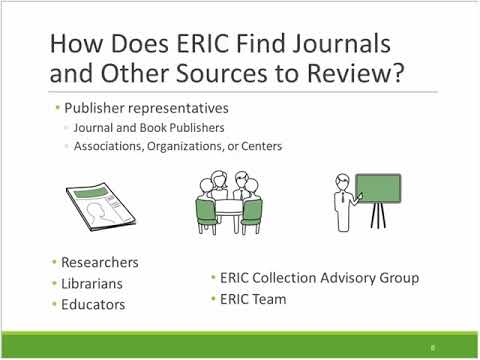
So how does ERIC find journals and other sources
to review for indexing in ERIC?
The sources are either suggested to us,
or we've located them.
We receive a majority of requests for review
from a journal publisher representative or editor,
and we also hear from representatives of associations,
organizations, or centers.
The publishers providing content indexed in ERIC
are based in the U.S. and from around the world.
Some are large publishers, such as SAGE,
Taylor & Francis, and Wiley,
and others are small publishers,
such as a professional association
or a university college of education
that publishers their own journal.
For some, the journal is a commercial product
that requires a subscription through their website
for ERIC users to access the full text,
and an ever-increasing number of journals in ERIC
are open access.
Requests for review are also received from researchers,
librarians, educators, and other ERIC users.
ERIC has a collection advisory group,
and they may suggest a new source.
And of course, the ERIC team is regularly searching
and identifying new sources to review.
You may wonder how to suggest a new source.
Anyone may send an email to ERICRequests@ed.gov
or use the Contact Us form on the ERIC website.
In addition to the source name,
it is helpful to receive your website URL,
and if you're suggesting a journal,
the ISSN for us to confirm we're reviewing
the intended journal.
We will contact you if we have any questions.
You do not need to send sample content
when you suggest a source, however, if needed,
we may ask you to provide content or temporary online access
for the purpose of reviewing the content.
You may wonder what happens when someone suggests
a new source.
When we receive a request to review a source,
we send an email response to acknowledge your request,
then we add the source name
to our list of suggested sources that we maintain,
and the information you provided,
including the name and contact information of the person
who sends the request.
The only action we take immediately is
to validate or locate the website URL
to make sure we have a good link to information
and content for the suggested source.
Fairly soon after a source has been suggested,
a staff person will conduct a preliminary review.
We confirm that the website is in English,
and if the journal publishes in another language
as well as English, we validate that at least 80%
of three recent issues are in English.
We make sure there is current content
and record the year of the most recent issue or report.
We also confirm that the content is education related
and the type of material produced
by non-journal sources is acceptable.
If all of the basic criteria are met,
we assign the status of Suggested for Review to the source.
This means that it will move forward
to be reviewed during the next formal review cycle.
If the content is a mix of English and another language
but does not hit the 80% benchmark
or if the content does not seem current,
we may assign the status of Watch.
This means we will conduct a preliminary review again
in a few months.
If none of the full text is in English
or the content is not education related,
we may assign the status of No Further Review.
This means that it will not be looked at again
unless we receive another request to review it.
We are often asked how long the review process will take.
The review cycle takes two to three months to complete.
So for each source it will depend
on when we receive your suggestion.
We do not review sources outside of the
formal review process, and if your source
is assigned a status of Watch during the preliminary review,
we may not review it again for six months
to a year to allow time for you
to publish two to three more issues
or several more reports.
Another question we receive is whether ERIC will consider
indexing a brand new journal.
The answer is yes.
If it is a good fit for ERIC,
we would like to begin indexing it fairly soon.
Our working policy is that a minimum of three issues
have been published and are available
for the review process.
If the new journal is only published annually,
we may review it when two issues are available.
If you are wondering what type
of grey literature content we index,
I would like to refer you to two tables
in the selection policy.
The first table is called types of material indexed,
and the other is types of material not indexed.
We have tried to make our working policy very clear,
but please let us know if you have any questions
about a specific type of material.
ERIC conducts the formal review process twice a year,
and it may take up to three months to complete.
We receive a large number of requests
and may consider about 200 sources
during each review cycle.
We begin by conducting an analysis
of the current collection.
How many sources selected during a previous review cycle
are currently indexed in ERIC?
How are they contributing to the topic areas?
This helps us to identify underserved areas,
and from this point, we can set our collection goals
for the upcoming review cycle,
such as a desire to increase peer review sources
or add more content for a specific topic area.
Then we visit the source's website
to gather information that we'll need
to complete the review.
If not yet collected, we locate the ISSN,
a direct link to an archive of content,
and whether the source has a peer-review process in place.
We read the aim and scope statement,
browse the table of contents,
and read abstracts or full text
for three to five current journal issues.
If we find there is a pending name change
or a move to a new publisher,
it will not move forward.
Instead, we change the status
to Watch and will consider it again
during the next review cycle.
For non-journal sources, we read the mission statement
and review several current reports.
When we have gathered information
and reviewed the aim and scope, abstracts,
and possibly the full text,
we apply the standard of being relevant
to one or more education topic areas.
The topic areas represent the field of education
and include the 16 topic areas
that were covered by the former ERIC clearinghouses,
plus "closing the achievement gap"
and "educational practices that improve academic achievement
and promote learning."
We assign one or more of these topic areas
to every source, record our observations,
and determine if the source will move forward
in the review process or if we'll change the status
to Watch or No Further Review.
We do get some requests to review sources
that have nothing to do with education.
Once we have confirmed that the suggested source
meets the standard of being related to education,
we consider our selection criteria of quality.
The materials produced by a selected source
must be complete and usable as presented.
Working papers may be accepted occasionally,
provided they are free of tracked changes
and are not watermarked as drafts.
For integrity, we must be able to determine
that the source, for example a journal,
owns the material and has the right
to distribute it to us.
The material must have substantive merit
in that it addresses the area
in a professional or definitive way.
And it must be relevant or important
to the current issues in the field of education.
Our next question, once we have determined
that the primary focus of a journal or center
is related to the field of education,
is whether the content contains education research.
By research, we mean original presentations
of empirical or data analysis,
literature reviews or summaries,
presentations or critiques of theories,
or logic models that can guide practice.
We look for content that outlines the methodology used,
includes analysis of data, well-formed arguments,
and has a reference list for citations.
By education research, we mean the field of study
that examines education and learning processes.
We look for content that examines effectiveness
of educational programs, practices, and policies,
and includes research conducted
for the purpose of improving the quality of education.
We often get recommendations for sources
that contain subject-matter research,
but ERIC does not select sources that only contain
subject-matter research.
For an example, a Journal of Chemistry
would not be a good candidate for ERIC,
but a Journal of Teaching Chemistry
would move forward in the review process.
If the source produces a combination of education research
and subject matter, we determine that the primary focus,
using the 80% benchmark again,
is education research.
We may make an exception and selectively index journals
with less than 80% if we need to increase coverage
for a certain topic area.
Some critical observations made during this phase
will determine if the source moves forward
or if we will watch the source until a new review cycle
or if we determine that it is not a good fit for ERIC.
Next we consider other selection criteria.
Let's start with peer review.
We accept both peer-reviewed
and non-peer-reviewed material for indexing.
However, as mentioned earlier,
one of our goals is to increase
peer-reviewed content in ERIC.
To determine if a source is peer reviewed,
we research the publisher's website
to locate a description of a blind
or expert peer-review process.
ERIC does not accept an editorial
or internal review process for the peer-review indicator
on the ERIC records.
For language, the full text of materials indexed
in ERIC must be available in English.
For a journal to be reviewed for ERIC,
the full text of 80% of the articles
in each issue must be in English,
and if selected for ERIC,
80% of the articles must continue to be in English.
For material format, we must be able
to receive the material in an acceptable electronic format,
such as PDF or XML.
We do not index content that can only be provided
in print, or if the content is only available
on a website in HTML.
We also look at editorial and publisher policies
and processes.
We like to find information about the manuscript review
and selection and take a step to confirm
that the content produced matched the stated
aim and scope statement.
The final element is sponsorship.
We note when a journal is sponsored
by a professional association or a center
producing non-journal content
has been funded by the U.S. Department of Education
or a foreign government agency.
Sponsorship is not a requirement,
but preference may be given to a source with sponsorship.
These criteria are all more fully explained
in the Selection Policy document,
and we would be happy to answer
any questions you might have
at the end of our presentation.
By this time, we will have a list
of good potential sources.
We review the notes we've taken along the way
and even look again at the abstracts
and full text to confirm our intended decision.
We will ask a few other questions
to create our final set of sources to recommend.
Is the content highly relevant to the current issues?
If it's not open access, is there adequate access
to the full text for ERIC users?
Our benchmark for this is that a minimum
of 30 libraries subscribe, as we've found in WorldCat.
What percentage of the content is education research?
Is it 80-100% per issue,
or does it barely meet the benchmark of 80%?
And are the research methodology
and results clearly presented?
Some journals we've reviewed have a very broad scope,
so in this final step, we consider
the editor's selectivity.
Do all articles relate to the stated aim and scope?
And if English is not the native language,
is the English translation easy to understand
and the grammar excellent?
And when reviewing sources other than a journal
or book publisher, we verify that the center or agency
publishes acceptable types of material.
As I've mentioned previously,
the complete list of types of material we index is
in the Selection Policy.
We are now ready to review the observations we've made
during the entire review process
and assign a final status to each source.
The candidate sources that are education research
and meet all of our criteria and collection goals
will be recommended to the Department to select.
We will provide a list of these sources to the Department
along with the background information we've collected,
links to the website, and links to sample content.
If a source is fully reviewed but not recommended,
we may assign the status of Watch
and include it in a future review cycle.
For these sources, the content may seem to be a fit,
but there might be some hesitation.
Perhaps the percentage in English
is not consistently 80% or higher,
or the issues contain a mix of subject matter
and education research, and the percentage
is not consistently education research and
is not 80% or higher.
Sometimes the source appears to be suspended.
For example, they publish four times a year,
and as of March they haven't yet published
the last issue from the previous year.
Or perhaps we've found a few broken links
or other problems with the website
but the content seems to be a fit.
And if we have a concern about access to the full text,
we will assign the status of Watch
and review it again in a future review cycle.
The number of libraries subscribing may increase
or it may change to be an open-access journal.
We assign the status of No Further Review
to any source that does not meet the standard and criteria
we've just discussed or has a critical problem,
such as the website suddenly disappears
or the source is closing or ceased.
For sources that will be recommended to select,
we determine the starting year of coverage in ERIC.
Our working practice is to begin indexing journal issues
or documents that were published a minimum of two years
prior to the year the source is selected.
However, we may consider on a case-by-case basis,
and a recommendation to vary the starting year of coverage
may be provided to the Department.
Examples of what may cause a different recommendation
is if the first volume or document was published
just shortly before the two-year timeframe.
If we wish to increase content
for an underserved topic area such as rural education,
we may also expand the timeframe.
Or if they've granted permission
for the full text to display in ERIC.
We also decide whether a recommended journal
will be indexed comprehensively,
which means every article in every issue
is indexed in ERIC,
or selectively, which means we will review every article
to determine if it is a fit for ERIC.
This decision is based on a review of three current issues
to determine the percentage of education research
versus subject-matter content in the issues.
In the two examples on your screen,
we index Journal of Learning Disabilities comprehensively,
or every article is chosen.
We index Journal of Adolescent Research selectively,
and in this representative issue,
we've selected three of the five articles
for indexing in ERIC.
In addition to pure subject matter,
we do not select articles that just relate to children,
but select the articles containing education research.
For our non-journal sources,
all materials are indexed selectively.
We will review every report, brief, or book
to determine if it should be indexed in ERIC.
So at this stage, what happens next?
The Department will consider all of the information
we've provided for the recommended sources
and make the final source selection.
When reviewing the source recommendation,
Erin looks for the same elements that I looked for earlier,
mainly, are the articles or documents education research?
Are they from a source that produces
high-quality, relevant information?
And how do the sources fit into the existing collection?
If your source is selected for indexing,
you or the appropriate publisher or provider contact
will receive an email communication from Erin
with an agreement form attached.
This agreement is between the publisher
or the copyright entity
and the U.S. Department of Education.
The form on your screen is the front page
of the agreement for journal publishers.
We also have a form specific to book publishers
and another for centers and organizations.
When the publisher or provider representative
receives the agreement, they should review it
and complete the optional sections.
The agreement includes several standard sections.
The first states that we wish to receive
or have access to your content in electronic format
for the purpose of creating ERIC records.
In section two, you will have the option
to display the full text in ERIC immediately,
after an embargo, or not at all.
Other sections include a statement
that the publisher retains all copyright,
that we will attach full text content
to the ERIC record, or link to the publisher,
and lists the responsibilities
of the licensee and licensor.
The agreement also includes a statement
that the ERIC database is intended for educational purposes,
and the use of your content to include records in ERIC
does not imply an endorsement of the publisher
or the content.
Section seven mentions the process for adding another
reviewed and selected source to your agreement.
The selected source will be listed on the agreement,
and if you have another journal,
you may not add it to the form,
but you could request that we also review it.
Section seven mentions that the agreement
automatically renews to smoothly continue indexing
your content in ERIC until you or we decide
to terminate the agreement.
The agreement language is comprehensive,
but section nine is available
if there is any specific language
that you feel would be important to add.
The last page of the agreement is prepopulated
with a source or sources selected for ERIC.
If it is a journal, we will include the ISSN
and the peer review status,
as well as the starting year of coverage.
The publisher that wishes to participate
will complete Part A and provide
the publisher customer service information
that we will place on your ERIC records.
In Part B, you will provide contact information
for up to three publisher representatives.
And in Part C, indicate if you would like us
to download the content from you, your website,
or if you will send the content to us,
and then check the type of format we would be receiving.
Then the appropriate publisher contact
should sign the form.
We will accept either an electronic signature
or you may print off the form, sign,
and scan it.
And then email the agreement to ERIC@ed.gov.
Erin Pollard, as the Department's representative,
will review the form, countersign it,
and email a final copy to you for your files.
We will update our agreement management system
with all the information you've provided
and will record the options you've chosen.
With the agreement in place,
we are ready to acquire or receive the content
and begin indexing your material in ERIC.
You can expect to see records representing your content
after about six to eight weeks
after we first receive your agreement.
This slide shows an example of a brief ERIC record
with a PDF of the full text attached,
and the second one includes a Direct Link
to the publisher.
When you click on the article
or the report title from the brief record,
you will see the complete ERIC record.
Each record will contain the article title,
author, source name, bibliographic citation,
and an abstract, either one that you've provided
or one that ERIC has written.
At the bottom of the record you will see descriptors.
These are ERIC Thesaurus terms,
and the publisher customer service contact information.
Now Erin and I would like to cover a few questions
we are often asked, and then we will open the floor
if you have other questions that we haven't covered.
For the first question, will ERIC provide feedback
on why your source wasn't selected?
The answer is yes, we would be happy to tell you
the status of your source or why it wasn't selected.
We receive a very large number of requests
to review new sources, and at this time,
we are only contacting publishers of selected sources.
We typically send these emails containing the agreement
to add new sources to publishers in July and January.
If you haven't heard from us after this time frame,
you may contact our help desk to find out
if we reviewed your source yet.
If the review is complete and it was not selected,
we will include the reason in our response.
We hope that the selection policy, this webinar,
and other multimedia pieces we've created
will help you understand the criteria
that we use to select sources.
Another question we receive is what happens
if you change the journal title?
If we have not yet selected your journal,
please let us know so we can update
our suggested source list.
If we are indexing your journal,
please notify us as soon as you know
of a pending title change.
We will quickly review the updated aim and scope statement
and the first issue published under the new title.
If it is a minor change to update
the currently used terminology,
we will be able to continue indexing it
without conducting a formal review again.
You will not need to sign another agreement.
Instead, we will associate the previous
and the new source name in our system,
and link the new name format to your current agreement.
If there has been a significant change
in scope or if your journal merges with another journal
that is not selected for ERIC,
we will pause coverage,
and we will review the journal again
during the next formal review cycle.
Next, a similar question is will ERIC continue
to index the selected journal if it moves
to a new publisher?
The answer is yes, if there is no change in scope.
We will contact the new publisher
and establish an agreement with them
to ask permission to continue indexing the journal
without a gap in coverage.
- [Erin] Okay, thank you, Fern.
Another question publishers often ask
is whether we can provide usage statistics.
This is something we are hoping to make available
in 2019, however, at this time, we do not have
the capability to provide usage statistics to publishers.
And the last question that we've prepared
is whether or not you need to do anything for ERIC
to continue indexing your content.
The agreement to index a selected source
automatically renews each year,
so if you continue to publish content
that meets our standard and criteria,
ERIC will continue to index it
without requiring any paperwork to continue.
If we notice that there's been some type of change,
such as a change in scope,
or increase in non-English material,
we may look at it again in a review cycle.
If we find a source no longer meets
the ERIC Selection Policy standard and criteria,
it may be discontinued.
If that happens, we will contact you
with the reason we will stop indexing your content,
and the records that are already indexed in ERIC
will remain, and you may request another review
after you begin publishing content
that complies with the Selection Policy.
So what we'd like to do now is to answer
any other questions or comments.
So please enter them in the chat box
on the right of your screen and send them to us.
And what we're going to do is
we're going to first answer general questions
about this specific webinar,
and then we're going to open it up
to any broader questions.
So our first question has to do
with do we index material from another database
that collects third-party materials?
So, would we index something from a clearinghouse
of another resource?
And the challenge here is that we need
to get permission from the copyright holder
to index something, so even if you have
very valuable content, we are not allowed
to index materials without going directly
to the publisher.
So if you have a database or clearinghouse
or something, we are unable to index that content.
So the next question, the articles must be about education
or can we publish articles about sport sciences?
So we are funded by the U.S. Department of Education,
and in our authorizing legislation,
Congress requires us to index education research.
So all material must be education research.
And the threshold is when we are looking at your journal
or non-journal material, are 80% of the articles
in your journal education research?
Is there any percentage limit of education articles?
So again, we are looking at 80% threshold,
but everything that we index is going
to be education research because
that is what we are authorized and funded to do.
Our publications are currently indexed
in ERIC through 2016.
How do we make sure our newest publications are included?
I'm going to be turning this over to Fern.
I am answering the first part
and then turn it over to Fern.
The first part is to check your agreement
and see how are we supposed to get your content?
If you are supposed to be emailing us content,
I would check to see if you actually have.
Frequently what we have found is that people are supposed
to be emailing content and forget to, as someone who
formerly has worked on the publisher side,
I had no idea that that was my responsibility.
What we encourage you to do is to contact us
and say can we switch to site download instead?
And that's where the ERIC team will go out
to your website and download the material
and you don't have to send us anything.
If it currently says site download
and we are checking into the individual who asked,
then we typically review your website twice a year,
and so you may see a gap or two,
but if it's more than like six months,
reach out to us because that generally shouldn't happen.
Do you have anything you want to add?
- [Fern] That'd be great.
No the only thing is for this specific one,
if you would send an email to our help desk,
and then I will send you a direct response
about where we are with that one.
- [Erin] Good, there you go.
So the next one is going to be,
are reviewers employees of ED
or do you utilize volunteers?
If the latter, can people apply to be a reviewer?
The answer is, I'm going to apologize
for being the bureaucrat.
Due to the Antideficiency Act,
we cannot accept voluntary services.
It's actually not allowed.
So the reviewers are Fern,
who is a contractor under a contract
with the Department of Education,
and then me, who is an employee.
So we can't accept volunteers,
but what we can accept is if you nominate sources.
And that would be wonderful, and to send them
to our help desk, and that way we keep a catalog
and we make sure that they all go to the right place.
Along with abstracts, are keywords useful?
Fern, do you want to answer that one?
- [Fern] The processing team can use keywords
if it's included in an XML feed,
and sometimes I've noticed keywords are included
on the, like a journal article PDF.
So I would say if it's included we will use it,
but don't necessarily send it separately
because that wouldn't be in a digestible format.
- [Erin] So then comes, if journals are currently
in print only but can be converted
to PDF easily, would they be considered?
So part of this is when you say
could be converted to PDF, do you mean that,
there's two issues.
If you convert it to PDF and send it to us
and it's a readable PDF, then that's one thing
that can be considered.
If you are proposing mailing something
to us or faxing it to us,
we don't accept materials that way,
and we don't make the PDFs.
So everything indexed in ERIC has to be a readable PDF.
But if that's something you are willing to do,
we would be open to reviewing that journal.
- [Fern] That would be right.
- [Erin] So then, all right.
This specific one I'm going to be turning over to Fern,
but to read it to you, there is a journal
that is a biannual publication.
The last issue was published in December 2017.
The next is not due until July 2018.
Will that be a problem?
- [Fern] No, I'd recognize this title.
As long as we have two or three issues
that have already been published,
then we'll be able to do the review.
If the December 2017 is the only issue so far,
then we'll need to wait until the fall
to look at that particular journal.
- [Erin] So then as an editor of an online journal,
if it's partially open access and partially members only,
would it be considered for indexing?
Yep, we love open access.
And let's explain why we like open access.
I think this is something that typically
may not make sense to our community is
that we have found that a lot of ERIC users
are not necessarily reaching out
for the 2018, 2017 content.
They're looking at materials
that are 10, 15, 20 years old.
And 10 years from now your website may have
gone down or changed.
And if it's behind a pay wall,
users may not be able to find that information.
So why we prioritize open access content
that we can display in ERIC,
it's so that way users can find this material
10, 15 years from now.
So we encourage you to allow us
to display the full text.
Immediately would be great.
After an embargo is also wonderful,
and it can be an embargo of your choosing.
It can be a five-year embargo after the profits of
that new article typically peter out.
So we encourage you to consider that as on option,
and if it is, let us know in the review cycle
when you are nominating your source.
But it's not a requirement at all.
- [Fern] And I might insert here, too,
if it's partially open access and partially member only,
we would look at WorldCat to see
how many libraries subscribe so that
if we index the articles that are abstracts only online,
that our users would be able to get,
at some point, some way, to the full text.
We have published our first issue in December,
the second volume will be published in June.
You can send the suggestion to us
and provide that information, and then we will,
what I'll probably do is schedule you for the fall.
By then you'll have two issues available
so that we would be able to have you on our list
for the fall review.
- [Erin] What XML formats do you prefer?
So I guess I am the one who,
I'm going to be the one who gets to answer.
ERIC has their own preferred XML format,
however, I can say that almost none of the publishers
use it and we are flexible.
And if you're selected, we will work with you
to find the right format.
And so if it's something
that traditionally what will have happened
is we'll either build our system
to take what you have or we'll say just send us a PDF.
It'll be easier that way.
A follow-up question is, how would a journal
be suggested if it's currently in print only?
You would email it to us, and preferably with a PDF.
- [Fern] Yeah, we would need a sample attached.
- [Erin] Yeah, sample content.
Are ERIC index publications available in Google Scholar?
If they are, is there a delay showing up
in the search results?
So ERIC, this is going to be a little long-winded answer.
All of ERIC's metadata is made freely available
to anyone, anyone on this phone, any user.
Google has the same access as Adscale or ProQuest,
as do you, the general public, and publishers.
So yes, I know that Google Scholar happens to index stuff.
It's based off of our site map, not our metadata,
which is generally updated every time we index records.
I know Google Scholar is always very keen
to make sure that the site maps are updated,
so there may be a delay, but the delay
for Google Scholar specifically is slight.
Like no more than a week or two.
For what you might see in other search providers
that index based off our metadata
as opposed to our site map,
you may see a month or two or longer delay
because it's up to when the publisher chooses
to index their material.
When you mention readable, are you including
accessibility features for 508 requirements?
So as the federal government, yes.
When I said accessibility, I was referring to
if something is 508 compliant,
which is a government term for a PDF
that means that it is accessible
to those who are using a screen reader,
a 508-compliant PDF is our preferred
and it's required on federal websites.
But what I was meaning when I said readable
and accessible is if you think back to 10 years ago,
it was much more common where you would
have a PDF that would be like a scanned from a scanner,
and you couldn't search the words inside the PDF
because it was just an image.
We can't index those in ERIC.
And the reasons for that are long and complex,
but we want to make sure that our content is accessible
to everybody, and so it's in proper reading order.
And if it is something that has been created
in 2018 from digital content,
it is almost always considered accessible
even though it may not meet the 508-compliance threshold.
If your website has changed, please let us know.
So what will happen is that will also change your URLs
on previously indexed records.
We will go back and update that as resources are available,
but it won't be immediate.
But definitely please email us
through the contact that is below.
So, one, we have the new information,
and two, so that we can update old records.
- [Fern] The next one is about someone who has sent in
a suggestion for application in 2015.
What you can do, if you'd please send a message
to the help desk and ask for some direct feedback
about the status of your review
and if it hasn't been selected,
then I'll give you some specifics
about the observations we've made
and whether or not we are going to review it
again this spring.
- [Erin] Then there can be several WorldCat records
for the same journal.
Do you sum the library accounts?
- [Fern] The answer is yes.
We look for that, and we keep track of which libraries
have subscribed to print versus electronic,
and then we add them together.
- [Erin] So that is all the questions
that we have gotten so far.
So we're going to just give it a minute
to see if we have any new questions.
You haven't mentioned a DOI number as a criteria
to be selected.
No, we haven't, because it's not a requirement.
However, if you have a DOI, that is wonderful,
and that will be included in the ERIC record.
The next one, is there any percentage
of educational article?
- [Fern] Yes, it has to hit the 80% benchmark.
If there is a topic area, typically something like
urban education and rural education,
where we are always looking for more content,
then we may, if you refer back to the other slide
that we talked about comprehensively
or selectively indexing, then if a journal has
at least 50% education research articles,
we may select it, and then what we'll do is
we'll pick out and only index the
education research articles.
- [Erin] We are going to give it one more minute
just to see if there's any other questions.
- [Fern] Okay, next slide.
- [Erin] Going to the next slide.
And we have several videos, infographics,
and recorded webinars in our multimedia area
on the ERIC website.
To find all the items, use this link
or click on the multimedia link
at the bottom of the ERIC website pages.
And I have also included a link to the Selection Policy
and the Journal and Non-Journal Lists.
These links are all easily found
in the footer of the ERIC website.
Thank you so much for joining us today.
We really appreciated to get to talk to you,
and please send us any questions that you have.
Thank you.
How ERIC Can Help You Write a Research Paper Using ERIC for Systematic Evidence Reviews About ERIC Pastor Gregory Toussaint I 7 Nights of Dominion I Representing the King in our Education I TG Good, Bad, and Ugly in Varanasi (Varanasi Holi) Civil Rights Pioneer Linda Brown, of 'Brown v. Board of Ed' Ruling, Dies at 76 Episodio #1384 Evita el envejecimiento prematuro வாணி ராணி - VAANI RANI - Episode 1528 - 28/03/2018 Bix = "Glix?"...a Character in the New Fed Comic! (Bix Weir) AMAZING FAMILY HIKE!! Hiking 11 Miles with Baby!
Facebook
Twitter
Google Plus
Latest Posts