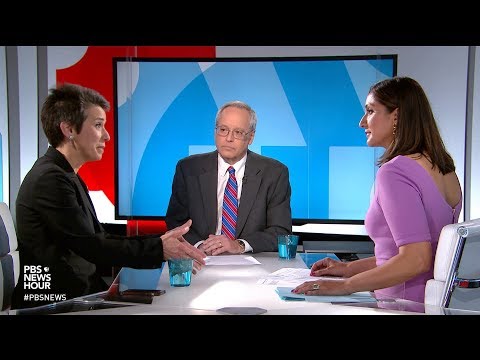
are heading to the polls tomorrow.
This time, it's primary voters in Georgia, Kentucky and Arkansas, and a run-off in Texas.
To give us an early look at what to watch, I'm joined by Amy Walter of The Cook Political
Report and Stuart Rothenberg of Inside Elections.
Welcome, Amy and Stu.
Let's talk about some of those primary races.
Now, two in particular, Georgia and Texas, have caught a lot of people's attention.
In Georgia, it's the battle of the Staceys, right, Stacey Abrams vs. Stacey Evans.
In Texas, it's a run-off between Laura Moser and Lizzie Fletcher.
Amy, what do we know about the Democrats right now?
What do these two races tell us about where they are right now?
AMY WALTER, The Cook Political Report: Well, I think the most important thing is the thing
that you mentioned at the beginning, which is, if you noticed, all these the names were
female.
So, we're seeing a lot of these contests.
Also, we have a contest in question Kentucky, where there's a woman in a very competitive
primary.
So women have been a big story of this 2018 election.
In either case, we're going to see a woman come out of one of these primaries and be
the nominee.
There's some debate -- a lot of it is centered in Washington -- about whether there's this
ideological battle going on the Democratic side between sort of the Bernie progressive
coalition and the more centrist Hillary Clinton coalition.
I think really what's happening is much more stylist than it is substantive.
It's less ideological than it is about the real fervor on the Democratic side, not just
to turn out and vote and put more Democrats in office and be a check on President Trump,
but to do it in a way that brings in a whole bunch of new people.
And so what you're seeing in both the Texas race and the Georgia race, one Democrat is
saying, if we're going to win, we have got to do it by bring out younger voters, voters
of color, people who don't normally turn out in midterm elections.
You're not going to do that with sort of a mealymouthed moderate message.
The other Democrat is saying, the only way we win in places like Georgia and Texas, you
have got to win Republicans.
These are not overwhelmingly Democratic areas.
So, that's really what we're going to be watching for in the primary and then how they translate
that.
Whoever wins has to translate that vision in a general election.
AMNA NAWAZ: Stu, what do you make about that?
There's a lot of talk about the battle for the soul of the Democratic Party, right?
STUART ROTHENBERG, Inside Elections: Yes, I think Amy is being too kind.
She's being very kind, that I think, in many cases, reporters, analysts are trying to kind
of impose a single interpretation on every race throughout the country.
I think the Texas 7 race with Fletcher and with Moser is an establishment vs. insurgent
progressive fight.
The Democratic Congressional Campaign Committee and EMILY's List have both endorsed Lizzie
Fletcher.
Laura Moser is the kind of Bernie Sanders insurgent progressive, hold your feet to the
fire, you have got to be true blood every issue.
The Georgia race is much less so, right, Amy?
It's -- there's a racial component here.
We have an African-American woman and a white woman.
And it's true that, traditionally, the argument was nominate the white woman who can hold
the African-Americans, and yet get white voters otherwise.
AMNA NAWAZ: That was the safe bet, right?
STUART ROTHENBERG: That was the safe bet.
But, otherwise, this race isn't really the ideological race.
(CROSSTALK)
AMY WALTER: Right.
And, right, this would be the first African-American woman governor ever, ever.
AMNA NAWAZ: In the country.
AMY WALTER: So, that, you have to look to as the more motivating factor than whether
this is ideological.
AMNA NAWAZ: But does this say something about where the party is heading when you look at
who they're choosing to endorse or support in these races?
STUART ROTHENBERG: Oh, yes.
I think the party is divided.
Look, both parties are divided.
They have multiple wings and they are trying to figure out, how do we all get along here?
How do we nominate candidates who can appeal to a broad spectrum of voters and have enough
charisma and energy to bring out the base, the core believers?
AMY WALTER: Right.
Right.
And this is -- the other issue in this election is so much of -- especially on the Democratic
side, the candidates who are coming, this is organic.
These people just decided one day they were going to run.
The Trump election really energized them, in a way that we haven't seen before.
Normally, the parties, they go out, they recruit somebody in these districts, and then maybe
there's an insurgent that comes in that they didn't expect.
In this case, there are five or six or seven candidates they never talked to, they don't
have anything to do with, meaning the party, and they may be the standard bearers.
They have got to -- they're going to have to catch up to where the candidates are, as
opposed to the candidates catching up with the party.
AMNA NAWAZ: Let me ask where about some of these candidates may end up, on Capitol Hill,
where the Republicans are in control.
They seem to have hit some road bumps, though, right?
They failed to pass the farm bill on Friday.
There's a new battle over immigration brewing now between the moderates and the Freedom
Caucus.
Amy, tell me about this.
Is the Republican Party sort of at war with itself right now?
AMY WALTER: Stu made this comment.
They're always at war, right?
The parties are always at war with themselves.
And this has proven time and again to be an ungovernable caucus on the Republican side,
right?
Time and again, it's the Freedom Caucus that tends to put the leadership in a really tight
position.
So, I think what we're seeing on immigration is the bigger internal battle with the Republican
Party between the hard-liners -- and now President Trump is over on that side talking about MS-13
and border security and sanctuary cities -- and more moderate Republicans who have to go back
in November and talk to more centrist voters with a message that is not as hard-line.
STUART ROTHENBERG: Let me just add, there is a reason why John Boehner survived as speaker
for so long.
The party couldn't figure out anybody else who they could vote for who would take the
job.
There was a reason why Paul Ryan became speaker.
The party looked around, was looking for alternatives.
Ryan had said no.
Finally, they had to get Ryan.
Leading this group is very difficult.
And, in fact, the nature of political leadership now is much more difficult when you have these
outside forces competing against the establishment.
AMNA NAWAZ: Speaking of leadership, I want to ask you, Stu, before we go, in reaction
to the Texas shooting last week, we did hear from Senate Majority Leader McConnell basically
expressing his condolences, calling it a senseless act of violence.
We haven't heard a plan.
We haven't heard any let's move for action, let's take this up, let's do this.
Is this where we are now?
Is this just the way it will move forward?
States will have to step up if they want to see some action?
STUART ROTHENBERG: Yes, I can't imagine the Hill doing anything in the near future.
And you're seeing some states address the issue in terms of gun control or access to
guns.
No, it's going to have to be in the states.
The only way this is a -- guns is a national issue has to do with the midterm elections
and motivating and mobilizing college-educated white women, who have simply had it now with
guns and shootings and school shootings.
AMNA NAWAZ: That's the core group that -- for whom this could become a voting issue.
STUART ROTHENBERG: I think they're a key group.
And they can be affected these efforts.
But, otherwise, the states are going to have take the lead in terms of legislation.
AMNA NAWAZ: Very quickly.
(CROSSTALK)
AMY WALTER: Right.
And not just those women, but also younger voters, who have been marching in the streets.
Are they going to show up to the ballot box?
AMNA NAWAZ: We will see, indeed, in the midterms ahead.
Amy Walter and Stu Rothenberg, always good to talk to you.
Thanks for being here.
STUART ROTHENBERG: You're welcome.
AMY WALTER: You're welcome.
What are the ramifications of Trump's FBI spy claims? WATCH: Prince Harry and Meghan Markle are married during the Royal Wedding ceremony New Trump strategy makes Iran choose between economy and U.S. demands Supreme Court delivers blow to workers' rights, making it more difficult to sue employers Watch ABC News Live How Europe's new online privacy rules could benefit Americans WATCH: Secy. of State Pompeo discusses Iran at Heritage Foundation WATCH: Kingdom Choir performs "Stand By Me" at Royal Wedding What we know about Trump's Justice Department meeting FRANCE 24 Live – International Breaking News & Top stories - 24/7 stream