-->
≡
Home
Woman
Sport
Business
Health
Privacy Policy
Contact Us
Contact Us
Harassment is 'an open secret' on Capitol Hill, former staffers say
:
:
2018-05-15T01:20:25Z
Tuesday, 15 May 2018 - 01:20 AM
Watch the video
click to begin
Youtube
JUDY WOODRUFF: Since the MeToo movement began last fall, seven members of Congress have
resigned or retired after sexual harassment allegations.
There is near universal agreement that the system for investigating such accusations
on Capitol Hill is deeply flawed.
Yet Congress has not addressed their own rules.
Our Lisa Desjardins is here with this story -- Lisa.
LISA DESJARDINS: That's right.
Still today, Judy, if you complain of harassment on Capitol Hill, you face a 90-day waiting
period and a system that everyone agrees is stacked against victims.
Now, the House passed a bill three months ago to change this, overhaul it.
But it has been frozen in the Senate.
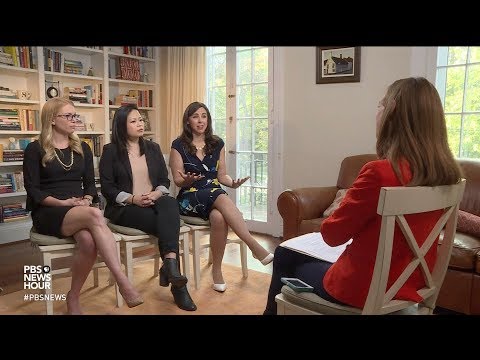
We talked to three former staffers who are pushing for change this, among many hundreds
who say this is an outrage.
Their names are Rebecca Weir, Anna Kain, and also Ally Steele.
They haven't done much television.
It was Anna's first interview.
She's the staffer whose abuse led to the retirement of Congresswoman Elizabeth Esty.
They began by telling their stories, starting with Ally Steele.
ALLY COLL STEELE, Former Congressional Staffer: Yes, so my experience was when I was an 18-year-old
intern.
And it was my first experience really in a real job.
You know, I had heard some rumors about this member who ultimately groped me at the national
-- Democratic National Convention in Boston at an evening event.
And, really, the message that was sent to me was that this was the cost of doing business.
I was a young woman in politics, partly because, as I told people about my experience, I learned
that this wasn't a surprise to many people, that this behavior generally and from this
particular member was somewhat of an open secret.
LISA DESJARDINS: You two are nodding.
What do you think?
Is that similar?
ANNA KAIN, Former Congressional Staffer: Yes.
I think, for me, it was -- I think the prevalence of harassment on the Hill is definitely very
much an open secret.
My story -- the second year that I worked for Congresswoman Esty, I -- a colleague who
I had dated the year before became her chief of staff in 2014.
And that began about 14 months of pretty consistent harassment, which was sexual harassment.
It was personal and professional beratement, and kind of explosive screaming fits in the
office that once included him punching me in the back in the office.
And a year after I left the office, on May 5, 2016, he called me 53 times in a matter
of just a few hours and threatened to find and kill me.
And I think that event was so significant to me because it was quite literally what
scared me into both coming forward, but also recognizing the extent to which I was abused
in the office throughout the entire second year that I had worked there.
LISA DESJARDINS: So, when you had a complaint, Anna, did you know where to go right away?
What did you do?
ANNA KAIN: I did nothing, both because of -- I was being threatened by my then chief
of staff from coming forward.
I had worried about the member that I worked for's career and reelection.
We had trainings on things like chemical leaks, but I had never participated in a sexual harassment
training, which I think sends a very strong message to staffers about what is important
and what is even worthy of being part of the conversation.
LISA DESJARDINS: Rebecca?
REBECCA WEIR, Former Congressional Staffer: My own personal experience was with my own
member of Congress, a man who I respected.
It was the August recess.
I had been working on a proposal.
I went into his office.
I said -- I made the proposal.
He was open to it, which was great.
I was feeling really good about it.
And, as I got up to leave, he stopped me, and said: "My God, Rebecca, you just look
amazing today.
Just really stunning.
Would you mind twirling for me?"
I was stunned by the request, but I didn't really know what to do.
I was young and inexperienced.
And I complied.
He's my member of Congress, and here he is asking me to do something.
So I just -- I did it.
Felt awful about it immediately after.
I went and sat down at my desk, tried to regroup, when I get a phone call from our Washington
office, saying: "Hey, Gary," my member of Congress, "just called, and he said you were
to have a bonus immediately.
Don't know what you did, but congratulations."
Of course, I knew exactly what I had done.
LISA DESJARDINS: You felt like an object.
REBECCA WEIR: Totally.
I felt like a prostitute.
I mean, here I am getting paid not because of, you know, my professional, you know, accolades
or my worth, but because of how I looked and how I made him feel.
LISA DESJARDINS: Is there a reason you think Congress and the power structure there is
different?
REBECCA WEIR: I think there's a couple systemic problems with just how the Hill functions,
and as opposed to traditional employers.
You have -- especially on the House side, where there's turnover every two years -- problem
number two is that it is so individualized, either by party or by state, region.
And so it's -- there's not really, again, a comprehensive approach to this.
LISA DESJARDINS: Each office, each member of Congress is in control of the rules for
their office.
REBECCA WEIR: Correct.
Each member of Congress is really the employer.
It's not -- you're not working for Congress.
You're working for your member.
ALLY COLL STEELE: People come to Washington, D.C., because they want to work on the Hill.
You will work really hard, as we have all mentioned, to get to the next level.
So there is a real desire to be there, and I think a willingness to put up with behavior
in general that shouldn't -- shouldn't be accepted.
LISA DESJARDINS: How do you take this idea that, even after all these conversations,
those who are elected to run this country have not been able to change a system that
they all admit is flawed in their own offices?
ALLY COLL STEELE: I was really moved by what the House did in January.
As a former Hill staffer, I was a little cynical about Congress' ability to quickly get things
done.
But they did.
They responded really quickly to this moment and with a bill that makes a lot of really
important changes.
And so it's been dismaying to see it held up in the Senate for so long.
ANNA KAIN: Yes, I think it's very frustrating that the Senate won't act on -- to pass reform
on this issue.
I think it's been made very clear that this isn't a Republican or Democratic issue.
This isn't a men's issue or a women's issue.
I think this is -- and this isn't a vague or hypothetical issue either.
This is a very practical issue that affects day to day the people -- the safety and well-being
of the people who work for these representatives.
And I think they have -- they absolutely have a responsibility to act.
LISA DESJARDINS: There are some people who say this conversation has actually gone too
far, and that now things which are very minor are being considered to be harassment.
How do you respond to that?
ALLY COLL STEELE: In terms of Congress acting on this legislation, I don't have a concern
that it's going too far at all.
I think, in fact, it's simply making changes that are long overdue.
REBECCA WEIR: I don't think it's gone too far.
It's never a bad thing for people to reflect on their own privilege, their own status,
their own power, and try and see their interactions through a different lens.
And I think all these little things, we're not talking about them individually.
You know, an insensitive comment here, you know, whatever there, that's not what we're
talking about.
It's them together, taken as a whole, really encage us and inhibit us from going forward
and finding our full potential.
That's what we're talking about.
LISA DESJARDINS: Are you worried about current staffers on the Hill?
Where would you recommend they go to complain?
Is it even clear yet that they have a place to go?
ALLY COLL STEELE: Well, I think that the -- that's why it's so important for the Senate to act
right now, is that it is unclear what the current environment is for women who experienced
misconduct on the Hill.
And if I were a current staffer on the Hill, I'm not sure that I would know whether reporting
was going to come at a risk of retaliation.
ANNA KAIN: Ultimately, this is a conversation that should be had, and I think it should
be had out loud.
And I think, in order for anything to change either legislatively or culturally, we just
need to keep talking about it and having these conversations.
LISA DESJARDINS: Ally Steele, Anna Kain, Rebecca Weir, thank you very much for talking with
us.
REBECCA WEIR: Thank you for having us.
ANNA KAIN: Thank you.
ALLY COLL STEELE: Thanks.
Amy Walter and Susan Page on Trump's embassy move Joe Rogan Experience #1109 - Matthew Walker Watch the second presidential debate between Donald Trump and Hillary Clinton PBS NewsHour full episode April 16, 2018 PBS NewsHour full episode May 7, 2018 PBS NewsHour full episode April 24, 2018 Macron warns US Congress: There's no Planet B PBS NewsHour full episode May 9, 2018 PBS NewsHour full episode May 10, 2018 Watch: Facebook, Twitter & Google to testify in Senate Russia hearings
Facebook
Twitter
Google Plus
Latest Posts