-->
≡
Home
Woman
Sport
Business
Health
Privacy Policy
Contact Us
Contact Us
How To Protect Your Computer From Getting Hacked
:
:
2018-05-05T14:33:25Z
Saturday, 5 May 2018 - 02:33 PM
Watch the video
click to begin
Youtube
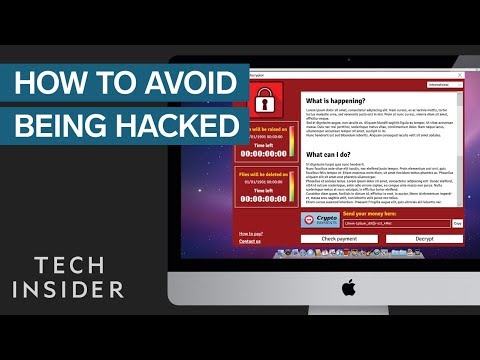
- [Narrator] Does this screen scare you?
It means your computer is disabled,
your hard drive is encrypted,
and you can't do anything unless you pay the ransom.
But it can be avoided.
- It's basically finding holes and gaps
to do malicious things,
stealing information, destroying your box,
or you know, doing something nefarious pretty much.
Typically with ransomware the most common thing
is to use encryption to encrypt all of your files
or your hard drive and then try to ransom you
the objects to get them back.
- [Narrator] One of the most famous ransomware attacks
happened fairly recently.
In spring of 2017, Wannacry, malicious code based
on a leaked NSA exploit, spread around the world
infecting about 200,000 computers.
Hospitals in the UK were hit so hard
they were forced to turn away non critical emergencies.
And while ransomware like that sounds like a nightmare,
spyware may be even worse.
- It can cover keystrokes, screenshots, video, or audio.
Essentially it's like the Trojan Horse,
you look like something benign but inside is malicious.
And it'll keep connecting back
to its command and control server.
And it'll keep sending data constantly back
to that command and control.
And on the hacker's end, he can access your box
and see like what kind of data just came back.
- [Narrator] Someone could be logging everything you do
on your computer.
A nightmare scenario that records your keystrokes
as you enter your bank password,
captures confidential documents onscreen,
and even watches you through your camera
as you watch this video.
- Let's just say the average breach is, it's like 40 days.
Like they don't figure it out until after 40 days.
So, that's 40 days for them to steal data and information
and get out and clean up.
- [Narrator] 40 days! That's probably more than enough
time for someone to steal all of your information.
So, how do you avoid this malicious software?
- You should have something as a stopgap to prevent it.
Like, for instance, if you're gonna download a document,
the most common thing is to allow macros, right.
Macros allow like little programs within the document,
in a Word document.
But that's the most common way that malware
is delivered these days.
So, by allowing, enabling macros you're allowing
you know, some code to run in the background
within the document.
- [Narrator] Your computer can get infected
from just a tiny piece of software in a text document.
But also, be careful with the websites you're visiting.
- You wanna look at the reputation of the website.
Does the website have SSL encryption,
or if it doesn't have the https like on the actual URL,
like that'll be a big indicator.
If there's a pop-up just close down the browser really.
'Cause by allowing that user interaction
you're giving the program rights to do
what it needs to do.
- [Narrator] It's very easy to hide malicious software
in other programs.
So, make sure the software you download
is from a reputable source.
- Even a Flash player or a fake AV,
there are a lot of clickable downloads out there
that says "Oh, your computer is hacked"
with a bright red screen.
But it's totally fake.
- [Narrator] Also, make sure you're being proactive
in maintaining your security.
- The more stopgaps you have, two factor authentication,
strong passwords, you know, is there a special
like code that you have with the person,
your account representative.
Like who's gonna know your first grade teacher,
or something like that.
- [Narrator] Finally, try to limit the amount of data
you put online.
That includes your vacation photos.
- You know, once you get onto a social media platform
or a banking site, you're giving up personal information
about yourself.
So, the whole thing of using cloud, and cloud servers
is like, yeah, you're giving data to that company
but you're also giving the third party
access to the data, as well.
And even the more information that you give out on the web,
like there's these whole programs to go search for
personal information about you.
And every social media profile, everything that you have
publicly, it will find it and use it
as like a way to kind of guess your password,
or guess your activities.
So, what if a robber knows where you live
and can figure out when you go out on vacation?
They're gonna go after your stuff.
- [Narrator] And if you do wind up getting hit
with some sort of malware, don't panic.
You may still be able to save your data.
- Just completely disconnect the box,
or if you have a picture of the ransom note,
go to a different computer and look up
like what type of ransomware it is
because eventually you'll find that there could be
a decrypter out there for it.
And you can get all of your information back
without having to pay the ransom.
Mexico tv – transmisja na żywo 17 w HD 12 Signs Your Computer Has Been Hacked 15 Clear Signs Your Phone Was Hacked Inside a Google data center Advanced Ancient Technology Discoveries That Will Blow Your Mind Top hacker shows us how it's done | Pablos Holman | TEDxMidwest This is what happens when a Scammer calls a Software Engineer Data Scientist: Reality vs Expectations ($100k+ Starting Salary 2018) What's the Difference Between Viruses and Malware? What Happens when you Run One of the Worlds Most Dangerous Viruses? (MEMZ)
Facebook
Twitter
Google Plus
Latest Posts