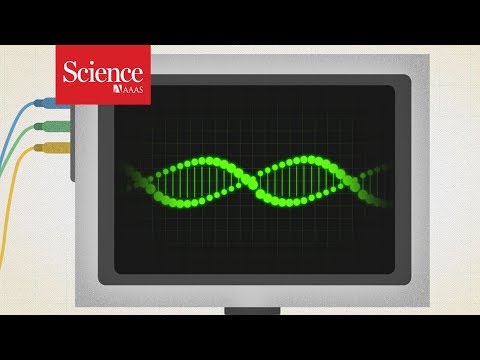
No heartbeat. No brain activity. No breath.
That seems pretty final.
But at the cellular level, only part of you is dead--
some of your cells are still fighting the good fight
Scientists want to know what is going on
inside those lingering cells.
So researchers looked at the activity
of more than a thousand genes,
in both zebrafish and mice,
for up to four days after they died.
Groups of genes related to immune response,
inflammation, stress response, and cancer
were all more active.
Even more surprising--genes normally only seen
during development were also suddenly active.
These genes are tightly locked down by cells
after the embryo develops and are never expressed
again -- until, perhaps, the organism dies.
So why do they revive?
It might be that some conditions inside the cell
after death resemble those before birth,
but they don't know for sure.
An alternative reason developmental genes
turn on might lie with changes in
epigenetic regulatory genes,
which control gene activity
by restricting access to the DNA
The activity of some of those regulators
was actually shown to increase after death.
Developmental genes are physically
tucked away in the genome.
But if the regulators spin out of control,
those genes could suddenly become accessible
and start expressing.
There isn't really a why question here--
it doesn't seem likely that there is a purpose
to these genes turning on.
That's because genes in a dead organism
can't be acted on by natural selection.
There's no evolutionary advantage
to turning them on after death. Probably.
If an organism isn't quite dead, there could
be some advantage to ramping up some genes,
like those related to stress responses
and recovery from injury.
But there's not enough data to know for sure,
and few other studies have tackled this question.
One that did looked at human tissue--
over 9000 samples from 36 different types.
After death, gene expression in brain and spleen tissue
was relatively stable.
But genes in muscle tissue went crazy.
More than 600 either increased
or decreased their activity
And those increases in gene expression
waxed and waned in a way that suggested biochemical
machinery was still working.
What can learn from this?
Patterns of gene expression
could be used to estimate time of death,
something that current forensic techniques
don't always get right.
And the experiment that looked at human samples,
identified the types of tissues that might
be most helpful to forensics:
skin and the layer of fat directly beneath.
And that's not all.
Patients that get organ transplants
from dead donors could start receiving better care,
the more we learn about gene expression after death.
These changes in gene activity could even help explain
why some transplant recipients
are at an increased risk of cancer.
It's also important for researchers to understand
gene activity in tissues that can
only be obtained after death.
If death alters our genes, scientists need to know
how that affects the tissues they study.
And we can't rule out simple curiosity
as a driving force for this research.
What our genes get up to after death is a beguiling
mystery, and one we've only begun to consider.
What if a nuke goes off in D.C.? Simulations of artificial societies help planners What's really behind 'gluten sensitivity'? Cheap smart wall can sense movement and electronics in a room Watch a 'ballooning' spider take flight How researchers are teaching AI to learn like a child Some people have evolved bigger spleens to hunt underwater Mini-antibodies discovered in sharks and camels could lead to drugs for cancer and other diseases Here's what happens when you replace toads and turtles with 3D printed replicas in the wild Can this robot build an IKEA chair faster than you? Scientists just 3D imaged the birthplace of stars—using sound