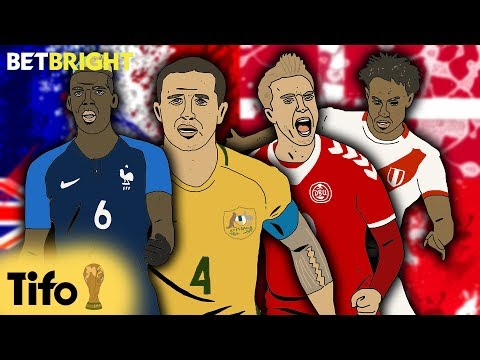
The Socceroos qualified for their fifth World Cup, and fourth in a row, via a play-off win
against Syria, having come third in the AFC third round. Thirty-eight year old Tim Cahill,
who could be the country's greatest ever player, scored 1o goals in AFC qualifying.
Australia are managed by Bert van Marwijk, who took the Netherlands to the World Cup
final in 2010, assisted by Mark van Bommel. It won't be a surprise, then, to learn that
Australia are well organised and physically assertive.
Van Marwijk's side tend to play a 4-2-3-1 that can look like a 4-5-1 against stronger
sides. The midfield pivot will be captain and expert penalty-taker Mile Jedinak, playing
alongside the creative Aaron Mooy or Massimo Luongo. Jedinak gets through a lot of work,
covering across behind the wide right player, usually Hertha Berlin's Mathew Leckie. Ahead,
Tom Rogic plays behind a lone striker, either Robbie Kruse or Tomi Juric.
[PIC 1 and 2]
Australia transition from their 4-4-1-1 in defence to a wide 4-2-3-1 in attack – the
full backs push up and Rogic peels off behind the striker to get into the box unmarked.
Mooy's job is to get the ball quickly into the wide spaces, either for the full backs
to play up the line, or directly to the wingers.
[PIC 3 and 4]
Australia lack a consistent goal scorer, so much will be needed from Tom Rogic's bursts
from midfield. The defence also looks inexperienced and Trent Sainsbury aside, lacks real ability,
though Mat Ryan is a very good 'keeper.
On paper, Australia are a mixed bag and everything will depend on their clash with Denmark.
Denmark
Denmark qualified after a play-off, having come second in UEFA's Group E behind Poland.
The play-off saw them draw 0-0 with the Republic of Ireland in Copenhagen, before hammering
them 5-1 in Dublin with Christian Eriksen scoring a hat-trick; Eriksen scored 11 overall,
joint third in UEFA qualifying.
Manager Aage Hareide has experimented with formations but appears to have settled into
a 4-3-3 that can look like a 4-2-3-1, though don't be surprised if a 3-4-2-1 is used
as well. Christian Eriksen is the hub, playing in front of a strong midfield pivot of Thomas
Delaney and William Kvist, but roaming away from the hole regularly. They will fall back
into a 4-4-1-1 in a block, but transition quickly.
[PIC 5 and 6]
Hareide has tended to play a big, strong striker on the right hand side, either Andreas Cornelius
or Yussuf Poulsen, with Nicolai Jorgensen the first choice front man. Cornelius or Poulsen
will push up alongside him, while talented Celta Vigo winger Pione Sisto tucks in from
the left alongside Eriksen, so Denmark can look like a 4-2-2-2 in attack with the full
backs pushing up.
[PIC 7 and 8]
Hareide has attracted criticism for not picking Andreas Christensen or Jannik Vestergaard
in defence, and the full backs lack depth, though Riza Durmisi can inject energy on the
left. Kasper Schmeichel is a very good 'keeper, though, and could spare defensive blushes.
Denmark are very reliant on Eriksen and if he's marked well, they could struggle to
create chances. Pione Sisto is an excellent attacking talent, though, and could be Denmark's
other world class player in years to come.
Denmark have the talent to progress from the group, but could find it hard against teams
that are tough to break down.
France
Winners in 1998, and runners-up in 2006, France topped a tricky qualification group beating
Sweden into second, and seeing off the Netherlands, who failed to make it through. Olivier Giroud
and Antoine Griezmann both scored four and four players scored twice, including Dimitri
Payet, who misses out on the final squad due to an injury.
Under Didier Deschamps, France have used a 4-2-3-1 and a 4-3-3, but in recent friendlies,
they have used the latter formation and it's likely they'll prefer this. The full backs
will push high to provide width and overlap round the inside forwards who flank a central
striker, either Giroud or Griezmann. N'Golo Kante is guaranteed to start in the midfield
holding role, and he will likely be flanked by Paul Pogba on one side. The other side
could see Blaise Matuidi for greater solidity and box-to-box mobility, Corentin Tolisso
or Thomas Lemar for pace and creativity, or Steven N'Zonzi for another deep passing
option.
[PIC 9 and 10]
France will press, especially in the midfield area. The 4-3-3 will fall back into a 4-5-1
or even a 4-1-4-1 against better sides, but France will always be looking to transition
quickly into a counter, exploiting the searing pace out wide of the two wingers Ousmane Dembele
and Kylian Mbappe. Dembele and Mbappe can cross, cut in and shoot, or drag markers wide
to cut the ball back.
[PIC 11 and 12]
France have been weakened by a few injuries to experienced players, and look to be lacking
some leadership in defence, but their forwards and midfield are as good as any in the tournament.
The group phase will not test them; the question is how far they can progress afterwards.
Peru
Peru, under manager Ricardo Gareca, came fifth in the CONMEBOL qualification section, level
on points with the more fancied Chile but ahead on goal difference. This put them through
to the inter-confederation play-off against the OFC's winning team, New Zealand. Peru
won 2-0 at home to seal a 2-0 aggregate win. Edison Flores and skipper Paolo Guerrero scored
five goals each for Peru in qualification, but Guerrero will miss Russia 2018 as the
result of a drugs ban.
Gareca, a former Argentina international whose goal denied Peru a place at Mexico 1986, uses
a solid 4-2-3-1 that looks like a 4-5-1 or 4-4-2 in defensive pose. The central midfield
pairing of Renato Tapia and Yoshimar Yotun stay narrow, while creative ten Christian
Cueva roams around the pitch to collect the ball and start moves.
[PIC 13 and 14]
The wide players, usually Jefferson Farfan and Andre Carrillo, will pull wide or push
up and inside to support the striker, so that Peru can almost look like a 4-2-4 in attack,
with Cueva drifting to the near side; the full backs will also get forward and Miguel
Trauco is a particualry danger from left back.
[PIC 15 and 16]
Pedro Gallese starred for Peru in goal during qualifying, but Carlos Caceda has played in
recent friendlies and been superb – this leaves Gareca with tough a decision to make.
Tapia, who can play at centre back as well, will be Peru's main man in midfield and
should show his class. While Guerrero's goals will be missed, Peru are still a technically
capable side with real grit in the middle.
While topping the group is out of their reach, Peru could spring a surprise and qualify at
Denmark's expense.
FIFA World Cup 2018™: How Spain May Line-Up FIFA World Cup 2018™: 'Group B' Tactical Preview ENG 2-1 NGA - All Goals & Extended Highlights - 02/06/2018 HD ROAD TO RUSSIA ● BEST GOALS OF 31 TEAMS IN WORLD CUP QUALIFIERS. BRAZIL VS GERMANY 1-7 - HIGHLIGHTS & GOALS RESUMEN & GOLES - WORLD CUP 2014 HD FIFA World Cup Russia 2018 (Official Video Preview) Tristans Football GREATEST GOALS ● WORLD CUPS (1958 - 2014) Russia World Cup 2018 Stadiums | AMAZING! Will Peru Be World Cup 2018's Best Story? FIFA World Cup 2018™: 'Group A' Tactical Preview