my Channel The Late Grower.
The topic for today is how to water plants
in container.
PLant Containers can be plastic,
in polybags
like this eggplant
and also includes those in clay pots like this Dragonfruit.
Let's start with the question
on WHEN should plant in
containers be watered?
Is it in the morning or in the evening?
The normal time or schedule for watering
is in the morning
just before sunrise .
It could be around 6am to 7am
The general rule is before the plant gets exposed
to the heat of the sun.
But if you're busy because of work,
you can also water your plants in the evening.
So there really is no problem whether you water in
the morning or in the evening.
Just don't water plants
when the sun is already up such as during noontime.
This is because plastic containers
tend to get hot when exposed
to the heat of the sun.
Watering plants in the middle of the
day may put your plants in shock or stress.
So what are the signs that the
plant in container needs to be watered?
I look for two signs:
First is to check the soil
by inserting a finger two to three inches deep
into the soil.
If I feel that that the soil is no longer
cold or moist
then it is a sign that the plant need to be watered.
So that's the first sign.
The second is by looking at the leaves.
When leaves are wilting especially during midday
and the top soil is dry then that is the sign that it needs watering
But don't water immediately.
Take it out of the sun and into a shaded area
let it recover and cool off
before watering.
So HOW should plants in container be watered?
There are actually
many methods being used to water plants
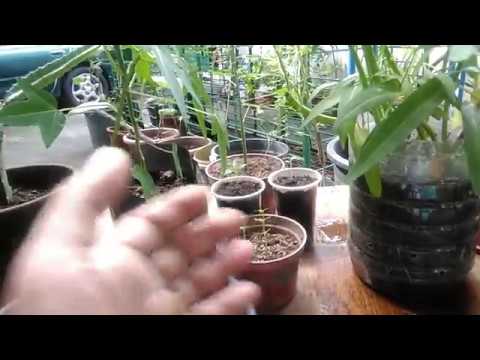
For seedlings
I have here as example pepper seedling
and tomato.
What I do is put them in basin with water.
like so...
This method will
allow soil to slowly absorb water from the bottom up.
This method helps to not disturb the
young roots of the seedlings
Top watering might dislocate some of the soil and
expose the roots
Another example here is this Papaya seedling
in a 12 oz. cup.
As you can see the soil is very dry
soil will absorb water
from the bottom and upwards so
in a few minutes this soil will turn to black
and totally watered.
Just don't let the seedlings stay in the water for too long.
Five to ten minutes is enough.
Papaya in particular does not want
its roots to be wet for too long.
When it comes to bigger containers:
Here I have water spinach (Kangkong)
planted in a 6-liter container.
Watering should be direct to the soil.
Not on top of the plant.
Actually plants can also be watered on top
especially if you have a big garden
it can also be done by hosing the plants
The problem with hosing is
plants can already be drifting wet but the soil has not received enough water.
So watering should be direct to the soil
like so..
When watering plants in container
you should make sure that water will come out of the bottom.
Water should reach the bottom of the container where lots of roots are located.
As you can see here, water is already coming ut of the bottom
but there are still portions that are dry.
In this case you have to repeat watering
So even if water is already coming out of the bottom
the process must be repeated
two to three times at most.
This is to make sure that the soil is evenly watered.
If not watered thoroughly, we might end up
with only a partially watered plant.
With the upper half being wet
and the bottom half being dry.
This is one method to make sure the bottom roots will stay alive
and will not be forced to go up to look for water.
The soil mix then must be loamy
and well draining.
Just like what you see here where water
immediately reached the bottom of the container.
When it comes to big containers
just like this Papaya planted in
a 15-gallon container.
It is advisable that the container also has holes on the side.
Watering plants in a big container like this
apply the same principle
of letting water come out of the bottom
to make sure that it is properly watered.
Big containers like this must also
be elevated or on a stand
especially during rainy season
to prevent water from being trapped in the bottom.
So how often should plants be watered?
As mentioned earlier,
I only look for two signs:
When the top two to three inches of the top soil is dry
that is a sign that the plant needs watering
or when the leaves are wilting.
It can also happen that the top soil is wet
but the bottom portion is dry
This happens when thorough watering is not done
This is why when watering you have to make sure that water reaches and comes out of the bottom.
It is also important to understand
the watering requirements
of the plants chosen to grow in container.
In this example aloe vera
and dragonfruit.
They belong to the succulent family.
They don't have much water requirement.
These type of plants store
water in its stem
so they can afford not getting water
for one week or even two weeks
They actually prefer soil to be dry
This dragonfruit is in a big container
and has fully grown.
I don't water it frequently
It gets watered only when I need to put fertilizer
It gets watered fully during the rainy season.
One thing good about dragonfruit is
it can withstand even too much rain
as long as you have a well-draining soil.
Tomatoes require frequent watering
compared to pepper plants.
Tomatoes don't want dry soil for a long time.
Especially when planted out in the open
tomatoes must be watered regularly
preferably in the morning
or even at night when necessary.
Pepper plants on the other hand
are stronger and
can withstand occasional drought.
It can also withstand ocasional over-watering
But when it is already fruiting
pepper plants don't want
the soil to be always wet.
When it comes to the kind of water to be used in watering plants.
One might ask what kind of water to be used in watering plants....
Water from deep-well
or jack pump
are good for watering plants.
Rain water is the best
During start of rainy season you will notice
even in vacant lots
the sudden growth of plants
and that is because rain water
rehydrates the soil.
which is what plants need.
Question is, it is okay to use chlorinated water?
Water from companies like Maynilad,
or water from swimming pool?
You can use chlorinated water as long as
chlorine is not too strong.
If water has too much chlorine,
we can even taste it,
then do not use it to water plants.
The best way to do is put that chlorinated water in a bucket
and let it sit there for at least overnight,
and afterwards you can use it to water your plants.
This way the much of the chlorine already evaporated.
Chlorine is not really harmful to plants
it can even be better for plants in small amounts
The problem is when there is too much concentration of chlorine
it might delay the plant's growth.
Chlorine is actually a micronutrient
needed by plants
but needed only in small quantity.
So if your water has more chlorine than usual
better if you can let it sit in a bucket
for 24 hours or at least overnight.
This is it, the video is already long.
Thank you very much for watching
Special thanks must go to new subscribers
I noticed in the past few days
the surge in the channel's subscription
so I want to thank all of you for supporting the channel.
Thank you so much again
and hope to see you in my next videos.
Paano Magtanim ng Bawang/How to Grow Garlic (with English subtitle) Yolly Riguer MANA Maunlad Na Agrikultura Sa Nayon Mag-Agri Tayo Salamat Dok: Health benefits of Mangoes | Cure Mula Sa Nature How To Top Pepper Seedlings Salamat Dok: Vertical Farming | Okay Eco Good News: Huling Hirit ng Surot! iJuander: Kabute, ang kumikitang kabuhayan! GUSTO KO ORGANIKO - Garden of Life Eggplant Combo Salad 3. Pag-abono sa Panahon ng Pagsusuwi at Paglilihi: Ang mga Kwento ni Ryza