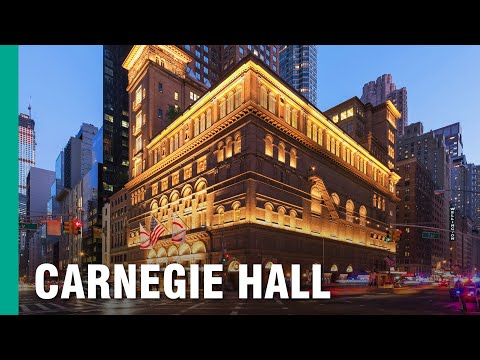
in the Carnegie Hall Studio Towers, I couldn't help but notice a peculiar window detail.
Wherever there's an exterior window,
there seems to be a duplicated window assembly directly behind it.
What exactly is the purpose of this?
There are two major reasons.
One, acoustics.
Two, the exterior facade of the building cannot be altered.
The latter reason is because Carnegie Hall is designated as a New York City
and US National Historic Landmark.
In addition to preservation of exterior facades there may also be limitations on altering
internal structures, functional characteristics, and interior design elements.
Each site is different as each site has their own unique historic significance.
So what are Carnegie Hall's design guidelines and how are architects, designers and engineers
bringing its facilities into the 21st century while maintaining its historic integrity?
♫ ARTicultions Theme ♫
I'd like to thank the sponsor for this episode, Siemens, who provided the building automation,
fire safety, and security systems in Carnegie Hall, for providing me with a unique behind-the-scenes
tour of the building, as well as insights to the its most recent 2014 renovations.
So why do we even designate historic landmarks?
Well, just like how we collect and conserve significant artworks and historic objects
in museums, some architectural works are also important pieces of our cultural heritage.
Carnegie Hall is a world renowned concert venue that first opened its doors
in the spring of 1891.
From inception, it was held as a marvel of acoustic design - a place where
astonishingly rich and warm tones resonated through its halls.
As a venue open to a diverse range of musical genres from early on in its days, including
classical, jazz, folk, and pop - it established itself as an important cultural hub.
For over a century it's also been an important forum of public speech and debate.
And since becoming a non-profit institution in 1960, when New York City purchased Carnegie Hall
to save it from demolition, it has also developed a wide variety of public educational
programs serving both New York and the wider global community.
Carnegie Hall has gone through numerous renovations and additions over the years.
And unlike old paintings, buildings need to be updated to meet contemporary building code,
safety, security, technological, and programmatic needs.
The most recent major renovation was completed in 2014.
A new education wing was created in order to accommodate the growing educational programs
that have been taking place offsite.
The backstage area was expanded and made accessible for those with disabilities.
The upgraded fire alarm system includes automatic protocols that can engage fire door closure,
elevator capture, and air handler on/off toggles upon alarm activation.
A new security and access control system was installed to better facilitate the movement
of staff, performers, students and visitors.
And a centrally controlled building automation system was implemented to efficiently calibrate
the humidity and temperature of each individual space.
The original steel roof trusses were also exposed and skylights were added to create
the space for the new admin offices.
These trusses were also reinforced in order to support a beautiful new rooftop terrace above
which was actually a feature envisioned by the original building architect,
William Burnet Tuthill, that he never actually got to execute.
Speaking of original design - arguably, the most critical design principal of Carnegie Hall
is in maintaining its high level of acoustic excellence.
In the original interior design, Tuthill opted to keep it simple.
By building a smooth, elliptical interior, a domed ceiling and omitting typical theatrical
elements like heavy curtains, ornately decorative walls, and chandeliers - it allowed sound
to distribute and reverberate smoothly throughout the space
while also being aesthetically open and elegant.
In fact, throughout the years, curtains, backdrops and acoustic panels have been added,
which went against the design intent by preventing certain subtle sounds
from being clearly distributed throughout the auditorium.
Thus the added curtains and panels were eventually all removed.
In the most recent renovations, building designers carried through the principle of open and elegant
yet solid and impeccable acoustic performance.
What I find fascinating is that, other than the double glazed windows I initially noticed,
most of these design elements are invisible.
In the new practice rooms for instance: monolithically poured concrete enclosures separated from
the rest of the structure sit behind the walls, finished ceilings hung from spring isolators,
and resilient floors sat overtop isolation pucks.
Each music room is also equipped with its own air handling unit, supply and return HVAC ducts
to further ensure sounds are self-contained within each room.
And while you may think the trapezoid shape of the rooms is just a quirky aesthetic decision,
they're actually angled non-parallel to minimize reverberation.
So if you're holding a violin practice session, it'll be optimized to sound crisp and solid
throughout the room, you won't hear any of the traffic and honking noises from outside,
nor the piano practice session from the adjacent room.
After touring through these spaces, my key take away is that architectural preservation
really embodies a remarkable integration of artistic creativity and technical innovation.
As preserving a building is not limited to aesthetics, but also in respecting
functional elements while adapting to contemporary infrastructure needs.
Carnegie Hall is an active institution that needs to support its present day performance
and educational programs, which are in fact important in maintaining its historic roots.
Thanks for watching everyone.
What are some of your favourite historic buildings and why?
Let me know in the comments below.
If you liked this video, here are some more you can check out.
And don't forget to subscribe for more to come.
Bye for now! *snap!*
♫ Jazz Music ♫
Toronto's Most Famous Public Art? | ARTiculations See How Termites Inspired a Building That Can Cool Itself | National Geographic A Brief History of the Exit Sign | ARTiculations AMAZING VIDEO: Man Lifts 20 Ton Block By Hand Expert Guesses Cheap vs. Expensive Bed Sheets | Price Points: Home | Architectural Digest World's Funniest Engineering Fails A Couple Were Renovating This Beautiful Chateau When They Uncovered Some Astonishing Treasures Inside Zedd's $16 Million Mansion That Has a Skittles Machine | Open Door | Architectural Digest Why Yayoi Kusama Matters Now More Than Ever #InfiniteKusama | ARTiculations Why Are Professional Office Chairs So Expensive? | ARTiculations