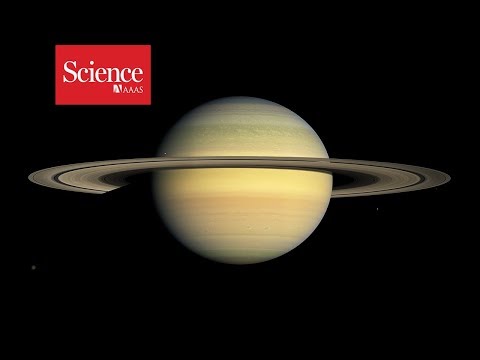
We know it's a gas giant
surrounded by a system of rings.
We know it's orbited by a whopping 62 moons.
We even know that it's north pole has a
mysterious hexagonal cloud pattern.
Despite everything we know, we still don't have
the answer to one very simple question —
how long is a day on Saturn?
On rocky planets, such as Mars and Mercury,
the length of a day can be easily calculated
through simple observation.
But for gas giants like Saturn and Jupiter,
figuring out day length is a little more complicated.
In these planets, the interior layers of metallic
hydrogen are obscured by thick clouds of gas
that rotate at different speeds than the planet itself.
What researchers can do is track the magnetic
field generated by the spin of the planet's interior
For most planets, the axis of the magnetic field
is offset from the axis of the planet itself.
Earth's magnetic field, for example,
is tilted 11º from its rotation axis.
Jupiter's is 9.2º
This offset causes the magnetic field to wobble
around the planet at regular intervals;
each wobble causes a distinctive swing in its radio
emissions, allowing researchers to track the
length of the planet's day.
For Jupiter, Uranus, and Neptune,
this method worked perfectly.
Saturn, however, wasn't so cooperative -
in 1980 and 81, the Voyager 1 + 2 spacecrafts
were the first to attempt to measure the rotation of Saturn's magnetic field.
Based on those measurements, the length of day
for Saturn is 10 hours, 39 minutes, and 24 seconds.
But when the Cassini space probe made an attempt
in 2004, its readings suggested a Saturnian
day of 10 hours, 45 minutes, 45 seconds.
Nothing in the solar system could cause the planet
to slow down so much, so fast—
so researchers concluded that the measurements
from both Voyager 1 + 2 and Cassini must be wrong
The problem seems to lie in Saturn's magnetic field.
Unlike the other planets in the solar system,
the magnetic poles line up almost perfectly
with the planet's rotational axis,
making it incredibly difficult to
accurately measure the wobble of its radio emissions.
Researchers hoped that Cassini's final passes
between Saturn and its rings—
12 years after the first measurements—
would allow them to better measure
the magnetic field's tilt and its related radio waves.
The initial passes were promising—
there was evidence of a wobble in the data that
scientists believed
could be linked to Saturn's rotation rate.
However, toward the end of Cassini's final passes,
researchers realized their radio wave
data were showing differences in the
magnetic field's rotation rate, from season to season,
AND between the northern and southern hemispheres.
This meant that something other than Saturn's
interior was affecting the rotation rate of
its magnetic field and accompanying radio waves.
Researchers believe these low-frequency radio waves
are affected by the density of electrons
in Saturn's magnetosphere and therefore
are not a reliable way to measure the length of its day.
At the time of Cassini's last dive,
the mystery was still not solved.
However, all is not lost— the amount of data
collected during Cassini's final passes
was immense and it will be years
until all of it is properly analyzed.
An answer could still lie somewhere in those data.
Until then, researchers will continue their work,
hoping that eventually an answer to the question
"How long is a day on Saturn?"
is, well… clear as day.
PLUTO AND BEYOND - A Traveler's Guide to the Planets | Full Documentary The story of 'Oumuamua, the first visitor from another star system | Karen J. Meech Jupiter: Crash Course Astronomy #16 What Life On Other Planets Would Look and Sound Like How the Universe is Way Bigger Than You Think Mars Calling: Manifest Destiny or Grand Illusion Farewell Cassini: The Grand Finale and the Final Images of Saturn What's hidden under the Greenland ice sheet? | Kristin Poinar Jupiter's Moons: Crash Course Astronomy #17 What has NASA's Juno discovered around Jupiter so far?