There used to be a lot of debate about how old they were - some people thought they were
Bronze Age, many people thought they were Iron Age and some people even thought they
were early Christian. But it was only with Radiocarbon Dating of sites like Skara Brae
that we realised that these were in fact Neolithic objects.
To make a Carved Stone Ball you don't need very many techniques and they are techniques
that most Neolithic stone workers would be very familiar with. Sort of pecking and grinding.
But the actual process requires quite a few stages to go through.
At the start you have to take a raw lump of material - it might be a beach cobble, it
might be a lump of raw rock - and peck that into a sphere.
One of the biggest mysteries around Carved Stone Balls is what they were actually used
for. Over the last 200 years there have been almost as many theories about how they were
used as there are Carved Stone Balls. Were they used for divination? Were they part of
a game? Some people have suggested weights, but that theory didn't hold much water because
they weigh a huge range of different weights.
More recently we've seen all sorts of suggestions that they somehow relate to mathematics, representations
of platonic solids. We see them suggested that they could be memory devices as well,
things that hold stories within them - so that as you tell the story you rotate it and
the lines and the nobbles on the surface help you recount that oral history of your society.
So there are many different explanations for these objects and the truth is it could be
any one of them.
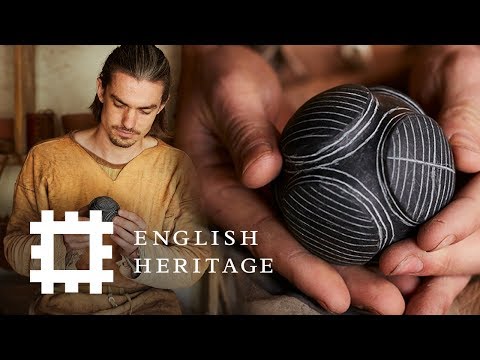
Today we've been making a replica Carved Stone Ball. This is a type of object that comes
from Scotland. And usually found in sites that are dated to the late Neolithic, so the
same time that Stonehenge is being built. But these are not objects that are found here
at Stonehenge, they only have a distribution in Scotland. But what he's making for us is
showing the techniques and the tools and the artwork and decoration that links this Carved
Stone Ball to all the other parts of Britain at that time.
As a second stage you have to grind that to make it a smoother surface. In Orkney a number
have actually been found in Neolithic context, at Skara Brae they were found on the floor
of Neolithic buildings which dates them very firmly to the late Neolithic. Recently in
2013 one was found at the Ness of Brogdar buried under one of the buttresses within
one of the buildings, one of the largest buildings onsite.
The Carved Stone Ball sits in part of the exhibition that talks about the late Neolithic,
so the time Stonehenge is being built. At this particular time we have types of pottery,
types of objects and styles of building monuments that are really only found in the British
Isle. They are not found at all on continental Europe. This is a time when people are making
Grooved Ware Pottery that is found all across the British Isle. But they are also doing
regional things, so Carved Stone Balls in particular are only found really in a small
part of Scotland. So they've got shared ideas, shared religious ideas, building similar types
of monuments such as stone circles, but there are also still regional traditions and regional
trends.
Now the next stage is marking out the individual knobs on the surface. Here you have to make
a choice about what sort of Carved Stone Ball you're going to make. Most Carved Stone Balls
will have 6 symmetrical knobs, but they come in a wide range of different sizes, different
shapes, from having as few as 3 knobs to having over 200 knobs.
So once you've marked out your knobs you can begin to peck around those areas and actually
define the shape of your Carved Stone Ball. And you can keep working it until those knobs
are quite different shapes, some Carved Stone Balls have very shallow flat discs, other
ones have quite deep, rounded knobs. So you have a lot of working to do with pecking,
very delicate working on that surface.
This was something that stone workers potentially did over series of years, potentially generations
as you pass these balls from one generation to the other people might have added to the
design, reworked them, enhanced them in different ways. You realise it was a time consuming
process but something that the individual stone worker was really engaging with and
something that with each successive generation these objects became of more significance
to the actual person who held them and the person who was working them. A treasured biographies
of those generations that have passed before you.
Seeing someone actually make one of these objects and being able to handle a replica
in your hands gives you a much better insight into how special and how much time and energy
went into making these particular items. We're showing some really precious objects here
in the exhibition and they've been polished for hours on end, or they've been carefully
constructed from really thin pieces of sheet gold, or cast in bronze and seeing an insight
into that craftsmanship and the amount of skill and techniques that people had is really
eye opening and it brings a whole new dimension to seeing the actual objects.
Once you've achieved the basic shape you then have to return to grinding it again, and again
very difficult to sort of grind into all those crevices, but you'd probably take a very small
piece of sandstone and just work around those bosses and those knobs to grind that surface
smooth. And that's generally the finish we see, they didn't go to polish the surface
like we see with polished stone axes, they just ground it to a smooth finish.
And the very final stage is decorating the surface. And only about 40 Carved Stone Balls
out of 500 have decorated surfaces. And this involved the very fine incision of lines over
the surfaces. We see spiral designs, we see chevrons, we see concentric circles - we see
sort of Neolithic designs which are reminiscent of Passage Grave art that we typically find
in Ireland and up the West Coast of Britain into Orkney.
The Carved Stone Ball that's being recreated today is based on an example found at Old
Deer in Aberdeenshire, which is the real centre of the distributions of Carved Stone Balls.
Most of them come from the North East of Scotland, and this one is a particularly stunning example
because of the decoration on its surface. But we know very little about its discovery.
It was found, allegedly, in a Cairn and it first sort of came to the attention of antiquarians
in 1874 when it was shown to the Society of Antiquities of Scotland in Edinburgh and it
was published the following year. It wasn't until 1930 that it was donated to the British
Museum.
Seeing a Carved Stone Ball recreated really helps me understand that process of manufacturing
a Carved Stone Ball a little bit more. It really brings out the number of decisions
you have to make during that process of manufacturing it. And how slow that process is. And if we
think back to the past they weren't necessarily manufacturing Carved Stone Balls in one go,
this was potentially a process that was drawn out over many years potentially decades. It
might even be that things were decorated over generations where you began to change and
decorate that Carved Stone Ball in different ways. But what you realise is that the level
of detail and precision of thought that has to go into that process and that's what really
is just wonderful to see someone actually making a Carved Stone Ball.
If this film has piqued your interest about Carved Stone Balls you can come along and
see it and lots of other amazing objects at the British Museum exhibition here at Stonehenge
which runs until 21st April 2019. You can also click on the British Museum video to
find out more about the Carved Stone Ball.
History Inspired Makeup Tutorial - Elizabeth I | Feat. Amber Butchart and Rebecca Butterworth The Conservation of "Iron Workers by Reginald Marsh Narrated Stories from the Stone Age edited How to Harvest Apples - The Victorian Way 8 NEW ROBOT Inventions That will Shock You STRANGEST Artifacts Ever Discovered! Adam Savage's One Day Builds: 1000 Shot NERF Blaster! Secrets in the Dust - Aztecs Sacrifice and Science Why should you read "Waiting For Godot"? - Iseult Gillespie I Turn An Old Hamster Into Stormbreaker From Infinity War!