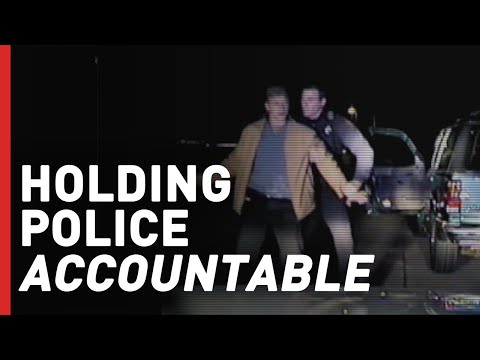
he was shot and killed by a Kenosha police officer.
We didn't know what was going on.
(dramatic music)
Nobody is talking to me, I wanna know the truth.
(dramatic music)
- [Interviewer] You mentioned that you'd
run into some of the members of law enforcement
and that some lived pretty close. How close is close?
- [Man] There's a grocery store right down the road here
and one day I'm walking through there
and who's coming in the other direction,
but is the officer who killed my son.
- [Interviewer] Wow.
- [Man] And I got to confront him eye to eye.
- [Interviewer] Police involved shootings
have sparked controversy and intense debate.
But long before black lives matter
versus blue lives matter, before
Colin Kaepernick versus Donald Trump,
there was a man in Kenosha, Wisconsin
by the name of Michael Bell.
- [Man] There's no video on Youtube that tells
you what to do after a police officer kills your son.
- [Interviewer] After his son was killed during
a traffic stop, this retired military officer
would spend more than a decade searching for
the truth and demanding reforms.
- [Man] I thought there's going to be an investigation
similar to what happens when an aircraft crashes.
Look at all the facts and make a
determination of what went wrong.
That's not what happens in law enforcement.
- [Interviewer] We came to Kenosha, Wisconsin
to ask the question Michael Bell has been asking
the entire country for more than a decade.
When the police kill, should they investigate themselves?
November 9, 2004,
just after 2:00 am
21 year old Michael Bell Jr is
parked in front of his home, when
he's approached by officers of the
Kenosha Wisconsin police department.
A police dash cam captures the
beginning of the traffic stop.
But important details about what happens that
night remain unclear more than a decade later.
Off camera Bell can be heard arguing with officers.
- [Officer] You're not getting in your car.
- [Interviewer] Things escalate as the encounter turns physical.
- The confrontation spills into Bell's
front yard, where he's tasered by an officer.
(pained yelling)
- [Interviewer] By the time more
officers arrive on the scene, (police sirens)
the encounter is moved up a narrow
driveway to the right of Bell's house. (police sirens)
And it's there
with his mother and sister watching from just 15 feet away,
Then Michael Bell Jr. is shot and
killed by officers of Kenosha police department.
(phone rings)
- [Man] About 10 minutes after two
my phone rings, I reach over and
I pick it up and it's my oldest daughter
and she says dad you need to come
come to the hospital Michael's been shot.
And in disbelief I'm like Michael's
been shot? Michael doesn't do anything
to get shot, what are you talking about?
(dramatic music)
I walked into the hospital and
I remember to the left was an emergency room
and I saw doctors working on my son
and to the right I saw about five police officers
and the district attorney kind
kind of huddled in conversation.
They never said anything to me that night.
The loss of a loved one, I describe it as
somebody jack up a car, you go underneath it,
kick the jack out and let the full
weight of that car rest on you.
That is probably the closest thing that one will experience.
My son was killed November 9, 2004 at 2 o'clock in the morning
And on Thursday, two days later
I get a phone call at noon
asking me for a comment because
they've found the shooting justified.
I was alarmed because I knew that
there were, there was a lot of eye witnesses
and none of those people had completed
all their statements to the law enforcement.
That bothered me right away because
how could you conduct an investigation
and be done in less than two days?
- [Interviewer] After a brief internal investigation,
Kenosha police concluded that it's officers
had acted according to department policy.
Their official conclusion: that
Michael Bell Jr. had been shot
in self-defense after he grabbed
an officer's holstered fire arm.
If Bell had grabbed an officer's gun, then self
defense might justify the use of deadly force.
But eye witness testimony has never
been entirely consistent with this claim.
And at least one Kenosha detective wasn't
satisfied with his department's investigation.
- [Russell Beckman] I didn't know Mike.
Mike was just some guy, he was
father of a victim of a police shooting.
However I was the bureau, I was like a fly
on the wall watching what was happening and
I was disgusted by some of the things that I saw.
- [Interviewer] Russell Beckman is a
29 year veteran of Kenosha police department.
But frustration eventually lead
him to resign from the force.
He'd eventually go to aid the Bell
family as a private investigator.
- [Russell Beckman] They ended up saying that the
shooting was okay so quickly before the
forensic reports were done, before the drug
and alcohol reports on Michael's son were in.
That was unbelievable to me. (music)
- [Interviewer] When most of us think about investigations,
we imagine something out of Law and Order.
It's about finding criminals,
putting the bad guy behind bars.
But in other contexts, investigations are often
about a lot more than just figuring out who to blame.
When a plane crash occurs, commercial air
lines don't investigate themselves.
That's the job of the National Transportation Safety Board.
The NTSB's independent investigators analyze
accident scenes, determine the factors
that lead to the crash and develop
guidelines to prevent future tragedies.
The end result is a transparent
evaluation of what happened, why,
and how to keep it from happening again.
Each accident investigation is an opportunity
to make the entire industry safer.
But across America, police shootings
are judge by an entirely different standard.
When a civilian is killed during a police
encounter, the resulting investigation
might be lead by the same department and even
the coworkers of the officer under investigation.
Even under the best circumstances the potential
for a conflict of interest are very real and
so is the possibility of repeating the same mistakes.
In the case of Michael Bell Jr.'s death
the Kenosha police department's investigation
would eventually come under serious scrutiny.
Despite official claims that Bell was
shot after a struggle for an officer's gun.
Forensic testing conducted months after the
internal investigation, failed to find Bell's
fingerprints or DNA on the weapon or holster.
The surprising discovery cast doubt
on the entire investigation and
the Bell family found itself demanding answers.
- [Man] We want to know the truth. We want to know
the factual truth about what happened to our son.
I called the governor, I was shut down.
I called the attorney general, I was shut down.
I was shut down from every different
aspect that you can consider,
nobody would give me the time of day.
When my son got killed, everybody in
local government became a defendant.
The mayor now had to defend his city
against the liability, the police and
fire commissions that were established,
they had to make a decision whether to
open this case up or to shut it down.
I didn't know the battle that I was going to be in for.
(violin)
After my sons death... - These are the words right here.
I get notified that the Wisconsin Professional
Police Association is awarding the officers
who killed my son, with meritory service awards.
(loud violin)
For the exemplifying the highest
tradition of law enforcement. (violin music)
And then I knew that, darn it if
I can't fix it locally, I need
to fix it on a national level.
- [Newscaster] Michael Bell vows to get his sons
case reopen no matter what it takes.
- [Interviewer] Stonewalled by local officials
Micheal Bell embarked on a state wide
media campaign that eventually on national proportions.
- If not us, who? if not now, when is this going to happen?
Why nationally, this is ground zero.
I see this problem nationally,
audacity, audacity, always audacity.
- [Interviewer] And he purchased billboards.
- [Man] Today we have 26 additional
and I said I'll take them all.
- [Interviewer] Lots of billboards.
- [Man] They are in your face.
- [Newsman] The billboards designed to turn up
heat on lawmakers support of public opinion.
- [Man] Anytime you investigate yourself in
the investigation, the investigation is tainted.
- [Man 2] The system is set up in such
a way, that every single time it's justified.
- [Interviewer] His effort to reopen
his son's investigation, was taking on a new form.
He found new allies and a call for independent
investigations of police involved deaths
was becoming a state wide issue.
- [Woman] Until a change is made in policy or
personnel, this father says he is not backing down.
(violin playing)
- [New Anchorman] Lawmakers hearing more than
three hours of testimony about a controversial bill.
The criminal justice committee heard
arguments over a bill that would create a state
wide review board to investigate any police involved death.
- [Interviewer] In the spring of 2014
after nearly a decade of effort.
Bell and his allies had achieved
a new milestone in criminal justice reform.
Wisconsin became the first state in America
to require independent investigation
for all policed involved deaths.
And in sharp contrast to the deep political
divides typical of these issues.
The bill was passed unanimously
with bipartisan support and
signed into law by a Republican governor.
Inspired by the Wisconsin legislation
several states have adopted similar reforms.
But across the rest of the country
local police departments and the
district attorneys with whom they
work closely, may continue conduct
opaque investigations into their own officers.
And while the Wisconsin law is a starting point.
Bell continues to advocate for related
reforms to help make investigations
more independent, transparent and effective.
- [Man] I believe the officer in my
son's case made an honest mistake.
The problem that I have here is
that there needs to be an external
learning model, like the NTSB.
That all they do is determine what
were the true causes of what occurred
and issue safety recommendations
to make sure that it doesn't happen again.
- [Interviewer] But even with everything
Bell has accomplished, the new Wisconsin laws
aren't retroactive, and the campaign to have his
own son's death investigation reopened continues.
(music)
What do you think Michael would
think about the work you're doing now?
- [Man] I think he's laughing at what
he's putting me through personally.
I almost quit all of this
and then I remember in August 2012,
I woke up from a dream, my son walked
up to me, he put his hands on my shoulders
he looked me in the eye and says dad, can you
believe it? I'm here early for my birthday party.
He put his arm around my neck and I gave him a hug.
Then I said
I'm going to give it one more try when I woke up.
How Police Departments Use Civil Forfeiture to Collect Billions My road trip through the whitest towns in America | Rich Benjamin 10 Courtroom Moments You Wouldn't Believe If They Weren't Recorded! Farmers market lies exposed: hidden camera investigation (Marketplace) TOP 10 Teens Who Will Grow Up In Prison Why Is Australia Deporting So Many Kiwis? | Foreign Correspondent I was an MI6 spy inside Al-Qaeda How Missing Man's Family Finds Him Alive 23 Years Later Meet The Lawyer Who Defends Anonymous | Freethink Coded MS-13's Active Members Are Laughing At Trump's Crackdown (HBO)