of a high revving engine.
(engine whirring)
But that's metal on metal,
how do you protect it?
And what's the difference
between a conventional and synthetic oils?
That's why I'm talking about oils!
(introduction music)
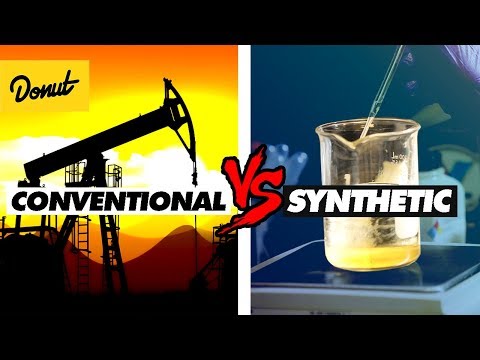
Synthetic oil versus conventional oil ultimate showdown.
(bell dings)
This week we're talking about that good old bubbling
crude...oil that is!
Black gold, texas tea.
Look, oil is the one thing your car needs to make it work.
Well, that's actually not true.
It needs that and gas and electricity and love.
But why does your car crave it?
Like I crave compliments.
Oil is an essential lubricant in your engine that lets
the metal come in close contact to other metal
without causing damage.
Sounds hot.
Without oil, metal-on-metal friction would create so much
heat that eventually the surfaces would weld themselves
together and the engine would seize.
That sometimes happens!
If you're a dummy who forgets to put oil in your engine.
You dipstick.
Alright, so inside the engine there's a system to
get that oil where it needs to go.
So, here's a simple breakdown.
There's an oil pan and that holds the oil.
That's where it sits.
The oil pump gets driven by the engine and it pumps
the oil all around.
First the pump draws the oil through a strainer,
so it can pump it.
And after the pump is an oil pressure regulator that makes
sure there's not too much pressure.
Then the oil gets to the oil filter that we all know
and love. That filter is designed to allow maximum oil flow
while filtering our particles that could interfere with
the engine. The filtered oil then pumped through holes
in the crank shaft, and main berring to lubricate them.
An oil spout shoots the oil up to the pistons cylinder,
so everything moving is lubed up in there too!
There's as many variations of this as there
is engine configurations, but in the end,
if it's in the engine there's a way we're getting oil on it.
Let's quickly talk temp.
Hot oil can get into more nooks and crannies
because it's thinner.
But, too hot then oil is too thin and won't protect.
So, some cars send the oil through an oil cooler
before it gets back to the pan.
Now, your engine has plenty of oil, but you never change it.
Dirt would accumulate in all the oil and the filter
would remove it for a while, but eventually the filter would
clog and the dirty oil would automatically bypass the filter
through a release valve.
Dirty oil is thick, and abrasive, and that causes more wear
Think about putting sand in your underpants.
Also, additives in the oil like detergents, dispersants,
and rust-fighters and friction reducers wear out over time
so the oil wouldn't lubricate as well as it should.
Eventually, as the oil gets dirtier and dirtier,
it stops lubricating and the engine fails.
So, that's why you have to change your oil!
Because if you don't, bad things happen.
I know from experience of reading about it
because I wouldn't make that mistake.
Motor oil is made from the same stuff as gasoline.
Crude oil contains hydrocarbons and other organic compounds.
Basically, a naturally occurring yellow to black liquid
found in geological formations beneath the Earth's surface.
It's buried underneath sedimentary rock where intense heat
and pressure has transformed dead organic organisms,
usually plankton and algae, into a mixture of many different
chemicals that can be used in all sorts of products.
The name petroleum covers both naturally occurring
unprocessed crude oil and petroleum products that are made
up of refined crude oil.
At a refinery, the raw crude oil is processed by chemical
solvents and heated to precise temperatures to
extract chemicals that's then mixed with additives
to make motor oils.
So what's the oil you put in your car?
Conventional oil is a mixture of base oil, which is the
refined oils made from petroleum, and then some additives.
Some common additives are dispersants,
that helps it spray better.
Detergents, that help it clean better.
Anti-wear additives, that make sure it's not too abrasive.
Friction modifiers to help it lube better
Antioxidants to keep it from wearing out.
Anti-foam additives to keep bubbles from building up in it.
Corrosion inhibitors to keep the metal in your engine shiny.
Viscosity index improver to help keep it thick
when it needs to be. And of course, love.
Because the main job of motor oil is to act as a lubricant,
one of the most important properties of a motor oil
is viscosity. The viscosity of a liquid essentially
means thickness. Basically, the measure of it's resistance
to flow. According to the automotive and industrial
lubricants glossary of terms, viscosity is ordinarily
expressed in terms of the time required for a standard
quantity of the fluid at a certain temperature to flow
through a standard orifice.
The higher the value, the more viscous the fluid.
Since viscosity varies inversely with temperature,
it's value is meaningless, unless a company by the
temperature at which it's viscosity was determined.
With motor oils, the viscosity is now commonly reported in
centistokes, measured at either 40 degrees celsius or 100
degrees celsius.
So, like I said, the viscosity must be high enough to
maintain a lubricating film, but low enough that the oil
can flow round the engine parts in all conditions.
You know, I have a lubricating film.
It premieres this year at Sunday's.
Motor oil's viscosity has to be low enough that it'll
flow when cool, but not so low that it fails to lubricate
at high temperatures.
Most pure petroleum lubricants are newtonian fluids.
In recent years, engineers have discovered that adding
certain carbon polymers to petroleum lubricants will give
them non-newtonian characteristics.
This makes them much better at protecting a car engine
under a wide range of conditions.
Those polymers are called viscosity modifiers and motor oil
makers have learned to add just the right combination
of viscosity modifiers to create lubricants that flow easily
at very low temperatures while maintaining enough
viscosity to lubricate the moving parts of an engine
at very high temperatures.
At cold temperatures, the polymers are coiled up
and allow the oil to flow as their low numbers indicate.
As the oil warms up, the polymers begin to unwind into
long chains that prevent the oil from thinning as much
as it usually would.
So, those numbers on a quart of oil refer to oil viscosity.
Basically, on a scale established by the
Society of Automotive Engineers, or SAE, man,
those dudes really know how to party.
The scale rates oil from a low of five, to a high of 50.
Five being thinnest, 50 being thickest.
As you've probably noticed, most automobile motor oils
have got two numbers.
These are multi-grade oils, which means they're
non-newtonian fluids.
Take that Newton!
What those numbers are 5W-30, 10W-40, is a description
of the way the oil behaves at cool temperatures.
Winter, W, verus operating temperatures.
So, rather than saying the viscosity at a given temp,
it says what way oil behaves like at that temp.
5W-30, at start-up, even in sub-zero temperatures,
this oil will behave like a five weight oil.
That means it behaves like a thinner oil
with a lower viscosity.
When the engine gets up to 210, the 5W-30 oil behaves like
a 30 weight oil, a thicker oil with a greater viscosity.
It doesn't mean it is thicker at operating temperatures,
it just means it behaves like a thicker oil would behave at
operating temperatures.
Got it?
It acts like a thin oil when it's cold,
and it acts like a thick oil when it's hot.
It does get thinner as it warms,
but it does so at a different rate.
Since the design of each engine is different,
from the widths of its nooks and crannies to what
temperatures it can reach, car manufacturers will suggest
a certain viscosity range from each of their engines.
That's why you should always the engine oil weight
that's recommended by your vehicle's manufacturer,
in the owners manual.
That being said, most manuals will recommend a range of oils
that take into account how harsh your winters might be
and whether you'll be putting extra stress on your engine
by towing or hauling an extra load.
Like your mom's chair.
There's no one-size-fits-all answer to motor oil selection.
Just be sure to consult your manual and choose the oil
grade that matches how you drive for best possible
engine protection.
There's also this little thing called synthetic
motor oils out there.
Remember those power mad scientist I mentioned earlier
that play God by adding carbon polymers to
petroleum lubricants?
They are making what's called synthetic motor oil.
Synthetic motor oil is a similar but different mixture of
base oils and additive components that generally lasts
longer, performs better, at higher and lower temperatures
than conventional motor oils.
The American Petroleum Institute divides oil types into five
groups. Three are conventional motor oils and two are made
up of various types of synthetics.
Synthetic oils often use a combination of up to three
different synthetic base fluids including synthetic esters,
polyolefin, and alkylated aromatics.
So where in the heck do these synthetic oils come from?
Synesthesia? Space? Was it space? Did it come from Space?
Close! Germany.
Germans created the first synthetic oils for aircraft
engines during World War Two.
Soon, they were used by both Germany and The U.S.
By using the mix of adipic acid ester with polyethylene oil
the engines could start easier in the winter,
and it eliminated sot deposits in the oil radiator.
Synthetics continued to be used in aircraft and in large
hauling vehicles over the next few decades, and eventually
made their way into car racing engines.
In 1966, French company Motul released century 2100,
the first semi-synthetic car lubricant.
In 1971, Motul release century 300V,
the first 100% synthetic car oil.
iN 1972, AMZOIL brought synthetics to the U.S. with it's
10W-40 synthetic motor oil.
The next year Mobil 1 followed suit.
A few decades later this show came along and about
four minutes from now the ending will happen.
Please like and subscribe.
Alright, let me go get some synthetic oil.
- Another episode, huh?
- Yeah, I'm doing one on oils. There's a lot of oils here.
I think I'm just going to get the full synthetic Benzoil.
- Yeah, that's pretty good.
You know, if you buy five quarts you get a free oil filter
over here.
- Yeah, I mean really I'm just doing the show
I just need to oil so.
- Yeah, you got to change your oil sometime though, right?
You don't want to have to make three trips, do you?
- Yeah, alright, let's get a filter.
Thank you Anthony.
- You're welcome. You got a funnel?
(lively music)
- Oh yeah!
(items crashing)
Alright we're going to do some demonstration.
We got a couple different kinds of oil,
we got some canola, and grandma's molasses.
One test for viscosity involves letting oil drip through
a small hole, and the more quickly it drips, the less
viscous it is. We're going to use these two little
ramps though so you can see it with your cute little
eyeballs.
Hey Nolan, would would you let me borrow your hands?
Could you time this for me?
So this is the 0W-60 full synthetic
and this is a traditional 0W-40.
Whoa!
- The faster oil, the thinner oil, did it in 1.57 seconds.
And the thicker oil did it in 2.27 seconds.
- And then we can just add it on screen and edit Nolan out.
Alright this is canola oil and this is molasses.
- [Man] And the purpose of this is?
- To demonstrate how thick and tasty grandma's molasses is
Grandma's molasses, perfect on your cooking.
- Wow.
- Yeah, that slower than molasses in the winter.
Did you hear that phrase?
- Ah, yeah.
- You're pretty folksy, I thought you would've heard
of that phrase. What we got?
- I totally (bleeped) up.
- Good. Did you time this one?
- This one, 14 seconds for the molasses to go down.
- How much for the canola?
- About probably like three quarters of a second.
- The difference between synthetic oil and conventional
oil is in the molecular structure.
In conventional oil, the molecules come from organic,
natural materials, and as we know, nature isn't always
consistent, so there can sometimes be a few odd ball
molecules in conventional oils.
Even a super high-quality conventional motor oil won't
have completely uniform molecules.
Some of those tiny inconsistencies can create friction
over time.
Synthetic on the other hand are created by scientists
in a lab.
So, where as conventional oils contain molecules of varying
size, the molecular structures in synthetics are consistent
in mass and shape.
This uniformity means that those molecules create less
friction as they collide and less less friction means
less heat. So what does this all even mean?
Well basically, compared to standard motor oil,
synthetics can withstand higher temperatures
and can flow more easily in cold temperatures.
Synthetic oil also takes longer to break down.
It does it's job better even after it's been used a while
Compared to conventional oil.
Also, if you live in a region with very cold winters or
very hot summers, or if you use your vehicle for towing
or hauling heavy materials, synthetic oil won't break
down as quickly.
Another great use of synthetic oil is a salve
for older engines that are prone to sludge build-up.
Gunky residue can block oil passages and lead to a quick
death of an engine.
While conventional oil works, synthetic oil outperformed
them in almost every application.
What's the drawback?
Well, they cost more.
Like twice as much, but they can last twice as long.
So instead of changing your oil every three to four
thousand miles you can stretch to six, seven, hey maybe
fifteen thousand according to some manufacturers.
Also, if you don't want to fully commit to synthetic,
well you can buy a blend.
But you won't get all of the benefits that pure synthetic
offers. But conventional oils can't stand up to synthetic
when it comes to longevity and the ability to handle extreme
high temperatures without breaking down.
Well, is there a difference then in the environment?
I mean, getting both still involves highly criticized
processes, and as you know, you don't dump oil that's bad!
But, since synthetics can last as much as three times longer
than conventional oil, then that could save the disposal
of 24 quarts of oil per year per car,
and that's a lot less pollution!
Subscribe to Donut.
We got a bunch of new stuff coming out,
hit this little yellow button.
You can check out other episodes of our shows here.
Guys we got new merchandise.
This is new. Look at that.
It says Donut, that's where I work.
Look at this, it says Donut twice
and it's got different designs on it.
That's pretty cool.
Don't tell my wife about all the Donut merch,
she's getting some for Christmas.
INLINE 6 vs. V6 - How it Works | SCIENCE GARAGE The Science of Stock - NASCAR RULES | SCIENCE GARAGE MAX OIL Fill VS NO OIL (The Honda forums told us to do it..) Top 10 *MEN STARTS TO CRY* EMOTIONAL MOMENTS ON GOT TALENT! What's inside a Tesla Tire? Christianity Debunked Using Science and History - Carrier 2WISTD - This EVO will BLOW YOUR PANTS OFF!!! (10000000%) NISMO - Everything You Need to Know | Up to Speed | Donut Media WARNING LOUD! How to Build A Custom Exhaust: AUDI R8 Freevalve Update Camless Engine -- /INSIDE KOENIGSEGG