- [Narrator] So, there's this little bacterium
that lives in ticks, Anaplasma phagocytophilum.
It's a nasty microbe
that causes a disease called anaplasmosis.
Fever, aches, vomiting and if it's not treated,
organ failure and death.
Lorne Farovitch is a grad student
at the University of Rochester
and he's studying tick-borne diseases like anaplasmosis.
He wants to understand how these diseases spread
and how to better test for them in people.
Lorne is also deaf.
His first language is American Sign Language, or ASL.
That wouldn't be a problem for his work,
except that if he wants to discuss Anaplasma phagocytophilum
in ASL, this is currently the best option.
- [Interpreter] A-N-A-P-L-A-S-M-A
P-H-A-G-O-C-Y-O-T-O-P-H-I-L-U-M,
Anaplasma phagocytophilum.
- [Narrator] Thankfully there's a better way.
It just means inventing new science language from scratch.
- Well, I have my protocol here
and it explains the steps I need to take
for each part of the process,
and the first step is for me to make antigens.
- [Narrator] Lorne is working on a PhD
in translational biomedical sciences.
Basically, he does lab research,
but also works on real-world public health problems
at the same time.
We interviewed Lorne
with the help of a couple interpreters.
They translated our questions into sign language
and Lorne's responses into English.
So that's the extra voice you'll hear.
Anyway, Lorne walked us through his work.
- [Interpreter] The first project, I'm collecting ticks
and I'm analyzing their global distribution
and what kind of diseases they carry
in what geographical areas.
And that information should help me with my second project,
which is to test these ticks
about what pathogens they're carrying
and develop a new diagnostic test.
- [Narrator] Lorne is using a new tool
called Arrayed Imaging Reflectometry.
It allows him to test a single blood sample
for lots of diseases at once, like Lyme disease,
Rocky Mountain spotted fever and anaplasmosis.
Basically, he prints multiple disease samples
onto a small chip and then coats the chip in antibodies
from the blood sample in question.
If the antibodies bind with any one disease,
Lorne will get a positive ID.
The system lets him run about 400 tests simultaneously.
Lorne's been in science for a decade,
five years for a dual undergrad degree,
two years in a master's program,
and this is year three of a five-year PhD,
but all the while science itself
has been a language barrier
that's made his work just a little harder
than it ought to be.
- [Interpreter] When I really started
to get into the sciences, there were, of course,
there's a lot of jargon, a lot of vocabulary there
and there just don't exist the signs for these terms.
There's new discoveries happening all the time.
There are new vocabulary words being established
and ASL it's hard to keep up with all of these new terms.
- [Narrator] ASL is its own unique language,
distinct from English, with its own grammar,
syntax, vocab, you name it.
When there isn't a good sign for an English word,
it's common to just spell it out using ASL letter by letter,
but lots of fingerspelling is a drag.
It grinds communication to a halt.
Again, consider that bacterium, Anaplasma phagocytophilum.
- [Interpreter] Fingerspelling would be like
someone spelling A-N-A-P-L-A-S-M-A
P-H-A-G-O-C-Y-T-O-P-H-I-L-U-M.
It's the process of looking at someone just spelling
over and over again the same terms.
Students are gonna disengage.
That's not interesting.
- [Narrator] The solution is to help ASL catch up
by inventing new signs.
Lorne contributes to two efforts called ASLCORE
and ASL Clear.
Both convene groups of deaf experts in fields like science,
technology, engineering and math,
also called the STEM fields.
They discuss terms that don't have widespread signs
and they make new ones.
So what does that actually look like?
We asked Lorne to show us some examples.
First, look at DNA.
- [Interpreter] D-N-A.
- [Narrator] Lorne could fingerspell D-N-A,
but now he uses this.
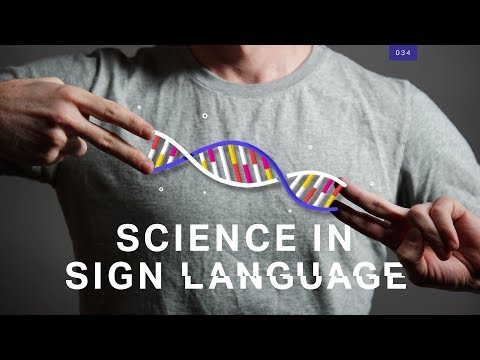
The sign captures the double helix structure of DNA.
You can actually see it
in a way that you couldn't possibly in English.
- [Interpreter] DNA is a double helix shape.
RNA is a single strand.
- [Narrator] Or go smaller.
Atom, proton, neutron, electron.
- [Interpreter] This is a sign for atom.
In the center includes neutrons and protons, as the nucleus,
and surrounding them is the electron cloud, hence atom.
- [Narrator] Each sign captures the way that protons,
neutrons and electrons all comprise atoms.
Macrophage might be Lorne's favorite.
- [Interpreter] Macrophages are signed to this way
because our body relies on their function
of cleaning up things in the body.
They eat pathogens and other things in the body.
They look like little Pac-Men, so macrophage.
- [Narrator] Or there's metastasis,
which is a little scarier.
- [Interpreter] Here's the sign for metastasis.
This is showing visually the process of how cancer
is spreading throughout the body,
how the cells are going everywhere within the body.
- [Narrator] The new signs that Lorne helped create
are published online, so anyone in the world can use them.
And thanks to the Internet,
there are more resources than ever before.
There are other specialized video dictionaries,
crowd-sourced forums,
where signs are shared more ways than ever,
for the deaf community to create and share language.
But all these new signs are only useful
if they're used and standardized.
- What tends to happen
is that a school for the deaf,
or a college with deaf students,
will have a word in a STEM discipline
and they will create their own sign for it.
It won't be the same as the sign in another institution,
or sometimes students will go to one class
and they will see one teacher using the sign
that that teacher has, or go to another class
in the same discipline
and another teacher will use a different sign.
- Geoff Poor is a retired professor
at the National Technical Institute for the Deaf.
He's also my dad, which is how we found out
about the story in the first place.
Over the past few years,
he's traveled to schools all around the country
to collect signs for the STEM fields and he's helped build
a different video dictionary altogether.
Now multiple dictionaries can lead to conflicting signs.
For example, here's the sign for molecule
on Geoff's dictionary.
Here it is on ASLCORE,
and here it is on another site called HandSpeak.
But that might be okay,
more dictionaries mean more ideas are shared
and in time one of those signs will probably take over.
- The the energy, the process that's important is,
which one of those signs is the most useful
for that language community?
That's what happens when an outside word
comes into any language.
And again, it's a meritocracy.
The best signs will win.
- [Narrator] Lorne knows better than most
that science communication can make a difference
far outside the lab.
The final goal of his dissertation
is to make information about tick-borne illnesses
more available to deaf people.
The work is urgent.
Climate change is helping ticks expand their territories,
putting more people at risk
and often deaf people are not well-served
by the information that's out there.
- [Interpreter] Typically public health doesn't have
that kind of system set up to make things fully accessible.
So we want to make sure people are aware of the risks.
Often you see posters
where things are listed out in different languages,
but there's no sign language there,
so it's leaving deaf people out
and putting them at higher risk.
- [Narrator] Ultimately, new science signs
might have the biggest impact on the next generation
of deaf students.
Lorne thinks that they're often failed
by English first education.
But with the right resources,
they have a chance to see science
in a totally different light.
- [Interpreter] Well, when I was growing up,
the teacher would fingerspell a lot.
And it was a struggle to get through.
I never really had an interest in science
in academic settings growing up until I went to college
and I had teachers that were able to spark my curiosity more
when it comes to science.
And I realized that science was interesting
and it was something I wanted to get into,
and so I'm trying to change that with this group,
that's trying to come up with these signs.
So hopefully, the next generation of kids
won't have the same experience that I did.
- So, if you want to learn more about this,
we put links to a couple of these video dictionaries
in the description.
They're really worth exploring.
They will teach you a lot about American Sign Language
and honestly a lot about science too.
So, check 'em out.
The new supercomputer behind the US nuclear arsenal How One Man Manipulated All of America How we'll earn money in a future without jobs | Martin Ford We decoded NASA's messages to aliens by hand 7 Organs You Could Totally Live Without Supersonic air travel is finally coming back How Some Words Get Forgetted We met the world's first domesticated foxes Sea level rise is so much more than melting ice Are diamonds still precious if we can make them in a lab?