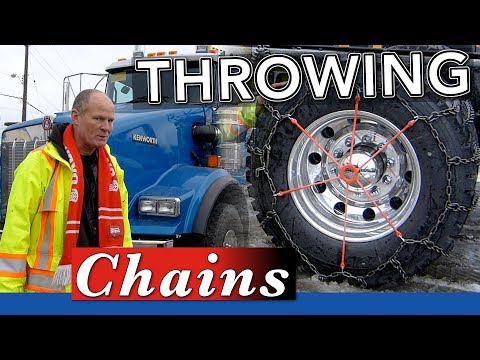
how to put chains on a big truck. And make sure you do it before you spin out,
not after you spin out. So stick around. We'll be right back with that information.
Hi they smart drivers. Rick with Smart drive test talking to you
[INTRO AND UPBEAT MUSIC]
Hi they smart drivers. Rick with Smart Drive test talking to you
today about how to put chains on a big truck. Now just before we get started
here I would like to thank Inland Kenworth here in Vernon, British Columbia, Canada for supplying
a truck, supplying chains, and equipment for me to be able to do this and show
you how to put chains on a big truck. And these are real chains; these are triples. They're
not cables or some other sort of knockoff that you can use going up and
down the highway. In British Columbia, or running in the bush, doing logging, or
you're running in the oil fields, or you're running up and down the
Coquihalla Highway, or the snow Snoqualmie Pass or other places you're going to
need a set of these on your vehicle. And actually, here in British Columbia, Canada you
have to have them on your vehicle and ready to be fitted between October 1st
and March 31st. That is the law here. And as well, there's a particular way that you
have to chain up your vehicle. And I'll put a link down in the description there
and you can find that sheet over at the Smart Drive Test website. That will give
you and guide of which axles you have to chain up for the purposes of being
legal and driving on the roads here. Now just before we get started here, if you're
new to Smart Drive Test, Smart Drive Test helps new drivers get a license, veteran
drivers to remain crash free, and CDL drivers to start a career as a
truck or bus driver. So consider subscribing. As well, hit that bell, that
way you'll get instant notification when we get the videos up for you. Now putting
chains on a big truck is not something that any driver wants to do! Every driver
that I have ever talked to hates putting chains on a big truck. And it usually
happens at night, in the dark, it's cold, it's around freezing, and there is mud
and crap and sand and salt and every other thing that you can imagine
dripping off your truck. And if you have a trailer on here, it's not so bad if
you've got a logging trailer, but van trailers and those types of things,
you're gonna have to stick your head under there and you are gonna get
dripped on with this... just awful mess! What they call in the plow industry pickle
mix--sand and salt--dripping on your head. So you're going to need some
old clothes. I've got a scarf on here. You probably don't want a
scarf hanging out while you're trying to work, so you want to do up your jacket so
that's not going to get caught in anything. You want to have some sort of safety and
those types of things. [ZIPPING UP JACKET] So I'm trying to get my jacket done up
here for you. Preferably you want a pair of old coveralls that you can wear. Get
your scarf in there because you want to stay warm. You're definitely going to
need a pair of gloves for chaining up to protect your hands and just keep them
warm. So you'll probably want a better pair of gloves than this. It's fairly
warm today. You might even want a pair of coveralls. And I have a fairly large old
pair of coveralls that I have here. And the reason I have them is big and large
is so that I can fit them over my jacket and clothing and those types of things. And
stay nice and warm in the winter time. So that's a couple of things that you need
for chains. As well we'll, just get the chains out here and we'll show you how
to lay them out to put them on the truck. So the first thing you want to do is you
want to lay your chains out on the ground. You want to make sure that the
tines are up. You want to inspect the chains and make sure that there's no broken
or stretched links. And you want to figure out what kind you have. You can
see here on this set of chains that you have the cantilever hook up on the ends
of the chain. Some of them will have the cambers on them. You'll have to have
a T-wrench and you'll have to turn those. But these work just fine. We'll show you
how to put these on here. You just fold them over towards you and
then lift them up by the center and drape them over the wheels. And then drape
them over both wheels. And I'll show you how to do that here. So you take the back
set and fold it towards you like this. Just fold it over in half more or less
as best you can on top of the other one. That's simple. You basically take it and
grab it in the middle here and drape it over the front tire as such best you can
here. And then take it and flip it back over the back tire as such here we're
more or less straight make sure it's all nice and drape here. And that's it. And
then we back up over the tire a couple of feet. And we'll get in the truck and
we'll do that. [TRUCK BACKING]
All right. So we got it backed up. So we just adjust our chains so they're nice.
And here, grab the bottom one here.
Sometimes that's going happen. You're not going to back up far enough. So we just
back it up a little bit more. [TRUCK BACKING] So we're back to the place where we need to be
now. Now you can hook these up in whatever order you want. But you're going to
have to... you're gonna have to mess around with them a little bit here. So we'll
hook the center one up here and then we'll hook the inside one up here. And I
know from hooking these up before in a practice run that it was the second one
here. We'll hook that up just to get that on there. And then we'll do the front one
here. You just want to stretch it out, weave this through here, and then fold
this back over here and link it on.
You can see it's going to be a bit finicky. And that's basically all it is here. Now
this center one here, you might have to just see if you can get another link in there.
So now I got two links on the center one.
I'm not very happy with it because it needs to be hooked from underneath for
it to be tight, otherwise it might come off on you. Okay looks like on this one
here we're only gonna get two links. I'm going to have to come back to it get that through
there first. No it's pretty loose. Try to go for three here. Slide back, get the
links out of there. Tons of fun! There we go. There we go!
Okay I'll take it up. The back one. We're going to do one more link. So we're going to
re-adjust that one. You want to try and keep them even & as tight as you can. So
up the back we got to four - okay. Oh good! Now we'll put our bungee cord on
here. Try and put it on equal distance around here. So equal distance,
equal distance. Okay, all right. It's fairly snug. This thing is tight. [STRAINING TO STRETCH BUNGEES] So just be sure that you
don't let it snap back In your eyes there. There we go. One more note about
driving with chains on on a big truck. You're probably not going to do more than
30 or 40 miles an hour--50 or 60 kilometers an hour--depending on what
kind of terrain you're in. Because chains are going to slop around a lot and
they're gonna make a lot of noise. You're not going to go very fast with chains on. So
just know that when you chain up. So you can see we've got it all chained up here.
You're ready to go now. The other thing about chaining up is you always need to
put it on the front axle. Especially driving a tandem axle.
This is a triple axle, but on a tandem axle, depending on whether you've got
lockers (Inter-Axle Locks) on your truck or not. Most trucks are just going to have a power divider,
which locks across the front axle. And that's where you put your chains. The one
that you can lock up the differential. Otherwise it's not going to do any good
on snow and ice. Most of these logging trucks, like this one here, have power
dividers, as you can see here in the image, which means that it locks the
inter axles, it locks all three of them and then the whole thing just churns.
Because one old-timer said going up the hill he said you don't have
any steering power because the thing is just pushing you forward. So
oftentimes what they'll do is turn the lockers off, going around the corner - go around
the corner, and then turn the lockers back on to get back up the hill. So that's what
you've got to keep in mind. This is why when you chain up, they always recommend
that you chain up the front axle. But a lot of times that's going to be
difficult because you got fenders on there and you get van trailers and those
types of things. And it's going to be really problematic. So this is how you
chain up. This is how you put chains on. As I said, wear old clothes because it's going
be messy. You can see my gloves are completely soaked at this juncture, my
boots are wet. I'm here in the slush and this is when you're going to be putting
chains on. Not when there's two feet of snow on the ground, it's when there's two
inches of snow on the ground is when you're gonna putting chains on. And don't
chain up after you spin out! One of my former students, who worked in the bush:
he said if you even have the thought of having to put chains on, it's too late! So
that's what you need to do to put chains on I'm Rick with smart drive test thanks
very much for watching. Good luck on your road test. And remember, pick
the best answer, not necessarily the right answer. Have a great day. Bye now. [UPBEAT MUSIC]
How to Install Tire Chains Correctly, Tips, Tricks, and Safety! How to Shift a 9, 10, 13, 15 or 18-Speed Transmission | Truck Driving How to Pass a Driver's Licence Road Test First Time | Road Test Smart 8 Great Reasons to Consider a Career as a Truck Driver How to Do a 3 Point Turn :: K Turn :: Y Turn CDL Basic Backing Skills; Alley Dock, Offset, Straight Line Backing 2018 How to Determine Air Brake Adjustment :: Applied Stroke—Pry Bar—Mark & Measure The Downhill Descent on Canada's Coquihalla Highway | Air Brake Smart How to Shoulder Check :: Head Check | Pass a Road Test Smart 2019 Volvo VNL Truck - Better Than Your Bedroom (LUXURY TRUCK)