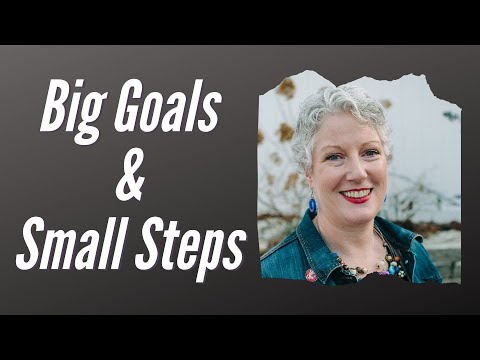
and thanks so much for joining me today
for this Facebook Live.
I'm looking forward to having the conversation.
I don't know where you live,
but here in New England,
we're feeling just that hint of snow.
As my friend David would say,
it smells like snow outside.
And I know that some other parts of the country
have already been walloped.
So, I hope everyone is safe and hanging in there.
I wanted to take some time today
to do a couple of things.
In the blog post this week,
I talked about small steps,
and so I wanted to drill down on what I mean
by setting big goals and having small steps
associated with 'em.
I also wanted to answer any questions folks might have
about the Business Blueprint for Performing Artists.
It's a course that I've developed
to help artists over obstacles in their path.
And those obstacles are a lack of knowledge
about some business skills
that artists aren't taught in their programs,
or in school, or they haven't developed specifically
with that artist lens.
So, I've created a course and all the content I work on
in Your Ladders is about building ladders
over those obstacles.
I feel really strongly about this.
I also know that understanding businesses
has helped me tremendously as I've been navigating my path,
so I'm sharing some knowledge that I've also learned.
But let's talk about setting big goals
and having small steps, small, incremental steps.
As part of opening my own business,
which is what Your Ladders is,
I have been reading blog posts
and listening to podcasts, and reading books,
and in discussions, and learning a ton of things
that I've learned a long time ago.
Several years ago, I took a Franklin Covey class
called What Matters Most,
and that was about discovering and thinking about big goals
and then how to break them down into manageable tasks.
But one of the conversations I've heard several times
from several different areas,
most specifically from a woman named Brooke Castillo
in a podcast that she did
is about setting big goals, right?
Big goals, big, maybe feeling unattainable goals
and then daily doing some action towards those goals.
In in the blog post I wrote,
I used my example.
And I have four big goals for this year,
and they're all big, audacious goals.
And one of them is to lose some weight,
and so when I think about that,
and I think about what my goals,
how I'm gonna get there by the end of the year
because it's not a small amount
that I've decided to set out for myself,
I need to make daily actions towards that goal
in order to reach it.
I can't keep eating junk food or not move
or drink soda and expect that I'm gonna lose weight.
I need to take daily action.
When I decided to go and try to move
from being a writer to a published author,
it's great to put the intention out there.
And I just sent out an email to folks about this.
It's important to put the intention out I am a writer
or I am an artist, but you need to back those intentions
up with action.
And that action can include things like taking a class
for my writer life.
It was going to conferences, and meeting people,
and joining Sisters in Crime,
and learning how to write a query letter
and taking everything opportunity I could
to pitch agents and to take advantage of opporitunities
as they came up and to solely work towards it.
Still took me over 15 years to become a published writer
because it's a long game.
And I would have it any other way in some ways,
and I'm still published, which is great,
but then you go on to that next set of goals
of staying published and building up a career,
but that's a separate life than my writer life.
My writer life, I still take classes
and I figure things out,
and I rethink how I'm doing characters,
or I learn about plotting
and that's all really helpful,
but you need the other skills
in order to take the professional leap.
So, the reason I created Your Ladders
is to give artists specifically some professional skills
so that they can take those leaps.
And though I teach classes in planning, and budgeting,
and income plans, and on marketing,
they're all taught through the artistic lens.
They're all taught for artists.
The budgets I talk about
are specifically geared toward folks
who are in the performing arts.
And when I teach students, I taught a class
on budgeting on yesterday, and when I teach students
about budgeting for example, 'cause that can be
the castor oil of subjects, right?
I mean, when we all talk about budgets,
there are money issues involved
and there's all kinds of ways
that we put in our way of success there.
But when I think about budgets,
I also think about the fact that as an artist,
you need to make intentional decisions about budgets.
If you wanna pay artists,
that needs to go into the budget
and your income plan needs to give you a way
to make that happen, right?
If your mission is to create new work,
then you need to spend more money
on development of that new work
so that you can adequately support it.
And your marketing budget probably needs
a little bit more of a boost
so that you can get people excited
about this opportunity to see this new work.
So, the intentionality and active decision making
around business decisions in your life
are part of your artist path.
And even if you don't wanna produce work
but you want to up your career,
you need to make intentional decisions about that as well.
You need to understand what you need to do as an artist
to make sure that you're out there
to support yourself, to figure out what your mission is
as an artist, and make sure that everything you do
is supporting that, to make sure folks can find you.
All of those things are so important
and I think sometimes neglected.
We think that by putting the intention out there
and doing the work on the artist side
of getting coaches, and taking classes,
and doing everything else you do,
and getting good headshots,
and everything else that you do
to support yourself as an artist that that's enough,
but it isn't always enough.
You need to have the extra boost.
You need to understand how to play the long game,
and that's why I created Your Ladders.
And the Business Blueprint for Performing Artists
is a business blueprint.
It's a very comprehensive course
that I've developed over the past six months
for Your Ladders, but I've been doing
for a long time since.
But you also need to think about or take advantage
of the other resources I've put out.
I've got videos on the blog and on YouTube,
and I have some other things
that you can download on the site
so that you can start thinking about this.
I think sometimes fear is what doesn't move us forward.
I think that fear of success
can actually be a stopper.
Like if I learn this, then I have to actually know,
I have to implement it,
but this is a mindset shift
that I'm working on as well as I'm exploring
this new business and I'm figuring stuff out.
But it's a mindset shift we all need to make,
and as all of you in the performing arts,
and I know you're actors, and directors,
and playwrights, and producers, and teachers,
and folks who are doing it as a profession
or folks who are doing it as an advocation,
folks who are doing it or supporting others doing it.
You're running community theaters,
small theaters, fringe theaters.
You wanna produce your own work.
There are all kinds of folks out there.
You're a teacher who's gotta produce
a couple of shows a year.
I want you to embolden yourself and empower your work
by understanding the business skills that you need.
And in my estimation, they include planning,
they include budgeting for expenses,
they include figuring out your income streams
and planning ahead for them.
And they include a solid marketing plan.
In addition, they include understanding how to pitch
and talk about your work so that it matters
to the audiences you're talking to.
But Business Blueprint for Performing Artists
that I've created does all of those things,
has three different classes in this one course.
Each class has several lessons.
There are videos.
You can get a worksheet for the different lessons.
You take 'em at your own pace.
You can retake them at any time,
and for this first inaugural launch,
I've added some great bonuses
that include a class I've developed
called Spotlight on Spreadsheets
that will teach you how to use spreadsheet in general
and also specifically for budgeting,
and for audience development, and for your career tools.
I also have a webinar on pitching.
I have a resource library.
I'm gonna be doing three live webinars in March
for folks taking the Business Blueprint,
what you want on each of the different classes.
And for this inaugural launch,
I am offering something that I won't be offering
as part of this package in the future,
and that is a half hour call with me
so that I can talk to you about anything you want to.
I can answer questions about any of the classes
you've taken or we can brainstorm together
how to apply them to your work,
or I can give you some guidance.
After many years of doing this work,
I have a lot of thoughts on a lot of different things,
and I've worked in a lot of different areas.
So, I can also help you with that.
So, that package together is gonna be available
through midnight on Thursday,
and I will put the registration link in the comments here.
I hope that you'll join me.
Now is the time, right?
Inaction isn't that opportunity.
It's actually time to take some action.
And again, your big goals are your big goals,
but incremental steps, learning how to do things,
figuring out how to plan, knowing the difference
between your mission statement
and your unique value statement.
And that's something that I covered in a webinar
that I did last week on creating a plan
is critical no matter who you are,
no matter what your path.
And they're interesting exercises that you can do
at any time.
I encourage you to do them.
I think that having the solid foundation
is what will let you leap
and what will let you move forward.
So, that's what I wanted to talk about today.
And certainly, the Business Blueprint is one way to do it,
but the other thing you can do to help yourself
move forward when it gets frustrating,
and it does get frustrating.
In so many other careers, if you do everything right,
you get a natural progression.
In the arts, you're on a rollercoaster ride, right?
And that's really frustrating sometimes,
but if you break things down into this is my longterm goal,
but for today, for right now,
here are the three things I wanna do.
I'm gonna find myself a URL and start thinking
about building a website.
So, I'm gonna start collecting some photos
from shows I've been in, or I've designed,
or I've directed, or plays that I've written,
and I'm just gonna start putting them all
in a Google Drive, and that's the goal for today.
It's an incremental step towards the bigger goal
of your career, and taking those incremental steps
is really important.
Figuring out what they are and what they need to be
might be a different conversation.
So, this is what I wanted to do this Live about today,
and I'm gonna look at my phone
to see if you have any questions on this.
And I apologize.
I should have done that earlier
because this is what.
- Have any questions. - And now I'm gonna start
driving myself crazy. - I apologize.
- I don't have any questions from anybody,
and if I do, I want you to know
that you can leave a comment here
and I'm happy to answer any questions.
You can also email me at Julie@yourladders.com
with any questions about the Business Blueprint,
about anything else you want to.
And if you would leave a comment if you watch this
and you have a comment about any other subject
you'd like me to cover,
registration's done for this session of the class tomorrow
but Your Ladders is gonna keep moving on.
So, if there's something you have a question about
or you need any advice about,
or you think would be an interesting topic to talk about,
leave it in the comments or email me with it
and I would love to approach that
and figure that out.
I want Your Ladders to help you on your path.
I want Your Ladders to help you take a creative leap.
I want Your Ladders to help you empower your career
and your path forward as you define it.
And I am really proud of the class that I've created
and the work that I do, but I'm also proud of you
for saying intentionally that you're an artist
and being willing to take those steps forward.
So, I thank you very much
for listening to this Facebook Live.
Again, if you would like to ask me any questions,
that would be great.
You could do it here.
You can also email me at Julie@yourladders.com,
and I thank you for doing your work
and if you're interested in registering
for the Business Blueprint for Performing Artists,
I encourage you to do so
because the package I've put together
with the class and the bonuses is a great deal,
and it's pretty exciting, and it won't be offered this way
ever again, so now is the time to take that leap.
Thank you so much and I will see you
next Wednesday at two o'clock here on Facebook
to talk about the content that I'm sending out Monday
and also, to answer any questions you have about anything.
Thank you for doing your work.
Have a great week.
Bye now.
WHY DO YOU DO YOUR WORK Budget Expenses for Performing Arts BRANDING FOR PERFORMING ARTISTS WHAT DO YOU TELL FOLKS ABOUT YOUR WORK? Audition Prep Intro Video Holiday Shows YOUR UNIQUE VALUE UNDERSTANDING YOUR VALUE In Defense of A Christmas Carol You Don't Have to Start a Company