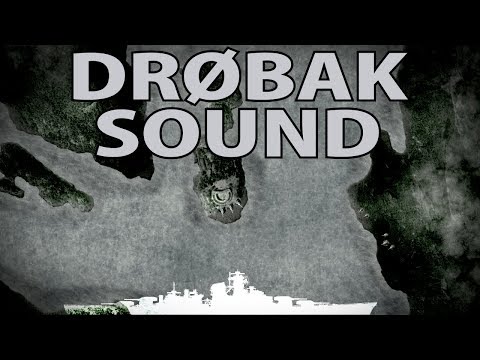
Colonel Birger Eriksen of the Norwegian Army takes his time, strolling down the pathway
and looking as thick mist slowly descends down the nearby hills that encompassed the Oslofjord.
The colonel is just about to end his regular inspection before going to have some well deserved rest.
The calm atmosphere is suddenly spurred into energy, as one of his officers catches up to him and gasps his report:
A flotilla of enemy warships has breached into the fjord some sixty kilometres to the south,
bringing war to Norway.
This video is sponsored by World of Warships Blitz
Tactical sea combat awaits, in the free to play World of Warships Blitz.
Available via the App Store and Google Play, World of Warships Blitz lets you take to the seas as the commander of your very own battle-fleet.
What's more, as of the end of this month the game now boasts a new, fast and deadly addition to your armada, The German Destroyers!
For the admiral who embodies the word, Blitz. Support our channel by clicking the link in the description below,
install the game and upon reaching level 3 you will receive your very own German Destroyer,
the G101 with forward firing torpedo capabilities!
It is the middle of December of the year 1939.
After the successful invasion of Poland a couple of months earlier,
the German High Command focuses on replenishing material and manpower losses,
in addition to sketching out plans for the following year's campaign to the West.
At the same time, German leaders also become increasingly aware
of the British readiness to infringe on the neutrality of Norway and Sweden
in the event of any hostile German activity in the area.
Such British action would not only curb the potential of the Kriegsmarine
by capturing some strategic naval bases on the Norwegian coast,
but also be a severe blow to the German war economy.
Due to insufficient domestic supply,
the German industry was heavily dependent on shipments of Swedish iron ore being moved through the ports of Luleå and Narvik.
Thus, the German planners were urged to lay out another offensive operation, but this time to the North.
Though initially of relatively low priority, the German invasion plan picked up momentum in mid February of the next year,
when the British destroyer flotilla intercepted the German oil tanker Altmark in the Norwegian fjord,
and freed three hundred British prisoners of war previously captured by the Kriegsmarine on the southern Atlantic.
This incident, where both allied and axis forces violated Norwegian neutrality,
convinced Hitler that the British threat to German interests in the region was real,
and so an invasion of Norway was given top priority.
In the beginning of April, the preparation period was over.
The invading force was organized into six battle groups to perform amphibious assaults on six primary targets,
among them, the capital city of Oslo.
Here the main German objective was to capture King Haakon alongside the Norwegian Cabinet
in a surprise strike and subsequently install a puppet government in place of the old one.
The nautical path to the Norwegian capital led through the Oslofjord, a 100 km long inlet naturally divided into two sections.
The entrance to the inner part of the fjord was guarded by Oscarsborg,
a 19th century coastal fortress with its main defensive facilities located on two small islets,
and equipped with three Krupp-manufactured 28 cm coastal defense guns,
which were, just like the entire fortress, well past their prime.
A few supporting batteries armed with 15 cm and smaller caliber guns were situated nearby on the mainland.
In addition, by 1940 Oscarsborg served primarily as a training facility and was only supplied with limited troops.
In the night between the 8th and 9th of April, Oscarsborg's commander,
65-year-old colonel Birger Eriksen received an urgent message that an unidentified group of warships forced their way into the fjord,
past the outer fortifications.
He immediately ordered the raising of the alarm and the manning of the guns.
Despite having three loaded artillery pieces at his disposal, he had barely enough trained men to crew two of them,
as he had only received a few hundred fresh conscripts just seven days before.
The night was calm and foggy, only occasionally lit up by beams cast by the searchlights.
As time passed by painfully slow,
the Norwegian crew patiently waited until enemy warships loomed out of the fog.
At 4:20 in the morning, Norwegian searchlights picked up the silhouette of the first ship steaming towards them from a few kilometres away.
It was the time for colonel Eriksen to decide whether to engage, or to let them through.
It wasn't an easy decision to make, as he could only guess at whether the invaders were British or German.
He was well aware of Norway's neutrality,
but he also knew that the Norwegian government leaned towards joining the British side in the event of Norway becoming involved in the war.
Enemy warships were drawing closer, past the 2 kilometer mark. Gunnery officers watched the old commander carefully.
That was when colonel Eriksen, hesitating no longer, gave the order saying:
"Either I will be decorated, or I will be court-martialed. Fire!".
The first high caliber gun roared, lighting up the surroundings for a brief moment.
The high-explosive shell hit one of the masts crippling the main rangefinder and setting the midship on fire.
Giving the enemy no time to react,
the second gun thundered, striking near the aircraft hangar and igniting a second major fire.
Though the defenders did not learn this straight away,
the ship they had shelled was the Blücher , the German brand new Admiral Hipper class heavy cruiser,
and the flagship of the taskforce dispatched to attack Oslo.
The fires quickly spread on board the Blücher, detonating some of the infantry explosives she carried,
while Norwegian mainland batteries scored additional hits on the German heavy cruiser as she steamed forward.
The second ship in the line, another heavy cruiser, the Lützow,
was soon hit several times by Norwegian medium caliber artillery causing serious damage and forcing her,
and the rest of the task force, to reverse their course and escape the fjord.
Meanwhile the Blücher, with violent fires raging onboard,
had already passed the main Norwegian battery and was just about to encounter another, unexpected disaster.
The Germans were well informed regarding the Oscarsborg defensive instalations,
but deemed them mostly harmless on account of the instalations being primarily used as a training facility.
What the Germans weren't aware of, however,
was the underground torpedo battery, Oscarsborg's secret weapon,
equipped with forty-year-old Whitehead torpedoes of Austro-Hungarian manufacture.
Though nobody was sure if this obsolete armament would work as intended,
the retired commander of the battery, captain Anderssen, ordered that they be fired anyway.
The first torpedo hit the bow section of the German cruiser, causing only some minor damage.
But the aim of the second torpedo was better adjusted,
and the projectile hit midship, roughly where one of the 28 cm shells had struck a couple of minutes earlier.
The Blücher started to take water, causing her to list heavily to the port side.
Firefighting teams struggled to contain the fire, and soon, flames reached the ship's secondary ammunition magazines.
Yet another violent explosion damaged the structure of the German cruiser.
With no other choice, the task force commander onboard the Blücher gave the order to abandon the sinking ship.
Three hours later, in the early morning of the 9th of April, the Blücher capsized and went down to the bottom of the Oslofjord,
taking with her the bodies of between five hundred and a thousand sailors and invading troops.
Despite the setback in Oslofjord, the German war machine continued to move forward against Norway.
Oscarsborg was the subject of heavy bombing from the Luftwaffe later that day, forcing colonel Eriksen to eventually surrender the fortress.
The invading troops landed further south, in considerable distance from the capital, but out of the range of Norwegian coastal defenses.
The unexpected resistance mounted by the crew of the Oscarsborg fortress not only destroyed one of the bigger and newest warships of the Kriegsmarine,
but crucially delayed the German invasion of Oslo by several precious hours,
during which, with national gold reserve secured, the royal family and the Norwegian cabinet were able to escape north,
where they could mount the defence of their homeland for the next two months.
The Battle of Wake Island 1941 Siege of Paris 845 AD The Battle of Adrianople 378 AD Wood Division Adventures #177 - Absolute Unit The Battle of Mantinea 362 BC Top 10 Best Thriller Movie Endings The Battle of the North Cape 1943 Narai Op - 464k damage, 19 kills 3.2k base EXP Atlanta The Battle of Leyte Gulf - Most INSANE Naval Battle in History Seven Years' War: Episode 1/2 | Animated Mini-Documentary