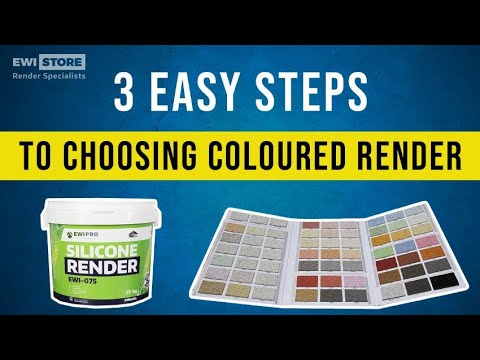
choosing your render. So if you're a homeowner and you're wondering what topcoat to use,
what render to use or how you want your property to look like at the end of the project, then
there are a few different things that you need to consider. Now, colour is one that
everyone jumps to straight away, they say right I want an ivory topcoat, i want an ivory
render or whatever - or you know, a pink one or something like that - but importantly you
need to look at the build-up first, you need to look at what's actually going onto the
wall besides just colour. So there are a couple of different options. The more traditional
render is just the sand and cement, very basic sand and cement with just a painted topcoat.
That is very heavy maintenance, so after a couple of years you need to paint that again,
any movement in the substrate is going to come through and show as cracks on the surface.
So that's not something that we terribly recommend really. The next one is what people sometimes
refer to as a "K Rend" finish, although K Rend is a brand much like EWI Pro, but it's
a monocouche, a scratch coat - basically a one-coat system. So all you're applying there
is you're applying one bag up to kind of 19mm in two passes, and then scratching it back
basically to 15mm. And that scratching back forms a kind of chalky finish, it forms a
sandstone-like finish, which looks great, it's very natural - there are limitations
to it. Because it's one product there's not the kind of flexibility of the others, like
the Silicone thin coat system which we'll move onto, any movement in the substrate tends
to come through and you do get these feather-line cracks coming up especially from pressure
points around windows and that sort of thing. The next system, the next kind of render system
that you see is often what people refer to a thin coat system. So a Silicone thin coat
or an Acrylic thin coat system. Now this is a bit different from the sand and cement and
the monocouche in that it's made up of different layers. So you've got a basecoat layer with
a Fibreglass Mesh embedded into that, you're then smoothing that over perhaps with another
thin pass of the basecoat, you're then priming this and then applying a very thin topcoat
which is through-coloured itself. It comes in tubs and pigments are added to those tubs
and mixed up, and they have a grain to it - you can get different sizes of grains, so
you can get a 1mm grain size, which achieves quite a smooth texture all the way up to a
3mm which gives it a rougher texture. Not quite as rough as your painted pebbledash
but along those lines. The most popular one that we see is a 1.5mm which is shown here.
So it's kind of a bit of texture there, but importantly with the Silicone thin coat is
that because you've got these layers, these flexible layers, any movement within the substrate
behind, so especially on timber frame if you've got different rates of contraction and expansion,
you know that is not going to come through to the topcoat. So that will be soaked up
basically, all that movement will be soaked up within that basecoat and mesh layer, and
won't come through and show on the topcoat. So within the Silicone thin coat system, once
you've done your basecoat and mesh layer and primer, you've then got the choice of a few
topcoats, still ignoring colours for the time being, but you've got the entry model of Acrylic,
which isn't terribly breathable at all, a high acrylic content means that you're almost
wrapping your property in a kind of polythene bag. So it's not going to let moisture out.
It is the entry model, but as soon as you go into the Silicones, so Silicone-Silicate,
that becomes breathable, very flexible but doesn't quite have the full self-cleaning
properties of the full Silicone - you know it will still last a lot longer than your
painted sand and cement or your monocouche in terms of looking clean and fresh but if
you're really wanting something that is maintenance-free you should look at your full Silicone render
or your Premium Bio Silicone render. So they are where you look into the hydrophobic properties.
So basically water forms large globules on the topcoat itself and that then drops straight
off, so Premium Bio that is where if you live in an area of high vegetation or in coastal
areas you get a bit of algae build-up, that's just going to wash straight off and it's a
really good self-cleaning mechanism to the topcoat. Once you've looked at that and you're
comfortable with the topcoat, you know if you decided to go for the Silicone-Silicate
thin coat topcoat or your Premium Bio because you live in farmland area, or on a farmyard
or something like that and you want to keep it fresh then you can look at colours. So,
I've got a monocouche colour chart here which I explained about before - fairly limited.
It comes in bags so you can't add pigment to that, we can't add any pigments that is
how it comes. So a fairly limited colour range. But the good thing is when you look at the
Silicone thin coat, you have got an absolute endless choice of colours, so as they come
in the tubs all we do is we add pigment to it to match any kind of colour - we have our
own colour charts here but that gives you a massive amount of choice there. So then
we would step back, leave it to you and see how it finishes.
Kingspan K5 Pull Tests Anything You Can Carry, I'll Pay For Challenge Making My Own Starbucks Pinkity Drinkity The Broken Galaxy Folds: Explained! Juice WRLD Goes Sneaker Shopping With Complex Doing An Easter Egg Hunt For My Dogs Best DIY Prank Wins $10,000 Plus How To Do Funny Magic Tricks & Slime vs Food Challenge Pastry Chef Attempts to Make Gourmet Peeps | Gourmet Makes | Bon Appétit Samsung Galaxy Fold Unboxing Forcing Hickok to review Guns he's uncomfortable with...