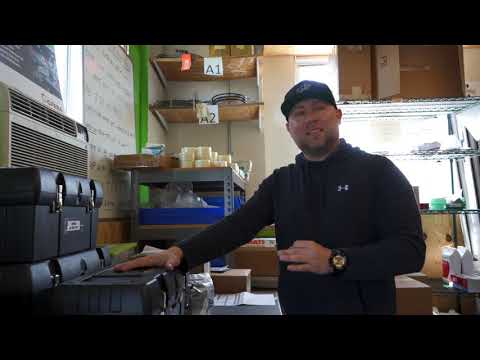
from the back of the install beast
that we use to install equipment
all over New Jersey in those beautiful
commercial kitchens of yours.
I'm here for a new, a new Top Five video.
And this one is a little unique
a little bit different than we usually do,
it's stuff that's going on here in our business.
And that Top Five is the Top Five Things
you need to do to onboard a new key account.
So guy's number One, the first thing we have to do
when we're onboarding a new key account is very simple.
We need to come down and visit with
that key account client and kind of
learn their needs, their expectations.
Take a look around their facility,
usually key accounts do have multiple locations,
so some of them could be cookie cutter
some of them maybe not so much.
We have to learn about that and
understand that early on so that we can
set the tone for the relationship that we want to build.
And it's about getting that face to face.
I always say face to face changes everything,
so we need to come off the phone and the emails
and really sit down at whatever location
of your choice that we're gonna be servicing
and just really get to know each other
from a business stand point,
from a personal stand point even.
Because it just goes a long way,
when you start to get the ball rolling
in service and installs and things are needed
business takes precedence over everything
once we get rolling.
And we want to make sure that we are that
partner for you, that you can count on all the time.
Number Two.
So this one is really simple honestly.
We're gonna get in there now with a technician,
maybe one of the sales team members,
even myself, and we're gonna start to
tag your equipment, we're gonna get
to know your equipment.
Now it could be one location,
it could be six locations, it all depends.
And sometimes this coincides with Plan Maintenance,
so we might have to really get in
to assess, as far as diagnosing any repairs
that may need to be done, but that's
a case by case situation.
Either way, we want that equipment tagged
and we want to know models and serials.
We want to know what you have,
we want to build equipment lists,
so we can then begin to report it
and track it and understand all the things
as we go along lifetime of that equipment,
when it's time to say "Hey, stop repairing it,
"it's time to replace it."
So these are really important things
that we need to do to onboard a key account,
because again, they're looking at us for everything,
they're looking at us to be their backbone
in times of need, when emergencies arise,
and the more information that we're gonna
have the better, so tagging that equipment,
assessing it, making sure we know
what's what and what's where.
Number Three ladies and gentlemen is
once you get to know your key account
as we do, we'll get to know you guys,
listen, that doesn't happen over night,
keep in mind, this is a six month to a year thing.
We really need to get in there and
start servicing the equipment to know
what's critical and what's not.
And then what we do, we start to compile go boxes
and we will have go boxes here,
we will also have go boxes on vans,
because we all want to get the ultimate
first visit fix.
And we begin to put all the critical parts,
things that are gonna cause downtime.
So we're gonna get their temp controls,
we're gonna get certain kinds of certain motors,
you got filter dryers, you got different
things that you're gonna need to
make sure that the equipment that
you're working on is not down.
That's the whole key right?
So we want to make sure that we put
critical parts in the box, not things
that are maybe cosmetic, only critical things.
We can always come back with those cosmetic parts.
So that's what we do over time.
We're gonna compile these go boxes
for all your locations, and these
are also available here in the warehouse.
Should we run out of stock, we
need to replenish the box fast enough,
we have parts runners, we can get those
out to you, because it's all about time and money.
So Number Three is a big one.
This is actually, really, probably
the most important to the customer for downtime.
Is knowing the equipment, knowing the parts
and stocking the parts, big one.
Number Four.
So this is another important one,
especially for us internally.
Making sure that our team knows who the key accounts are.
So we need to sit down and have a meeting
and go over all of the equipment lists,
all of the necessary action items
that we took back from the initial
assessment in the meeting, to make
sure that service and dispatch and parts
all know when you call on your key account,
(snaps)
we move.
That's the way it works, so that is
super crucial that we communicate internally.
Number Four, big one, communication internally
to make sure they know who you are.
And last but certainly not least, Number Five.
As everything comes full circle
back down to the media room for this
most important one that not everybody gets.
Number Five, onboarding a new key account,
access to me.
You get my personal cell phone,
my personal email, my home address,
my social security numb... well maybe not all that,
but you get access to me, which is really
important because there's gonna come a time
where you just are desperate for
something to happen and not that my team
isn't gonna take care of you,
but it's one of those things where you'd
rather just talk to the head than the feet
kind of thing, that old saying, so it's important.
It's important that you know me
one on one, that you have my information
and know that I'm gonna be there for you,
so for us when we're onboarding key accounts,
my contact info is super important at the end
with that handshake, with that hug
because we just became best friends.
And having that access 24/7, you can
call me any day, any time, I'm always available.
Oh sorry, I got a message, key account.
I'll get back to them right after if finish this with you.
Number Five, access to me, and
access to my personal phone so I
can be there for you when you need me.
And this company can be there for you
when you need it.
And that's it, Top Five things
to onboard a new key account.
And that's what we're all about here, key accounts.
So become loyal, it doesn't matter if
you have 10 locations or one,
it's about being loyal and being a key account.
So I urge you all to become a key account in your market.
I talk about it all the time, and that's it.
We're gonna take this video down,
another Top Five, whew, we're moving
through the year very quickly,
it's already May, so listen, you gotta
hit the like, subscribe and share,
we're getting ready to take on Chicago NRA,
big things are happening.
Right now as you're watching this,
we're actually in Ohio at the CFESA Region 5 Meeting.
So shout out to my people at CFESA and Region 5.
My region.
Go with the like, subscribe and share.
On to the next, see you on this video.
4 Things My Father Taught Me INSIDE A FOOD EQUIPMENT SERVICE COMPANY OFFICE COMMERCIAL KITCHEN TECHNICIAN INSURANCE? TOP 5 THINGS TO DO WHEN ONBOARDING A FOOD EQUIPMENT TECHNICIAN Media Disruption in the Food Equipment Industry | CFESA Talk TALKING WITH RATIONAL AT FOOD EQUIPMENT SERVICE CONVENTION | CFESA REGION 3 How To Put Your Service Company On Social Media | The Care Factor | SS2 EP8 Don't Hold Things In! | A Commercial Kitchen Tip Tuesday with Rich Malachy Vlog From Dallas Texas for CFESA Conference TALKING WITH CFESA REGION 3 SERVICE COMPANIES